Bristol Radical Film Festival 2015 – 9-11 October

The programme for this year’s Bristol Radical Film Festival, which takes place at the Arnolfini gallery from 9-11 October has just been announced. Full programme and tickets available now from the Arnolfini website here:

http://www.arnolfini.org.uk/whatson/the-bristol-radical-film-festival.

This year the festival is dedicated to commemorating the 40th anniversary of the First Festival of British Independent Cinema, which took place at the Arnolfini in 1975. Organised by the filmmaker, writer and curator, David Hopkins (1940-2004), the 1975 festival was a landmark event in the history of alternative film in Britain, screening overtly political film alongside aesthetically radical work in celebration of a vibrant independent film culture comprised of different forms, approaches and traditions.

Highlights include Laura Mulvey in conversation with Patti Gaal-Holmes, Reel News’ Shaun Dey alongside Cinema Action’s Steve Sprung, Liberation Film’s Starting to Happen with community filmmaker Ed Webb-Ingall, and a special screening of the recently re-released Blacks Brittanica with producer Margaret Henry.

Festival Pass : Bristol Radical Film Festival 2015

Friday 09 October 2015 to Sunday 11 October 2015, 13:00 to 22:00

£40 / £35 conc. Book

William Gibson on La Jetée

From: ‘Thrilling and prophetic’: why film-maker Chris Marker’s radical images influenced so many artists – theguardian.com

William Gibson, novelist

I first saw La Jetée in a film history course at the University of British Columbia, in the early 1970s. I imagine that I would have read about it earlier, in passing, in works about science fiction cinema, but I doubt I had much sense of what it might be. And indeed, nothing I had read or seen had prepared me for it. Or perhaps everything had, which is essentially the same thing.

I can’t remember another single work of art ever having had that immediate and powerful an impact, which of course makes the experience quite impossible to describe. As I experienced it, I think, it drove me, as RD Laing had it, out of my wretched mind. I left the lecture hall where it had been screened in an altered state, profoundly alone. I do know that I knew immediately that my sense of what science fiction could be had been permanently altered.

Part of what I find remarkable about this memory today was the temporally hermetic nature of the experience. I saw it, yet was effectively unable to see it again. It would be over a decade before I would happen to see it again, on television, its screening a rare event. Seeing a short foreign film, then, could be the equivalent of seeing a UFO, the experience surviving only as memory. The world of cultural artefacts was only atemporal in theory then, not yet literally and instantly atemporal. Carrying the memory of that screening’s intensity for a decade after has become a touchstone for me. What would have happened had I been able to rewind? Had been able to rent or otherwise access a copy? It was as though I had witnessed a Mystery, and I could only remember that when something finally moved – and I realised that I had been breathlessly watching a sequence of still images – I very nearly screamed.

William Gibson

Via http://chrismarker.org/

‘World Cinema and the Essay Film’ Conference: Keynote by Prof Timothy Corrigan

Organised by the University of Reading’s Centre for Film Aesthetics and Cultures (CFAC), the ‘World Cinema and the Essay Film’ conference (30 April – 2 May 2015) featured Prof Timothy Corrigan’s (University of Pennsylvania) keynote address on ‘Essayism and Contemporary Film Narrative’, in which he describes how the mode of essayist becomes more and more frequently a disruptive force in narrative films such as Tree of Life (Malick 2011) or The Mill and the Cross (Majewski 2011).

Timothy Corrigan is a Professor of English and Cinema Studies at the University of Pennsylvania. He received a B.A. from the University of Notre Dame, and completed graduate work at the University of Leeds, Emory University, and the University of Paris III. Books include The Films of Werner Herzog: Between Mirage and History (Routledge), A Cinema without Walls: Movies and Culture after Vietnam (Routledge), New German Film: The Displaced Image (Indiana UP), Film and Literature: An Introduction and Reader (Routledge), The Film Experience (Bedford/St. Martin’s), Critical Visions: Readings in Classic and Contemporary Film Theory (Bedford/St. Martin’s, both co-authored with Patricia White), American Cinema of the 2000s (Rutgers UP), and The Essay Film: From Montaigne, After Marker (Oxford UP), winner of the 2012 Katherine Singer Kovács Award for the outstanding book in film and media studies.

Prof Corrigan’s keynote speech abstract ‘Essayism in Contemporary Film Narrative

The essay, the essayistic, and essayism represent three related modes that, at their core, test and explore subjectivity as it encounters a public life and subsequently generates and monitors the possibilities of thought and thinking. The first is a semi-generic product, the second an intervention, and the third a kind of knowledge. The relation of each to other practices, such as narrative, is largely a question of ratios: as assimilative, as inflective, or as disruptive. My title obviously draws on the third mode, and aims to describe and argue a way in which the heritage and distinctions of the essay take a different form than those described more essentially by the essay film. Here, essayism becomes more and more frequently a disruptive force and presence within the presiding shape of a film narrative, a disruption that questions, at its heart, the limits and possibilities of film narrative itself. Specifically and too schematically, essayism questions the interiority of film narrative 1) through the disintegration of narrative agency as a singular and coherent figure, 2) through the exploration of the margins of temporality and history (as a realism) in a movement into unsheltered and “improbable” places, and 3) through the questioning of the knowledges that have conventionally sustained narrative. My two examples will be Terrence Malick’s Tree of Life and Lech Majewski’s The Mill and the Cross, both released in 2011, both engaged with and questioning–not coincidently I think–a dominant Judeo-Christian narrative as the foundation of knowledge, and both operating on the edges of conventional narrative form.

Timothy Corrigan University of Pennsylvania

Date: 30 April – 2 May 2015
Venue: Minghella Building, Whiteknights Campus, University of Reading
Conference convenor: Dr Igor Krstic

http://www.blogs.reading.ac.uk/cfac/

Essay Film – Sheffield Doc/Fest 2015: John Akomfrah in Conversation

A seminal figure of activist and ‘engaged’ cinema, British filmmaker John Akomfrah has been leading the charge for over 30 years. As one of the founders of the Black Audio Film Collective, which sought to use documentary to explore questions of black identity in Britain, Akomfrah has continually pushed boundaries in both form and content. In this session he discussed his remarkable career with Francine Stock, the presenter of The Film Programme on BBC Radio 4. From Sheffield Doc/Fest 2015.

via Sheffield Doc/Fest

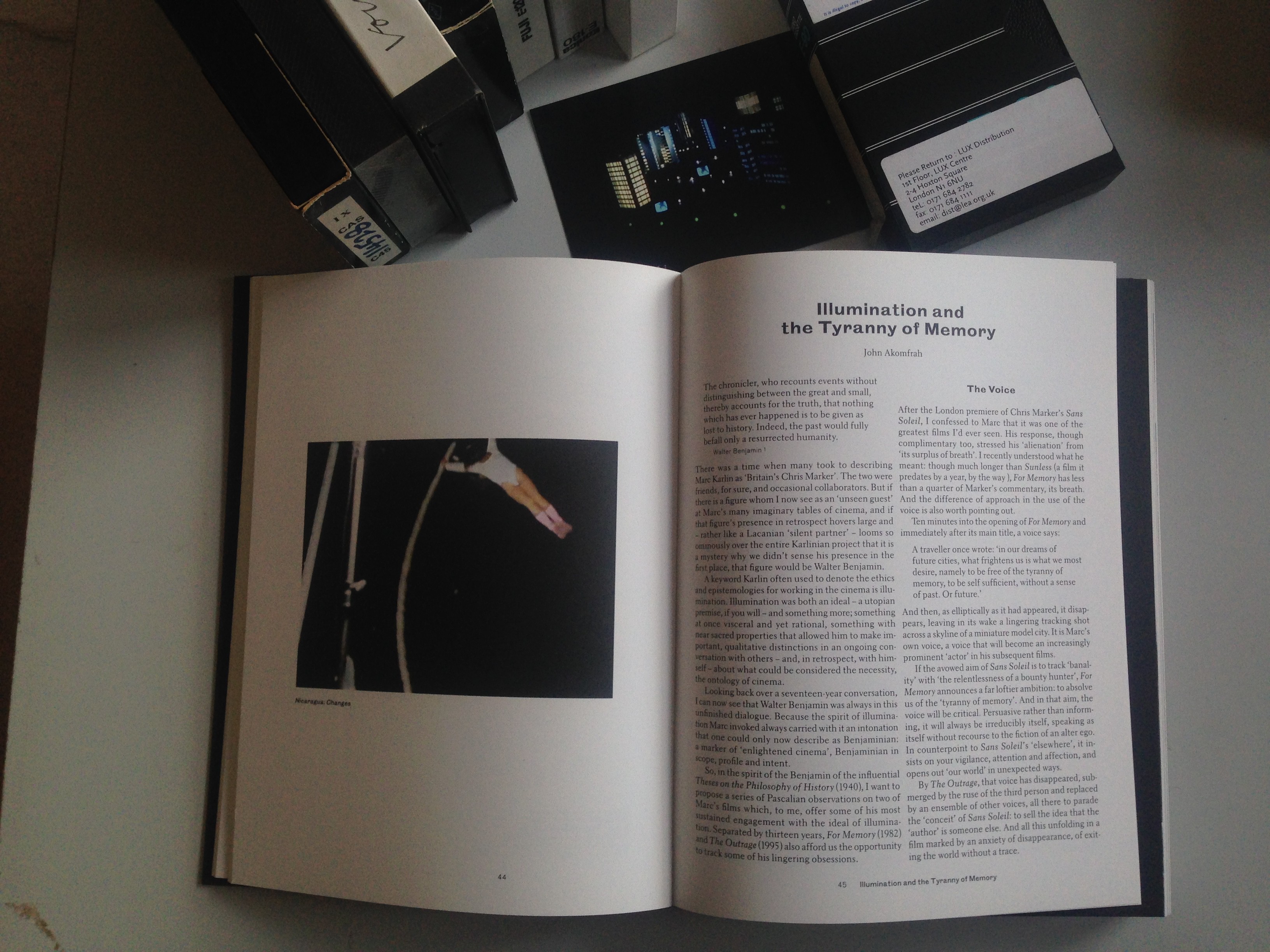
John Akomfrah’s essay on Marc Karlin, Illumination and the Tyranny of Memory, can be seen in Marc Karlin – Look Again, edited by Holly Aylett, published by Liverpool University Press. Available now at the BFI shop.

Akomfrah - Look Again

ARDECHE IMAGES – Les États généraux du film documentaire 17th-18th Aug 2015

Fragments of a filmmaker – Marc Karlin

Marc Karlin (1943-1999) belongs to that generation of filmmakers who, after having gone through the militant experience of the sixties and seventies, developed a new political filmmaking praxis in the eighties (the years of Margaret Thatcher and Ronald Reagan) by rethinking and moving beyond the Marxist tradition. His political activism expressed itself in a radical approach to documentary aesthetics and a constant attempt to build an alternative film culture in opposition to the media system – he was the editor and publisher of an independent film journal, Vertigo, founded in 1993. From Nightcleaners Part 1 (1972-75), made as a member of the Berwick Street Film Collective, Karlin saw the film form as a mirror of the revolutionary process: aesthetics had to be as radical as politics. All the rushes of the film, too similar to a classical agit-prop documentary, were completely deconstructed using the optical printer and the editing: the result was a complex avant-garde film about the contradictions of militant thinking and the women’s struggle for rights and union recognition. The discrepancies of militant cinema were inscribed directly in the film language and its materiality: this was the trademark of Karlin’s future work. In the eighties and nineties, Karlin made twelve films: he benefited from the new challenges and openings in television made possible by Channel 4 and he carved out a space that left uncompromised his political vision. The film form that Karlin thought about and refounded is the essay film: a hybrid form, open to political actuality (the revolution in Nicaragua for example), simultaneously turning to the past – considered as an archive of the oppressed – and towards the future – considered as a utopian promise. This hybrid form assembled elements from the archive (making visual metaphors and conceptual short circuit), arguments and quotations (a multi-layered literary voicing and a fragmented narrative), and an elegant visual choreography (camera tracking through space and time). At the beginning of the decade of the ascending neoliberalism, the age of oblivion, Karlin made For Memory (1982), an unorthodox portrait of capitalism, the growing of cultural amnesia and the tyranny of memory: the act of remembering is shown as an interrogation of the future and as a walk through the British revolutionary tradition – John Milton and the Levellers. Disappointed by the times he was living in Europe, Karlin, an internationalist socialist, was immediately interested in the Nicaragua revolution (that began in 1979 with the end of Somoza’s regime) and he decided to make a series of films about this challenging process. The starting point was a photobook made by Susan Meiselas: Voyages (1985) was the first of a four parts series that found a coda in 1991 with Scenes for a Revolution. Karlin never made a triumphant portrait of the country and never interviewed the main Sandinista leaders, as he wanted to be with the ordinary Nicaraguan people, filming from the roots and not from the top of the country. For each part of the project he invented and adjusted a dialectical film form in order to reveal all the daily beauty and the hard contradictions of the revolution. The five Nicaraguan films are not effective political or propaganda tools, nor ideological manifestos; they are subtle thinking forms about real struggle and real people. The following part of Karlin’s research about revolution was Utopias (1989), a melancholic and pensive essay about the crisis and the heritage of the left. Utopias was Karlin’s response to Margaret Thatcher’s claim that socialism was dead: the film is structured around an imaginary banquet where six guests, from different factions of the left are invited to debate the relevance of the socialist project for their own life’s work. If Utopias was about the past of the left, Between Times (1993) was a kind of a bitter coda made to imagine the future of the revolutionary tradition. After the collapse of the Soviet system and the birth of Tony Blair’s New Labour, Karlin was trying to make a film not about definitions, but an invitation to think about the possibility to find a place for the word “us” in the current political vocabulary and to build a possible resistance to barbarity. When Marc Karlin died, in 1999, The Independent wrote that he “was the most significant, unknown filmmaker working in Britain during the past three decades”: his work is now rediscovered, and we see it as an important missing figure in the documentary film history, the lost-and-found link between militant and experimental cinema.

By Federico Rossin

Partnered with the Marc Karlin Archive – Hermione Harris, Holly Aylett and Andy Robson.

Debates led by Federico Rossin – 17th-18th Aug 2105

See here for full schedule.
Ann Guedes and Steve Sprung on Cinema Action

Cinema Action members Ann Guedes and Steve Sprung discuss their work with BFI curators William Fowler and Ros Cranston. Guedes and Sprung talk about their productions, made with access to sites like Glasgow’s shipyards, and filmed during and in support of various protests across the country in the late 60s.

Ann Guedes – “I hope, especially with these films, that they are not a lament, they are actually still a call to action”.

Man with a Movie Camera (2014 Restoration trailer) In UK cinemas 31 July 2015 | BFI Release

One the most influential films in cinema history, Dziga Vertov’s exhilarating ode to Bolshevik Russia returns to cinemas across the UK from 31 July 2015.

‘I am the camera eye, I am the mechanical eye. I am the machine which shows you the world as only I can see it’
– Dziga Vertov

“Man with a Movie Camera” met with bewilderment on its release but is now recognised as one of the most radical films of Soviet cinema, and a major influence on Godard, Marker and others.
It’s a great city-symphony: the ‘Kino-Eye’ turns the camera into the protagonist, providing an impressionistic, lyrical portrait of a day in the life of Moscow’s masses at work and at play. But Vertov also investigates film itself, wittily transforming the world caught by his lens with a dazzling array of experimental camera and editing techniques. The constant invention remains astonishing to this day.

Marc Karlin on Karl-Marx-Allee – Cinemateca Nacional de Nicaragua – July 3 2015

1-17

In commemoration of the 36th anniversary of the Sandinista Revolution, the Nicaraguan Embassy in Germany arranged a Berlin screening of the documentary “La Construcción De Una Nación” (The Making of a Nation) (1985) director by Marc Karlin.

Ambassador Mrs. Karla Beteta Brenes, opened up the event which took place in Cafe Sibylle located in Berlin’s historic Karl-Marx-Allee. The cafe also acts as a museum to the street, displaying it’s turbulent history.

The documentary received great reception from the audience who highlighted the great work done by the director and the historical significance of the film.

The projection was made with the support of National Cinematheque of Nicaragua and forms part of the commemorative series organized by the embassy which takes place from July 3 to 10 and includes photography, poetry, documentary film and music.

This is one of many examples of the efforts in different countries to commemorate the 36th anniversary of the Sandinista Revolution.

via Cinemateca Nacional de Nicaragua

1-15

1-18