La mirada de Marc Karlin
Return to Nicaragua 2015: Scenes for a Revolution premiere in Managua.

Carlos Fernando Chamorro presents a look back at the premiere of Marc Karlin’s Scenes for a Revolution (1991) in Managua last week, on his Esta Semana programme.
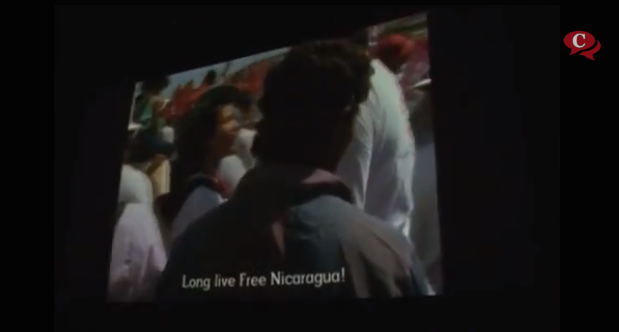
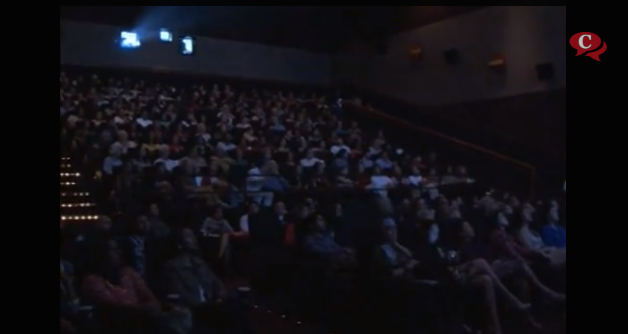

¿Y por qué murieron?

Return to Nicaragua 2015: El cine de Marc Karlin
Carlos Fernando Chamorro invites Hermione Harris and Holly Aylett to discuss the cinema of Marc Karlin on his chat show Esta Noche. Thanks to Confidencial. (Sorry no English subs). 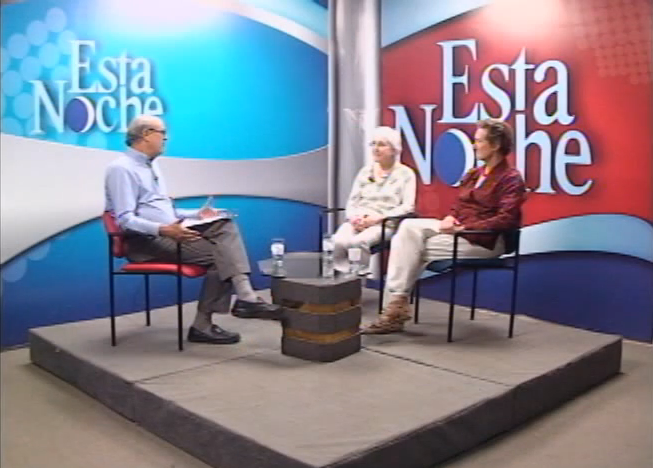
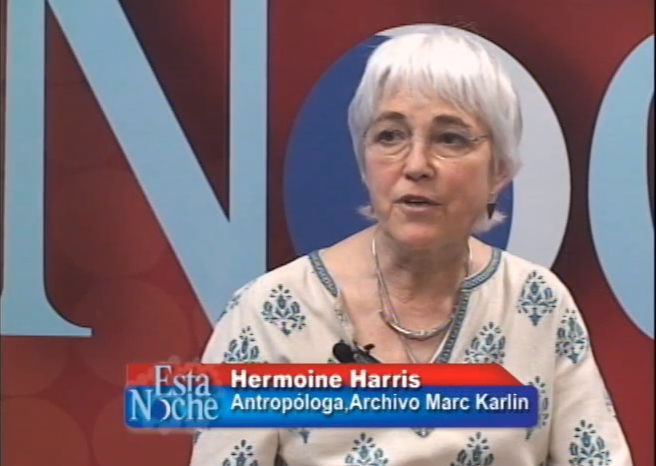
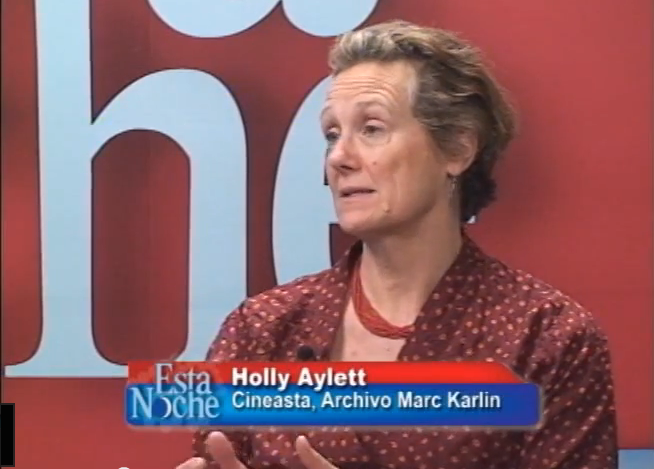
Return to Nicaragua 2015: Escenas de una revolución: Scenes for a Revolution

Hermione Harris and Holly Aylett have returned to Nicaragua this week to screen Marc Karlin’s Nicaragua Series (1985/1991), the first time the series has been seen in Nicaragua. Here is the trailer presented by Carlos Fernando Chamorro’s company Confidencial.
Return to Nicaragua – Susan Meiselas: Imágenes de la Insurrección Sandinista
Here is a video for Spanish speakers – a conversation between US photographer Susan Mieselas and Carlos F. Chamorro on his Esta Semana programme broadcast in Nicaragua, focusing on her photography capturing the two insurrections in Nicaragua 1978/79 and her work with Marc Karlin on Nicaragua Part 1: Voyages.
Audio from the Return to Nicaragua event will go up shortly.
Return to Nicaragua- Nicaraguan Canal Project

One of the main talking points coming out of the archive’s Return to Nicaragua conference last weekend was the proposed construction of the Nicaragua Canal. Carlos Fernando Chamorro, a guest speaker at the event, who appeared in Karlin’s Nicaragua series screened on Channel 4 back in 1985 and 1991 as the editor of the Sandinista daily, Barricada, spoke about his concerns on the construction. Here is his Huffington Post article from August.
Will China’s Nicaraguan Canal Shift Power In The Western Hemisphere?
Carlos F. Chamorro
Anchor, Esta Semana, Nicaragua
While Nicaragua was once a central concern — indeed, almost an obsession — of Washington, as Sandinistas and Contras seemed to be battling for the soul of the Western Hemisphere, in more recent times our small and quite impoverished country has slipped off the screens of those who fancy themselves the managers of the “world order.”
Now, a new and quite unexpected global political power play has been threatening to bring our now forgotten country back into world prominence. An unlikely private Chinese entrepreneur has appeared on the Central American horizon promising to bring the largest civil engineering project in history to Nicaragua. This mysterious developer, Wang Jing, has signed a 50-year renewable deal with our government to construct a new canal from the Pacific to the Atlantic Ocean right across our country.
At a minimum cost of $50 billion and capable of handling the world’s largest and most modern ships, this Chinese project right in the heart of the Americas will bring myriad uncertainties to Nicaragua. The unfolding of the Nicaraguan Canal is worth paying attention to, because it threatens to significantly reformat power alignments in Latin America and the world.
Earlier this summer, the Superior Council of Private Enterprise, known as COSEP, a federation of business groups, organized a public meeting with Hong Kong Nicaraguan Development (HKND), the Chinese company headed by Wang, which was granted a contract for the interoceanic canal without any bidding process over a year ago. The meeting was supposed to provide business organizations and chambers of commerce in Nicaragua with specific information about the current status of this megaproject and the feasibility and environmental studies related to it. Unfortunately, the presentations by HKND and Environmental Resource Management (ERM) were steeped in generalities and even when spokespeople agreed to answer a few questions, vagueness and evasion rather than clarity seemed to be the order of the day.
For example, in my capacity as anchor of the television program Esta Semana (This Week), I asked the HKND representative to name even a few of the potential international investors in the canal and explain why, despite the fact that in October last year Wang had said he would present the investors to the public in December, no information of the sort had yet been released.
The answers he did provide bordered on the bizarre. He said it was not possible to disclose the financial contributions or the identity or origin of the investors because of the “confidential” nature of “trade secrets” and the nature of the private entities that are listed on the Stock Exchange!
All of the secrecy around the financing for this $50 billion project contradicts the promise of transparency initially made by the authorities when the project was first proposed. It is now impossible to know whether it is an international project, or one that will only be funded by Chinese capital, especially state-owned Chinese enterprises and banks that do the bidding of Beijing. The difference between a global project, involving capital and diverse foreign interests, and an exclusively Chinese project would be substantive, especially for a small country such as my own.
There is no doubt China has the economic resources and the ability to undertake massive infrastructure projects such as this canal through the heart of Nicaragua, but if this is a project whose viability depends entirely on the political will of the state of the PRC, the geopolitical, environmental, and institutional implications for our country become totally different. If the Chinese state is, in fact, behind the project and using Wang as a front, as the secretive tone of the responses to our reasonable questions seems to indicate, then we must be ready for that front to obey and serve China’s interests regardless of what that might mean for Nicaragua. This will require special measures to safeguard the national interests of Nicaragua, never mind those of other surrounding countries.
The concessions for this new canal, granted in haste to HKND in a unilateral decision made by President Daniel Ortega, may compromise the sovereignty and national interests of the country in ways that could jeopardize our future for generations to come.
In a country whose democratic institutions have already been gravely compromised by authoritarianism, the unlimited power exercised by Ortega in this project has produced a secret concessionary deal that essentially grants an enclave within our territory to a private company, which may well be a front for a foreign power.
We are already suffering the consequences of the bizarrely opaque relationships between Ortega and this Chinese company. My first concern grows out of the lack of response to common sense questions that different sectors of the country have asked HKND, through a series of national forums organized by the Nicaraguan Academy of Sciences:
- What is the implementation schedule and when will the feasibility studies including the technical, economic, and environmental impact of the canal be finished and disclosed?
- Will these studies, funded by HKND, be subject to the scrutiny of independent national and international experts?
- If these studies are still ongoing, and therefore the viability of the project and its environmental impact is still unknown, how can they affirm that the construction of the canal will start in December?
- What will be the environmental impact of dredging Lake Nicaragua and how will its excavation and future dredging affect the country’s most important strategic water resources?
- Who will oversee our national interests given that the Ortega-created Grand Canal Authority has demonstrated little authority and no autonomy?
My second concern relates to new twists that bend the rules of the game of the canal concession even before its construction starts. Under the absolute discretion granted by the Nicaraguan government to HKND, the company is proposing new business initiatives called “sub-projects of the canal” which will be independent from the actual construction of the canal.
In the new design, the oil pipeline or railroad lines touted as part of the project when it was first announced have mysteriously disappeared. Instead, HKND revealed plans for a gigantic tourist project, the “San Lorenzo Vacation Resort,” to be located more than 10 kilometers south of Brito, i.e., a considerable distance from the canal route.
There is no doubt, however, that attempting to carry on such tourist-centric business deals under the extraordinary powers bestowed by the canal law threatens to undermine property rights throughout the country.
Legal experts pointed out the voracity of the Ortega-Wang agreement when the concession was first granted, but no one imagined the terms would be so extreme. During the COSEP-HKND conference I had the opportunity to ask the official spokesperson if the expropriation clause referred to in the canal law would also apply to the “tourist projects” and other business ventures. It was a timely opportunity for the Chinese company to clarify its intentions and its interpretation of a law custom-made for them. But that’s not the way it worked out. The response of Wang’s representative under the watchful eye of “the investment promoter” Laureano Ortega Murillo, the President’s son who serves as Wang’s official business liaison, was silence.
It was a gesture that should serve as a clear alarm bell for both domestic and foreign investors. The opacity of the Chinese response regarding exactly what it is doing, and who is doing it, should also serve as a warning to other countries about the underlying interest of China in Latin America.
Here is a TV interview Chamorro did with a British-Jamaican professor on the nonsensical commercial aspect of the canal, and the national security implications for Nicaragua. The questions are in Spanish but the answers are in English.
Susan Meiselas & Pictures From A Revolution (1991)
Susan Meiselas will speaking this coming Friday after a screening of Nicaragua Part 1: Voyages (1985) at our Return Nicaragua Event, at UCL.
In 1981, Susan Meiselas published Nicaragua, June 1978 to July 1979, 70 photographs she took documenting the Sandinista revolution. Ten years later, In Pictures from a Revolution, Meiselas returns to Nicaragua a decade later with co-directors Richard P. Rogers and Alfred Guzzetti to track down the people — guerrillas and bystanders — pictured in her original photographs. The people share their feelings about how their lives have changed, for the better and for worse, in the years since the conflict, and recall the circumstances surrounding those moments of their lives captured by Meiselas’ camera.
Directors: Susan Meiselas, Alfred Guzzetti, Richard Rogers
(USA/Nicaragua, 1991, 90min, 16mm)
http://susanmeiselas.tumblr.com/post/100504327090/pictures-from-a-revolution-susan-meiselas-monday
Maybe, she wrote to us… Nicaragua Part 1 – Voyages
Voyages (1985), the first part in Marc Karlin’s extraordinary Nicaraguan series, comprises of stills by the American photographer Susan Meiselas. Between 1978 and 1979, Meiselas captured the two revolutionary insurrections which brought the FSLN to power in Nicaragua, overthrowing the fifty year dictatorship of the Somoza family. The film is in the form of a letter, written by Meiselas to Karlin. Through her own words, the film interrogates the responsibility of the war photographer, the line between observer and participant, and the political significance of the photographic image.
The film is composed of five tracking shots, each approximately ten minutes in length. Shot in a studio by Karlin’s cinematographer, Jonathan Bloom, the camera glides slowly over Meiselas’ blown up stills, shifting focus between images in the background and foreground, allowing the editing to be achieved in camera. The mediative camera movement accompanying Meiselas’ words, creates a distance for the audience, reflecting the photographer’s own separation from the events she witnessed. The studio space was a form Karlin used repeatedly, layering his films with structured, contemplative intervals in between segments of exterior observation.
A new cut of Voyages will be shown this Friday at the Return to Nicaragua event. When broadcast by Channel 4 in October 1985, the film drew criticism due to the fact that Meiselas’ words were narrated by a British actress, whose RP delivery lends the film an unwanted class distinction. A letter from the archive explains Karlin’s decision. Originally, Karlin wanted to narrate the film. This was strongly objected to by Alan Fountain, the commissioning editor of Channel 4’s The Eleventh Hour, on the grounds of feminist politics – it was a women’s experience therefore a woman should read it. Karlin disagreed, feeling that after the popular revolution, men and women should be able to work together, and not be seen as appropriating a women’s experience.
Karlin went back to the drawing board and produced three choices, 1. to get Meiselas to read the letter out herself. 2. To get an American to play Meiselas. 3. To get an English woman to read the letter. Karlin adamantly stated the original intention of the film was that the letter would be read out by the receiver, rather than the writer. If he used Meiselas’ voice, it would be the sender’s voice addressing the images rendering the film one-dimensional. If he used an American voice, the same objections regarding the sender/receiver objections would come into play. So, Karlin opted for a female, English voice; albeit one that connoted privilege, running contrary to progressive politics at the time and the new found pluralism of Channel 4. Recently in the archive, a recorded voiceover by Marc Karlin was discovered on a umatic, and after a discussion between Susan Meiselas and Hermione Harris, Karlin’s partner, it was decided Karlin’s voice would narrate the film.

 marckarlin