Category: News
Utopias (1989)
Broadcast 1 May 1989 Channel 4 (ELEVENTH HOUR) repeated 2 March 1992 Channel 4 (GLOBAL IMAGE) (135 mins)
Seven visions of socialism invited to the banquet table: former union leader (TGWU), Jack Jones; miner’s wife, Marsha Marshall; London GP, David Widgery; economist, Bob Rowthorn; historian, Sheila Rowbotham; the editor of Race and Class, Ambalavaner Sivanandan; and the Cravendale Furniture Co-operative.
Director – MARC KARLIN
Production Company – LUSIA FILMS
Producer – MARC KARLIN
Script – MARC KARLIN/DAVID GLYN
Editor – BRAND THUMIN
Assistant Editor – ANNA LIEBSCHNER
Lighting Cameraman – JONATHAN BLOOM
Assistant Cameraman – CARL ROSS
Sound Recordist – JOHN ANDERTON
Dubbing Mixer – PETER HODGES
Grip – GLYN FIELDING
Lighting – JO McGINTY/RAY BATEMAN
Production Designer – MIRANDA MELVILLE
Art director – HENRY HARRIS
Assistant Art Director – GINA CROMWELL
Models – JAMES CLANCY
Construction – GUY ROSE/KEVIN MARTIN
1930’s Worker – DUNCAN McDONALD
Thanks to SID BROWN/JOHN GORMAN
Trainee – J.J ODERA
Production Manager – SHELLEY WILLIAMS
Production Accountant – PATRICIA COLLINSON
Marc Karlin’s Nicaragua Series (1985/1991)- Available on Vimeo On-Demand
Although informed by an international perspective, most of Karlin’s work focuses on the UK. An exception was the remarkable series of five films on the Nicaraguan revolution encompassing the popular guerrilla war of the late 1970’s, the development of the Sandinista government, the effects of the US-backed contra war, and the defeat of the FSLN in 1989. Rather than foregrounding the Sandinista leadership, the films speak from the grassroots, both urban and rural. This rare perspective portrays a revolution for what it is – an exhausting, uneven process.
Nicaragua Part 1: Voyages (1985)
Broadcast 14 October 1985 Channel 4 (ELEVENTH HOUR) (42 mins)
In 1978–79 American photographer Susan Meiselas documented the two insurrections that led to the overthrow of fifty years of dictatorship by the Somoza family in Nicaragua. Through an epistolary exchange over five unedited tracking shots across Meiselas’ photographs, the film articulates her relationship to the history she witnessed.
Nicaragua Part 2: The Making of a Nation (1985)
Broadcast 21 October 1985 Channel 4 (ELEVENTH HOUR) (80 mins)
Shot in 1983–84 and focusing on the work of the Historical Institute, this film witnesses how Nicaraguans are recovering their history, the memory of Sandino’s struggle, to transform their sense of identity.
Marc Karlin Collection – Available on Vimeo On Demand
The Marc Karlin film collection available now on Vimeo On-Demand.
Marc Karlin (1943 – 1999)
On his death in 1999, Marc Karlin was described as Britain’s most significant, unknown filmmaker. For three decades, he was a leading figure within Britain’s independent film community, actively contributing to opening up television through Channel 4. He was a founding member of the Berwick Street Film Collective; a director of Lusia Films, a key influence in the Independent Filmmakers Association, and a creative force behind the group that published the independent film magazine, Vertigo (1993-2010)
His groundbreaking films for television in the 1980s and 1990s combine documentary and fiction film conventions to explore the themes of memory, history and political agency. Karlin was a committed political filmmaker, and his dense, yet subtle films are rich meditations on the nature of filmmaking, the impact of ideologies on political choice and formations, and the necessity for rigorous, open interpretation to safeguard the future of the creative, human spirit.
He filmed his way through three decades of huge change, wrestling with the challenges of Thatcher’s free market economics; the demise of manufacturing; the imagining of socialist ways forward after the fall of the Berlin Wall; the role of art in society and the shape-shifting impact of digital technologies: all key concerns relevant to our world today.
This collection consists of the films broadcast on Channel 4 from 1985 to 1997, predominately commissioned by Alan Fountain Senior Commissioning Editor at Channel 4’s Independent Film and Video Department (1981–1994). Although informed by an international perspective, most of Karlin’s work focuses on the UK. An exception was the remarkable series of five films on the Nicaraguan revolution encompassing the popular guerrilla war of the late 1970’s, the development of the Sandinista government, the effects of the US-backed contra war, and the defeat of the FSLN in 1989. Rather than foregrounding the Sandinista leadership, the films speak from the grassroots, both urban and rural. This rare perspective portrays a revolution for what it is – an exhausting, uneven process.
Erratum: Marc Karlin – Look Again, Filmography, page 309
We regret that Brand Thumim’s work as editor of Nicaragua Part 2: The Making of a Nation and Nicaragua Part 3: In Their Time (1985) has been wrongly credited to Monica Henriquez.
Brand was one of Marc Karlin’s key collaborators and throughout the 1980s lent his creative skills to help Marc develop his own distinctive film language and voice.
We would like to apologise both to Brand Thumim and Monica Henriquez for this proofing oversight.
Look Again #3 – Sally Potter
Sally Potter writes a beautiful, heartfelt foreword in Marc Karlin – Look Again, describing Marc Karlin as a cinematic pioneer, thinker and activist. She also goes on to recall her first meeting with Karlin, after a screening of Nightcleaners, and how he kindly shared the Berwick Film Street Collective’s facilities while she was making her film, Thriller in 1979.
Here is an interview between Sally Potter and Wendy Toye, broadcast on Channel 4 on 9th May 1984. It was commissioned for the film programme, Visions (1983-1986). John Ellis, who co-produced the programme via his company Large Door, has very recently uploaded a collection of complete episodes from the series. ‘So there is now a Large Door channel for our moribund independent production company, with a selection from the hundred or so programmes we produced’.
Two women directors of different generations – both trained as dancers – meet for the first time. Sally Potter’s first feature ‘Gold Diggers’ had just been released. Wendy Toye’s career began in theatre and she directed her first short ‘The Stranger left No Card’ in 1952. She worked for Korda and Rank, making both comedies and uncanny tales. Directed by Gina Newson for Channel 4’s Visions series, 1984.
Large Door was set up in 1982 to produce Visions, a magazine series for the new Channel 4. Initially there were three producers, Simon Hartog and Keith Griffiths and John Ellis. Visions continued until 1986, producing 36 programmes in a variety of formats. Hartog and Ellis continued producing through the company, broadening out from cinema programmes to cover many aspects of popular culture from food to television.
Visions was a constantly innovative series, and John Ellis’ article in Screen Nov-Dec 1983 about the first series gives a flavour of its range:
Especially during the earlier months of production, we vacillated between two distinct conceptions of the programme: one, the more conventional, to use TV to look at cinema; the other, more avant-gardist, to treat the programmes as the irruption of cinema into TV. […]
We found that virtually all of our programme items could be categorised into four headings:
1) The Report, a journalistic piece reflecting a particular recent event: a film festival like Nantes or Cannes, the trade convention of the Cannon Classics group.
2) The Survey of a particular context of film-making, like the reports from Shanghai and Hong Kong, and the critical profile of Bombay popular cinema.
3) The Auteur Profile, like the interviews with Michael Snow and Paul Schrader, Chris Petit’s hommage to Wim Wenders, or Ian Christie’s interviews with various people about their impressions of Godard’s work.
4) The Review, usually of a single film, sometimes by a literary intellectual, ranging from Farrukh Dhondy on Gandhi to Angela Carter on The Draughtsman’s Contract. About half the reviews were by established film writers, like Colin McArthur on Local Hero or Jane Clarke on A Question of Silence.
The third series of Visions, a monthly magazine from October 1984 added further elements. Clips was a review of the month’s releases made by a filmmaker or journalist (eg. Peter Wollen, Neil Jordan, Sally Potter) consisting entirely of a montage of extracts with voice-over. We introduced the idea of the filmmaker’s essay, borrowed from the French series Cinema, Cinemas, commissioning Chantal Akerman and Marc Karlin to do what they wanted within a limited budget and length. The plan to commission Jean-Luc Godard fell in the face of his insistence on 100% cash in advance with no agreed delivery date. And then there was no further commission.
Further Reading and Viewing
http://cstonline.tv/resurrected-visions-on-youtube-the-large-door-channel
https://www.youtube.com/channel/UCkw6_1SR89FKzlV50e0aWAQ
https://vimeo.com/user12847153
http://www.screenonline.org.uk/people/id/490062/
Charlotte Crofts (2003) Anagrams of Desire: Angela Carter’s Writings for Radio, Film and Television(London: Chatto & Windus), pp. 168–193
John Ellis Channel 4: Working Notes, Screen, November-December 1983 pp.37-51
John Ellis Censorship at the Edges of TV – Visions, Screen, March-April 1986 pp.70-74
John Ellis Broadcasting and the State: Britain and the Experience of Channel 4, Screen, May-August 1986 pp.6-23
John Ellis Visions: a Channel 4 Experiment 1982-5 in Experimental British Television, ed Laura Mulvey, Jamie Sexton, University of Manchester Press 2007 pp.136-145
John Ellis What Did Channel 4 Do For Us? Reassessing the Early Years in Screen vol.49 n.3 2008 pp.331-342
BOOK LAUNCH! Marc Karlin – Look Again, BFI Southbank 30th April 2015

The Marc Karlin Archive is please to announce Marc Karlin – Look Again, edited by Holly Aylett, published by Liverpool University Press, is on sale now!
So please come and celebrate with us at our book launch at BFI Southbank on Thursday 30th April, courtesy of Liverpool University Press and the British Film Institute.
The launch will follow on from an Essential Experiments screening of Between Times (50′), curated by William Fowler, in NFT3, April 30th at 6.15pm, with a panel discussion led by Gareth Evans with Holly
Aylett, Sophie Mayer, Steve Sprung, and John Wyver.
There will then be a foyer break with wine on the house and books available.
At 8.40pm there will be a further double bill with The Outrage (50′) and The Serpent (40′). See the link below to book! If you are interested in attending both screenings, then please call the BFI box office to purchase a joint ticket – 020 7928 3232 – 11.30am to 20.30pm daily.
Hope to see you there!
Marc Karlin – Look Again, edited by Holly Aylett, published by Liverpool University Press
Vagrancy and drift: the rise of the roaming essay film

Freedom and possibility … a still from Grant Gee’s Patience (After Sebald) from 2011
by Sukhdev Sandhu. The Guardian, Saturday 3 August 2013
For years the essay film has been a neglected form, but now its unorthodox approach to constructing reality is winning over a younger, tech-savvy crowd.
For a brief, almost unreal couple of hours last July, in amid the kittens and One Direction-mania trending on Twitter, there appeared a very surprising name – that of semi-reclusive French film-maker Chris Marker, whose innovative short feature La Jetée (1962) was remade in 1995 as Twelve Monkeys by Terry Gilliam. A few months earlier, art journal e-flux staged The Desperate Edge of Now, a retrospective of Adam Curtis‘s TV films, to large audiences on New York’s Lower East Side. The previous summer, Handsworth Songs (1986), an experimental feature by the Black Audio Film Collective Salman Rushdie had once attacked as obscurantist and politically irrelevant, attracted a huge crowd at Tate Modern when it was screened shortly after the London riots.
Marker, Curtis, Black Audio: all have made significant contributions to the development of an increasingly powerful and popular kind of moving-image production: the essay film. Currently being celebrated in a BFI Southbank season entitled The Art of the Essay Film – curated by Kieron Corless of Sight and Sound magazine – it’s an elusive form with an equally elusive and speculative history. Early examples proposed by scholars include DW Griffith’s A Corner in Wheat (1909), Dziga Vertov’s Man with a Movie Camera (1929) and Jean Vigo‘s A Propos de Nice(1930), but some of its animating principles were identified in a key text, “The Film Essay” (1940) by the German artist Hans Richter, which called for documentaries “to find a representation for intellectual content” rather than merely “beautiful vistas”.
Essay films, unlike conventional documentaries, are only partly defined by their subject matter. They tend not to follow linear structures, far less to buttonhole viewers in the style of a PowerPoint presentation or a bullet-pointed memo; rather, in the spirit of Montaigne or even Hazlitt, they are often digressive, associative, self-reflexive. Just as the word essay has its etymological roots in the French “essai” – to try – essay film-makers commonly foreground the process of thought and the labour of constructing a narrative rather than aiming for seamless artefacts that conceal the conceptual questions that went into their making. Incompletion, loose ends, directorial inadequacy: these are acknowledged rather than brushed over.
Aldous Huxley once claimed an essay was “a literary device for saying almost everything about almost anything”. Essay films exploit this freedom and possibility, exulting in the opportunity to avoid the hermetic specialisation that characterises much academic scholarship, and to draw on ethnography, autobiography, philosophy and art history. A case in point is Otolith I (2003) by the Turner prize-nominated Otolith Group, whose co-founder Kodwo Eshun will deliver a keynote speech at BFI Southbank: it uses the mass demonstrations against the second Iraq conflict in London as an occasion to think about political collectivity, and deploys an elusive, eerily compelling compound of science fiction, travelogue, epistolary writing and leftist history to do so.
This roaming or tentacular approach to structure can be seen as a kind of territorial raid. Or perhaps essay film-makers are aesthetic refugees fleeing the austerities and repressions of dominant forms of cinema. It’s certainly striking how many essay films grapple with landscape and cartography: Patrick Keiller‘s London (1994) uses a fixed camera, a droll fictional narrator named Robinson and near-forensic socio-economic analysis to explore the “problem” of England’s capital; Los Angeles Plays Itself (2003) is an extraordinary montage film by Thom Andersen in which, sampling almost exclusively (unlicensed) clips from 20th-century cinema and with drily damning commentary, he critiques representations of his home city.
Essay films sometimes exhibit a quality of vagrancy and drift, as if they are not wholly sure of what they want to say or of the language they need to say it, which may stem from their desire to let subject matter determine – or strongly influence – filmic form. Here, as in the frequent willingness to blur the distinction between documentation and fabulation, the essay film has much in common with “creative non-fiction”. The literary equivalents of Hartmut Bitomsky, director of a mysterious investigation of dust, and Patricio Guzmán whose Nostalgia for the Light (2010) draws on astronomy to chart the poisonous legacies of Pinochet‘s coup d’etat in Chile, are writers such as Sven Lindqvist, Eduardo Galeano and Geoff Dyer. Perhaps it’s no coincidence that one of the most celebrated modern creative non-fiction authors was the subject of an equally ruminative, resonant essay film – Grant Gee’s Patience (After Sebald) (2011).
Essay film-makers – among them the Dziga Vertov Group (whose members included Jean-Luc Godard and Jean-Pierre Gorin) or the brilliant Santiago Álvarez – are often motivated by political concerns, but their work is never couched in the language of social realism or the journalistic dispatch. It is never purely utilitarian and is more likely to offer invitations to thought than clarion calls for action: Godard and Gorin’s Letter to Jane (1972) decodes at length a single still photograph of Jane Fonda on a trip to Vietnam; Black Audio Film Collective’sHandsworth Songs proposes that behind the blaring headlines of riot footage in the British media there lie the “ghosts of other stories”; Harun Farocki‘s Images of the World and Inscription of War (1988) explores the interplay of technology, war and surveillance. Essay films can be playful, but even when they are serious – as these three are – their approaches, at once rigorous and open-ended, are thrilling rather than pedagogic.
Just as literary critics used to lament that critical theory was taken more seriously in France than in the UK, the renown of essayists such as Marker, Godard and Agnès Varda (whose The Gleaners and I, a witty and moving meditation on personal, technological and socio-political obsolescence is a masterpiece) has served to obscure the range and history of British contributions to the genre: the sonically exploratory, surrealism-tinged likes of Basil Wright’s Song of Ceylon (1934) and Humphrey Jennings’s Listen to Britain (1942); Mike Dibb and John Berger’s Ways of Seeing (1972), which bears the imprint of Bertolt Brecht and Walter Benjamin; BS Johnson’s self-deconstructing Fat Man on a Beach (1973); Derek Jarman‘s exquisitely crepuscular Blue (1992), in which the director talks about and through his fading eyesight; and Marc Karlin’s resonant disquisition about cultural amnesia in For Memory (1986).
Some of these films started life on television, but these days it is the gallery sector that is more likely to commission or screen essay films, which are attracting ever more sizable audiences, especially younger people who have been weaned on cheap editing software, platforms such as Tumblr and the archival riches at YouTube and UbuWeb. Visually literate and semiotically savvy, they have tools – conceptual as well as technological – not only to critique and curate (moving) images, but to capture and assemble them. Having grown up in the era of LiveJournal and Facebook, they are also used to experimenting with personal identity in public; RSS feeds and news filters have brought them to a point where the essay film’s fascination with investigating social mediation and the construction of reality is second nature. It could well be that the essay film – for so long a bastard form, an unclassifiable and barely studied hybrid, opaque even to cinephiles – is ready to come into its own.
Revolutions 10-13 A Certain Sensibility: Films from the English Underground, Vivid Projects, Birmingham, (06-22 June)


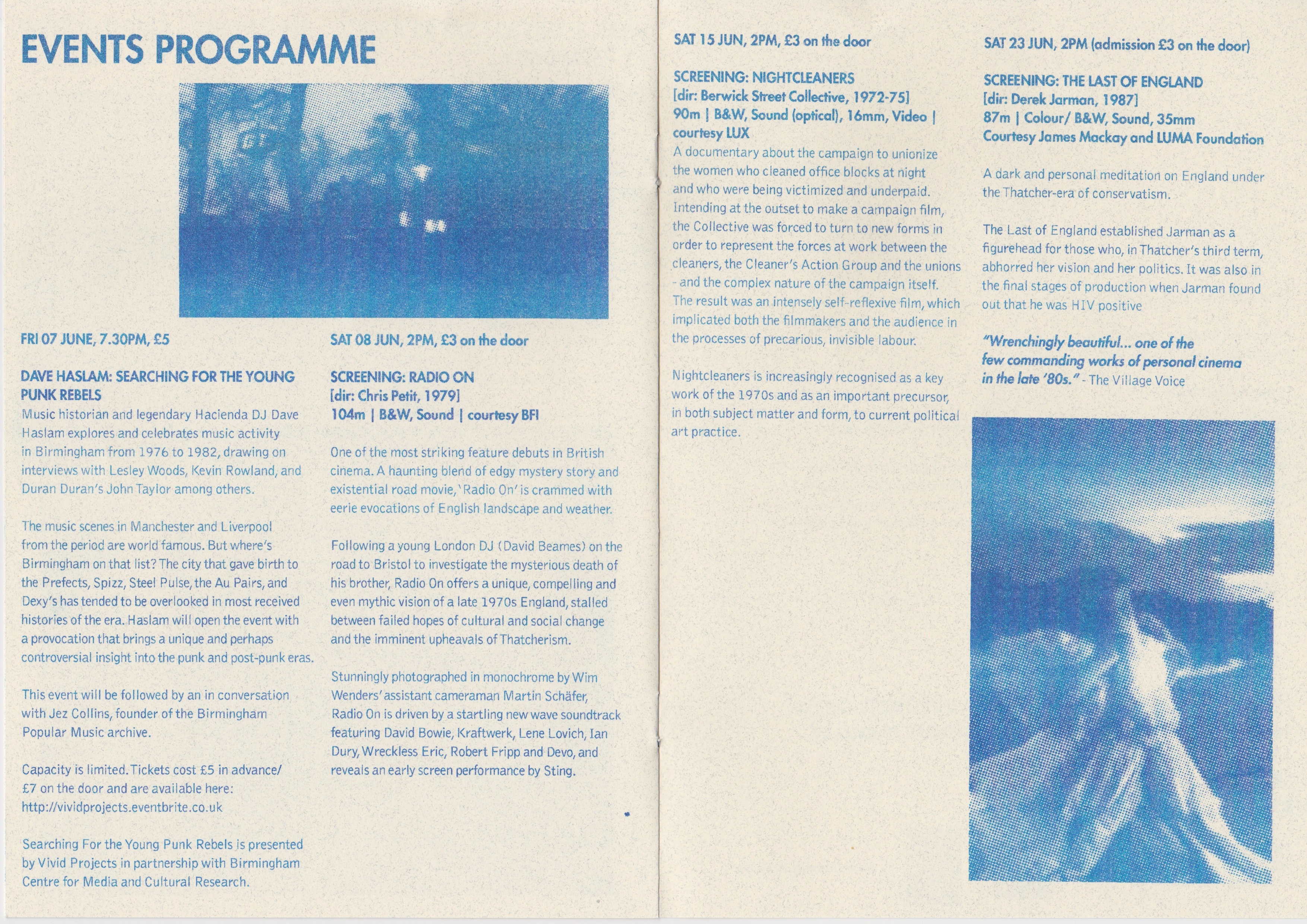

Revolutions 10-13 A Certain Sensibility: Films from the English Underground

Featuring Richard Heslop, Marc Karlin and Derek Jarman.
This new exhibition draws together works from three strikingly independent filmmakers key to the radical trajectory of the post-1976 English underground movement. Connected by themes of left field personal politics, history and nationality, and marked by an intense visual sensibility, Richard Heslop, Marc Karlin and Derek Jarman developed work both technically original and aesthetically radical.
WEEK TWO: THU 13 – SAT 15 JUNE EXHIBITION & EVENTS PROGRAMME
– – – – – – – – – – – – – – – – – – – – – – – – – – – – – – – – –
Thu 13-Sat 15 June, 12-5pm daily
EXHIBITION // Marc Karlin
Described as one of the most significant unknown film-makers working in Britain during the past three decades, Karlin (1943 – 1999) was a central figure in the radical avant-garde of the 1970s and made a major contribution to the shaping of Channel 4. Newly digitised works are shown including Utopias (1989), For Memory (1986), and Between Times (1993) alongside a one-off screening of Nightcleaners (1975) on Saturday 15 June. Courtesy the Marc Karlin Archive.
Running Times:
Thu 13 & Fri 14 Jun, 12-5pm // Utopias (2h 15m) and Between Times (50m)
Sat 15 Jun, 12-2.15pm // Utopias (2h 15m) and For Memory (1h 44m)
—————————–
Sat 15 June, 2.15pm (admission £3 on the door)
SCREENING // Nightcleaners [dir: Berwick Street Collective, 1975, 90m]
A documentary about the campaign to unionise the women who cleaned office blocks at night and who were being victimised and underpaid. Nightcleaners is increasingly recognised as a key work of the 1970s and an important precursor, in both subject matter and form, to political art practice. Courtesy LUX.
Revolution 03. Oh to be in England – Vivid Projects, Birmingham (March 2013)
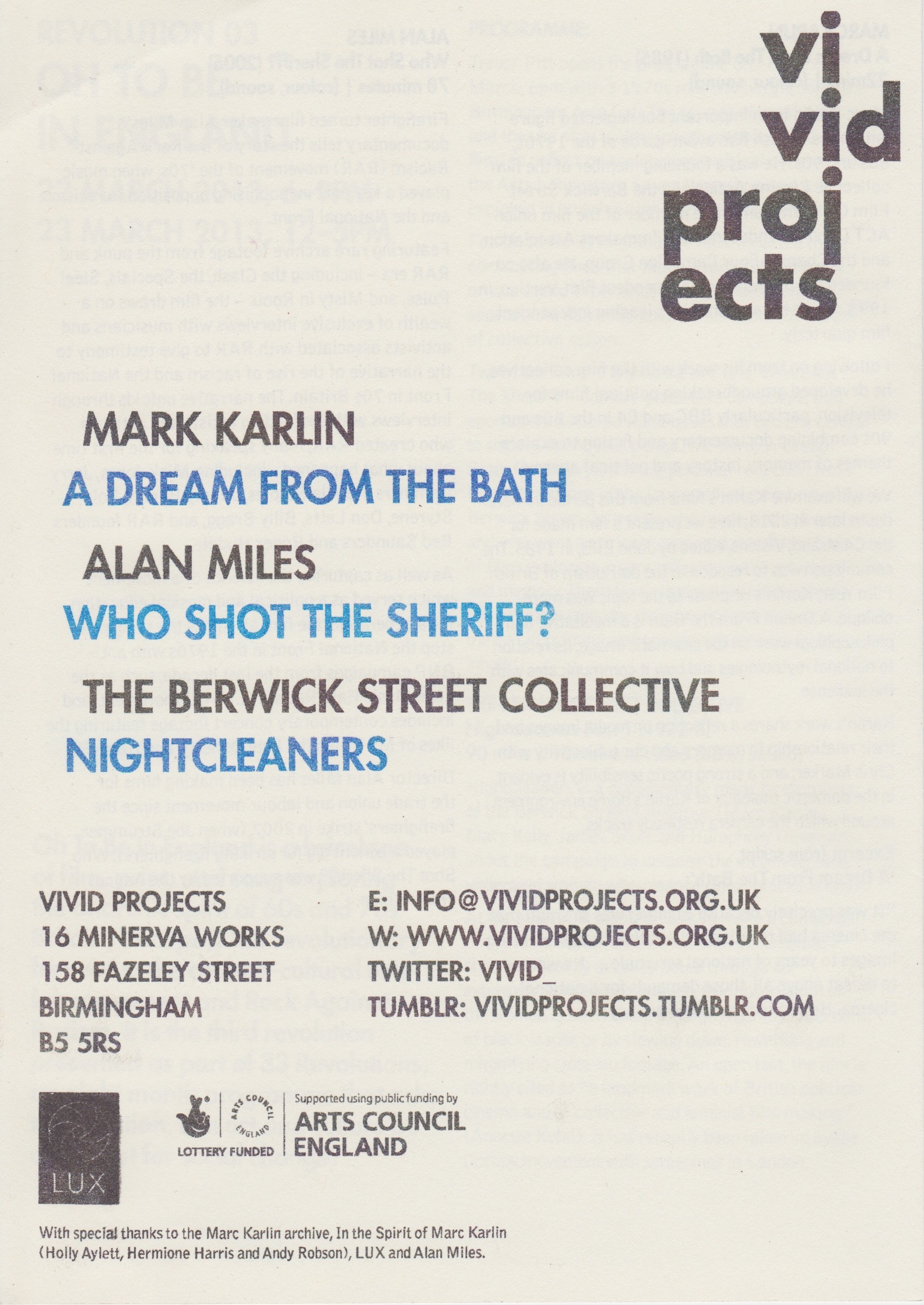
Following on from Vivid Project’s short introduction on Marc Karlin in March this year, three of Karlin’s films will be screened over a three days from tomorrow (13-15th June). Here is the flyer from the March event, promotional material for the June will be up soon.


 marckarlin