Category: News
50% off Marc Karlin-Look Again @LivUniPress


Marc Karlin – Look Again Edited by Holly Aylett £25
This book provides almost the only published material on the work of Marc Karlin. On his death in 1999, Karlin was commemorated as one of the visionaries of independent British film culture, with its roots in the seventies and its expansion in the first decades of Channel 4 television. This edited collection will profile his films and ideas, drawing exclusively on documents and correspondence from his recently recovered archive. It includes appraisals both from his collaborators and eminent film theorists, and is an illuminating addition to the sparse but rapidly expanding field of independent cinema studies. Marc Karlin was an incisive, witty man and a passionate advocate for an inclusive cultural space. He filmed his way through three decades of huge change, wrestling with the challenges of Thatcher’s free market economics; the demise of manufacturing; the imagining of socialist ways forward after the fall of the Berlin Wall; the role of art in society and the shape-shifting impact of digital technologies: all key concerns relevant to our world today. The book is structured through four contextualizing essays followed by twelve chapters expressing the focus and aesthetic of his documentaries and cultural politics. It combines academic analysis with memoir, and includes a recorded discussion on Karlin’s creative practice, his unpublished writings on cinema and over 150 images from his films. With a foreword by UK’s celebrated film director, Sally Potter MBE, this book presents the reader with an illustrated mosaic of encounters engaging with the spirit of this remarkable man, and will ensure that his work is restored to the canon of British cinema.
Scenes For A Revolution (1991) Sunday Pop Corn at Ύλη[matter]HYLE
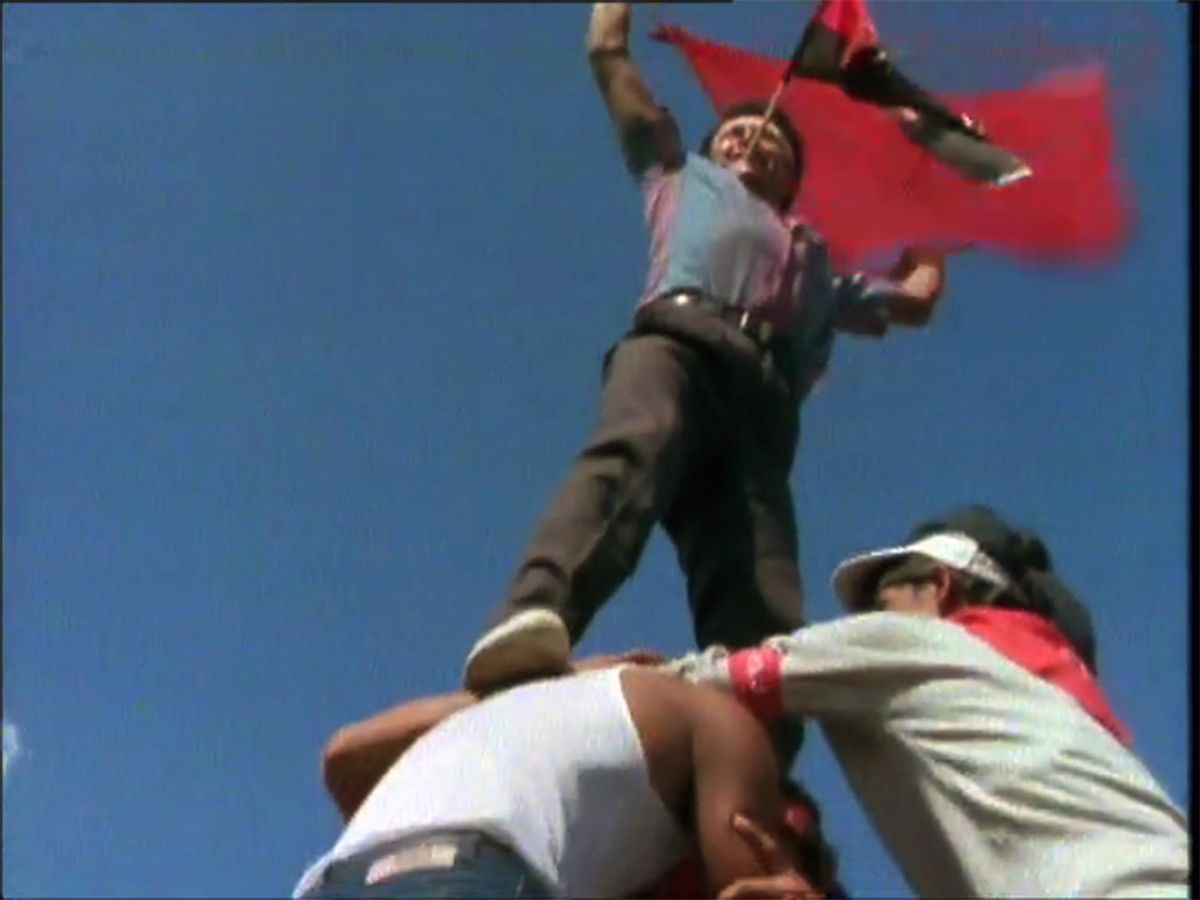
I missed this from a week ago, but it is fantastic to hear of a screening of Karlin’s Scenes for a Revolution (1991) at Ύλη[matter]HYLE in Athens last Sunday. It was screened in a new series of artist film programmed by Katerina Nikou, currently curatorial assistant of the public programs of documenta 14 based in Athens and artist Theo Prodomidis, currently based in Paris, in collaboration with Ύλη[matter]HYLE.
In an attempt to avoid the stereotypes of global financial and social crisis the film program aims to go far beyond status quo and address issues of contemporaneity as well as to examine the following basic parameters: the change of our perception of time, the redefinition of public space, the reconciliation of geopolitical boundaries and the position of individuals in a precarious society. We challenge the public to imagine new spatial conditions defined by social relationships and to question once more this era of social apathy and absence or suppression of passion, emotion and excitement. We aim to investigate tools that are constantly undermined: education, collective attempts of resistance, production of spiritual knowledge and raise of social consciousness.
The film series at Ύλη[matter]HYLE is a spontaneous reaction to the needs of the contemporary society. You are kindly invited to follow us in this attempt of gain and share knowledge.
|
Scenes For A Revolution (1991) SUNDAY NOV 27th, 7:00 pm
Director – MARC KARLIN* Courtesy: Marc Karlin Archive Scenes For A Revolution (1991) Subtitles: English Duration: 1 hour 44 minutes
|
| Marc Karlin returns to Nicaragua after five years to examine the history of the Sandinista government and the prospects for democracy following their defeat in the general election of 1990. A film about aftermaths and reckonings. Revisiting material for his earlier four-part series (1985), Karlin returns to Nicaragua to examine the history of the Sandinista government, consider its achievements, and assess the prospects for democracy following its defeat in the general election of 1990.
Marc Karlin (1943-1999) is widely regarded as Britain’s most important but least known director of the last half century. His far-reaching essay films deal with working-class and feminist politics, international leftism, historical amnesia and the struggle for collective memory, about the difficulty but also the necessity of political idealism in a darkening world. Chris Marker hailed him as a key filmmaker, and his work has inspired or been saluted by moving-image artists and historians such as Sally Potter, Sheila Rowbotham, John Akomfrah, Luke Fowler and The Otolith Group. Yet, in large part because his passionate, ideas-rich, formally adventurous films were made for television, until recently they were lost to history. |
Unearthing Filmmaker Marc Karlin, an Oft-Overlooked Pioneer of Documentary Film by Wanda Bershen

Largely relegated to broadcast television, the British filmmaker’s highly visual work explored memory and social history, and pushed for stylistic innovations.
Read Wanda Bershen’s full article at The Independent.
Out Now! Dossier Marc Karlin edited by Gianluca Pulsoni in Cineforum/557
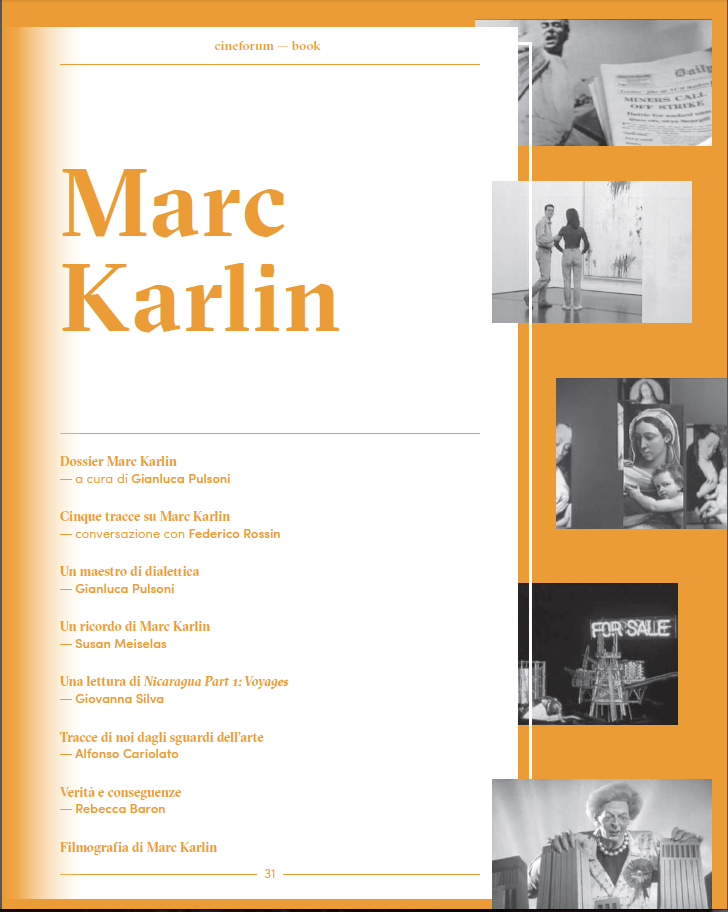
Dossier Marc Karlin/a cura di Gianluca Pulsoni p. 32
Cinque tracce su Marc Karlin/Conversazione con Federico Rossin p. 33
Gianluca Pulsoni/Un maestro di dialettica p. 38
Susan Meiselas/Un ricordo di Marc Karlin p. 42
Giovanna Silva/Una lettura di Nicaragua Part 1: Voyager p. 44
Alfonso Cariolato/Tracce di noi dagli sguardi dell’arte p. 45
Rebecca Baron/Verità e conseguenze p. 47
Buy the Marc Karlin dossier here
The Bristol Radical Film Festival 7th – 9th October 2016
The Bristol Radical Film Festival returns this October for its fifth year celebrating political, activist and experimental filmmaking. This season’s programme promises an exciting blend of some of the newest and provocative features, including the winners of our international short film competition, alongside a number of rarely screened classics. There is a timely showing of A VERY BRITISH COUP, the 1980s made for TV drama about the obstacles facing a newly elected left wing labour government; and rare screenings of BLACK IS… BLACK AIN’T and SYMBIOPSYCHOTAXIPLASM by the legendary US filmmakers, William Greaves and Marlon Riggs. Two outstanding contemporary feature films: SLEAFORD MODS – INVISIBLE BRITAIN, about the radical post-punk band, Sleaford Mods; and LIGHT YEARS, the acclaimed first feature from Bristol-based director Esther May Campbell, offer reflections and explorations of life in contemporary Britain.
Bristol Radical Film Festival was set-up in 2011 to provide a platform for politically-engaged, aesthetically innovative cinema, and is now part of The Radical Film Network, an international network of similar organisations involved in progressive, alternative film culture.
The Old Malt House, Little Ann Street, BS2 9EB
Festival Pass: £30, individual screenings: £6/4.
SHOOT SHOOT SHOOT / Soft Floor, Hard Film Celebrating 50 Years of the London Film-Makers’ Co-op ICA, London
SHOOT SHOOT SHOOT / Soft Floor, Hard Film
Celebrating 50 Years of the London Film-Makers’ Co-op
ICA, London
Thursday 13 October 2016, 7:00pm
Tickets are available via ICA, £5 or free for ICA members
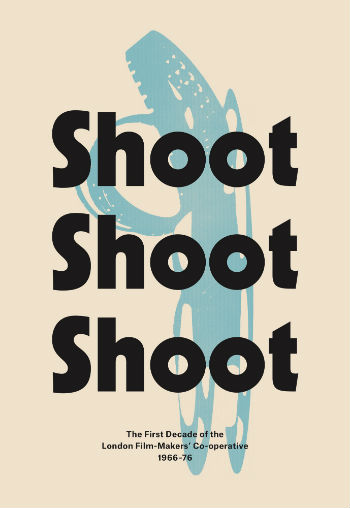
To mark the 50th anniversary, to the day, since the founding of the London Film-makers’ Co-operative (LFMC), LUX launches a new publication at ICA: Shoot Shoot Shoot: The First Decade of the London Film-Makers’ Co-operative 1966-76, edited by Mark Webber (now available for pre-order here).
Organised in conjunction with Frieze Video and the ICA’s Artists’ Film Club, the evening will feature a newly commissioned short film about the LFMC, produced by Frieze in collaboration with artist and writer Matthew Noel-Todd, who will also chair a discussion with Mark Webber, Malcolm Le Grice and Lis Rhodes on the organisation’s early ideals and ongoing legacy. The panel will be followed by a special presentation of Lis Rhodes’ seminal expanded cinema piece Light Music (1975-77).
The 1960s and 1970s were a defining period for artists’ film and video, and the LFMC was one of its major international centres as an artist-led organisation that pioneered the moving image as an art-form across the UK. Shoot Shoot Shoot: The First Decade of the London Film-Makers’ Co-operative 1966-76documents its beginnings, tracing its development from within London’s counterculture towards establishing its own identity within premises that uniquely incorporated a distribution office, cinema space and film workshop.
Shoot Shoot Shoot began as a major survey of the first decade of the London Film-Makers’ Co-operative, curated by Mark Webber and organised by LUX in 2002. Consisting of 8 programmes of single screen films, double projections and expanded cinema, it premiered at Tate Modern in May 2002 and then toured internationally to 19 cities worldwide over the next two years, heralding a resurgence of interest in the historic work of British filmmakers. A smaller touring programme in 2006-08 accompanied a DVD release of 13 films. For the LFMC’s 50th anniversary in 2016, an exhibition of archival documents, also titled Shoot Shoot Shoot, was on display at Tate Britain from April to July 2016.
Marc Karlin – Look Again edited by Holly Aylett published by @LivUniPress
“a meticulously researched treasure of a book.”
“This is a volume not only to read but also to experience with almost tactile pleasure.”
Giovanni Vimercati, Film Comment – September/October 2015
“…what Ezra Pound called an ‘active anthology’ – a book that sets ideas in motion, and establishes a complex network of internal cross-references, concerning Karlin and his ideas, images, politics, collaborators and films.”
“...the future of Channel 4, whose existence owes so much to the campaigning activities of Karlin and his colleagues in the Independent Filmmakers Association in the 1970s and early 1980s, lies in doubt due to the government’s apparent privatisation plans. In tackling the issues of how to protect Channel 4’s remit and how to make films in a hostile funding climate, the current generation could learn a very great deal from Marc Karlin.”
Ieuan Franklin (Bournemouth University), Journal of British Cinema and Television, Volume 13, Issue 2, April, 2016
“Overdue reader on British independent filmmaker and advocate Marc Karlin”.
Artist’s Moving Image Publications of the Year, 2015 LUX Artist Moving Image
Marc Karlin – Look Again. Edited by Holly Aylett. Available here
Watch the Marc Karlin Collection here
In Between Times – Courtisane Festival 2016 – Programme Selection
“Wanting to believe has taken over from believing,” a filmmaker observed. But the uncertainty did not stop filmmakers from making films, just as it didn’t stop movements from occupying the spaces that the traditional counter-forces had excluded and abandoned. Instead of holding on to the plots of historical necessity and lures of an imagined unity, they chose to explore twilight worlds between multiple temporalities and realms of experience, situated in the wrinkles that join and disjoin past futures and future presents, memories of struggle and struggles for memory.
via Courtisane
Inoperative Community II exhibition @muzeumsztuki 20.05 – 28.08 2016
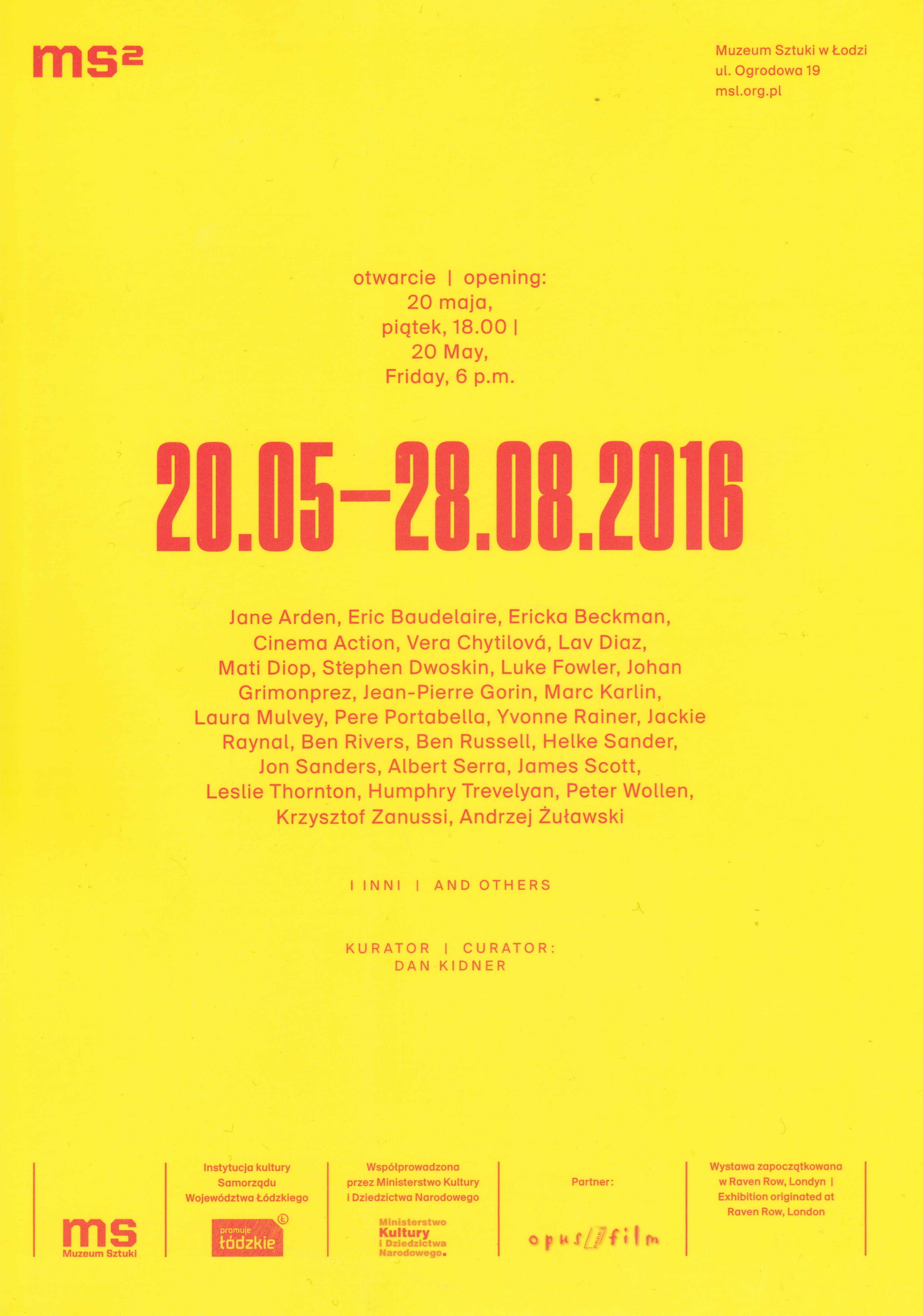
This “second iteration” of an exhibition which originated at Raven Row, London (presenting a different selection of films) will see the museum turn into a multiplex cinema of sorts, screening video materials addressing the problem of the dissolution of communities due to post-1968 cultural transformations.
Mick Eaton’s ‘Now About This Policy’ shown @Channel4 Visions 24 April 1985. A satire on British Film Policy.
Mick Eaton directed and Alan Drury scripted this amusing and insightful view of the twists and turns of UK government film policies. Shot using the then-new video technique of blue screen studio, it features Geoffrey Keen (who played the Minister of Defence in six Bond films) as the hapless Minister, and Joan Blackham and Jack Elliott as the ineffectual civil servants. It was the first part of a special edition of Visions devoted to the problems of British cinema on 24 April 1985.
via Large Door
 marckarlin