Militant Image: Screening of In the National Interest? (1986) 16/05/2013

From over two years ago now –  as part of the Iniva’s Keywords exhibition and programmed by The Otolith Collective – the Militant Image presents Penny Stempel’s rarely screened film In the National Interest? (1986). (16/05/2013)

Penny Stempel’s seminal film, co-directed by Chris Rushton, looks at those sections of British society targeted by the government, the judicial system and the police in the name of the national interest in Britain in the 1980s. The film assesses the legitimation crisis of the British state by exploring the connections between trade union struggles, racial attacks and processes of criminalisation.

In the National Interest? was produced by Cardiff based Chapter Video Workshop, co-founded by Stempel and Rushton, a franchised workshop under the ACTT Workshop Declaration – an act that facilitated the funding of film and video workshops to produce work for television. This allowed the groups, already working on directly politically and socially engaged film-making, to consolidate their activities. During the Miners’ Strike of 1984/85, Stempel had worked closely with Wales’ mining community, recording testimonies that contributed to the widely distributed Miners Campaign Tapes. Upon viewing this, Alan Fountain, the Commissioning Editor of Channel 4’s Independent Film and Video Department (IFVD), approached Chapter to make a film for Channel 4’s People to People strand.

In the National Interest? was made in a unique and unprecedented cooperation with other independent film and video workshops including ABSC Film and Video, Activision Studios, Albany Video, Another View, Belfast Independent Video, Biased Tapes, Black Audio Film Collective, Derry Film & Video Collective, Faction Films, Films at Work,Open Eye, Sankofa, Sheffield Asian Film and Video, Trade Films, TUTV and Women in Sync. Seemingly galvanised by the Miner’s Strike, these workshops donated film and video material from their own campaigns to Chapter for integration within In the National Interest?

In the discussion that follows, Kodwo Eshun and Anjalika Sagar of The Otolith Collective, remark on this ‘cinema of coalition’ that links up other struggles within Britain’s ‘geography of resistance’ at the time. The discussion also explores the complex and controversial production history of In the National Interest?, the formation of the workshop movement in 1980s Britain, the struggles of the workshops to invent a new language for television, the role played by the Independent Film and Television Department at Channel 4 and the legacies of oppositional film in Britain in the present.

This was a Militant Image event, an ongoing programme in which Iniva investigates radical film practice in association with the Otolith Group and with the support of the Department of Art at Goldsmiths College, University of London.


There Goes the Neighbourhood

Critic Jonathan P. Watts takes a cross-generational look at how artists have survived in London from the 1970s until the present, and why they continue to stay.

‘There Goes the Neighbourhood’ is the first in a three-part series of film and essay projects titled ‘Page and Screen’, supported by Arts Council England, exploring the relationship between art writing and the moving image. Read the accompanying article in the November-December issue here

via Frieze

The Inoperative Community, 3 December 2015 – 14 February 2016, Raven Row

2881_rr_tic_web_lores-2

Serge Bard, Eric Baudelaire, Ericka Beckman, Cinema Action, Patrick Deval, Lav Diaz, Mati Diop, Stephen Dwoskin, Luke Fowler, Jean-Luc Godard, Jean-Pierre Gorin, Johan Grimonprez, Marc Karlin, Stuart Marshall, Anne-Marie Miéville, Pere Portabella, Yvonne Rainer, Jackie Raynal, Anne Charlotte Robertson, Helke Sander, Jon Sanders, James Scott, Albert Serra, Leslie Thornton, Humphry Trevelyan

 Curated by Dan Kidner

‘The Inoperative Community’ is an exhibition of experimental narrative film and video that address ideas of community and the shifting nature of social relations. It draws on work made since 1968 for cinema, television and the gallery, reflecting the overlapping and entangled histories of these sites. The exhibition’s title is borrowed from Jean-Luc Nancy’s 1983 essay of the same name, and while this connection did not determine the selection of works, they all bear witness in their own way to what Nancy characterised as the ‘dissolution, the dislocation, or the conflagration of community’. Many concern the limits of political activism and the fate of left political subcultures, and all use narrative as a means to explore social and political issues.

Encompassing over fifty hours of material the exhibition can be navigated by means of a printed or downloadable programme. Each visitor will only be able to see a fraction of the works on offer, but connections can be made between works on any particular course through the exhibition, which has been designed to accommodate both prolonged viewing and shorter visits. A screening room will show five daily programmes, in a more structured approach to the exhibition’s historical and political framework. These begin with an Anglo-French focus before expanding to include international filmmakers reflecting on the radical political movements of the 1960s and 1970s.

The exhibition focuses on a period that could be described as the long 1970s (1968-84) – all the works were either made during this time, or reflect on the radical social and political movements of the era. The defiant video installation about the Aids crisis, Journal of the Plague Year (1984) by Stuart Marshall (1949–93, UK) has been specially restored for the exhibition. Also included is a new edit – within an installation designed for the exhibition – of Peggy and Fred in Hell (1984–2015) by Leslie Thornton (b. 1951, USA), featuring footage shot whilst in residence at Raven Row; and newly available reels from the epic Five Year Diary (1981–97) by Anne Charlotte Robertson (1949–2012, USA), preserved by the Harvard Film Archive, will be screened for the first time in the UK.

Extended gallery opening hours: 11am-7pm, Wednesday to Sunday

theinoperativecommunity_programme_ravenrow_1

Film is Fragile – Film needs your help! Donate to the BFI

The BFI looks after one of the most important collections of film in the world – films from as early as 1895 to the latest British features just released in cinemas. But film is fragile. And restoring and preserving it is expensive.
As a charity we rely on the generosity and support of film-lovers such as you to continue this culturally important work.
Any donation, large or small, makes a huge difference, and if you give today every donation we receive up to £400,000 will be matched by a generous supporter – so your gift will be worth twice as much!

Help protect our nation’s film collection. Donate now: https://www.bfi.org.uk/filmisfragile/

Here, director Carl Addy explains how Mill+ approached the project as a whole and the inspiration behind the burning film motif.

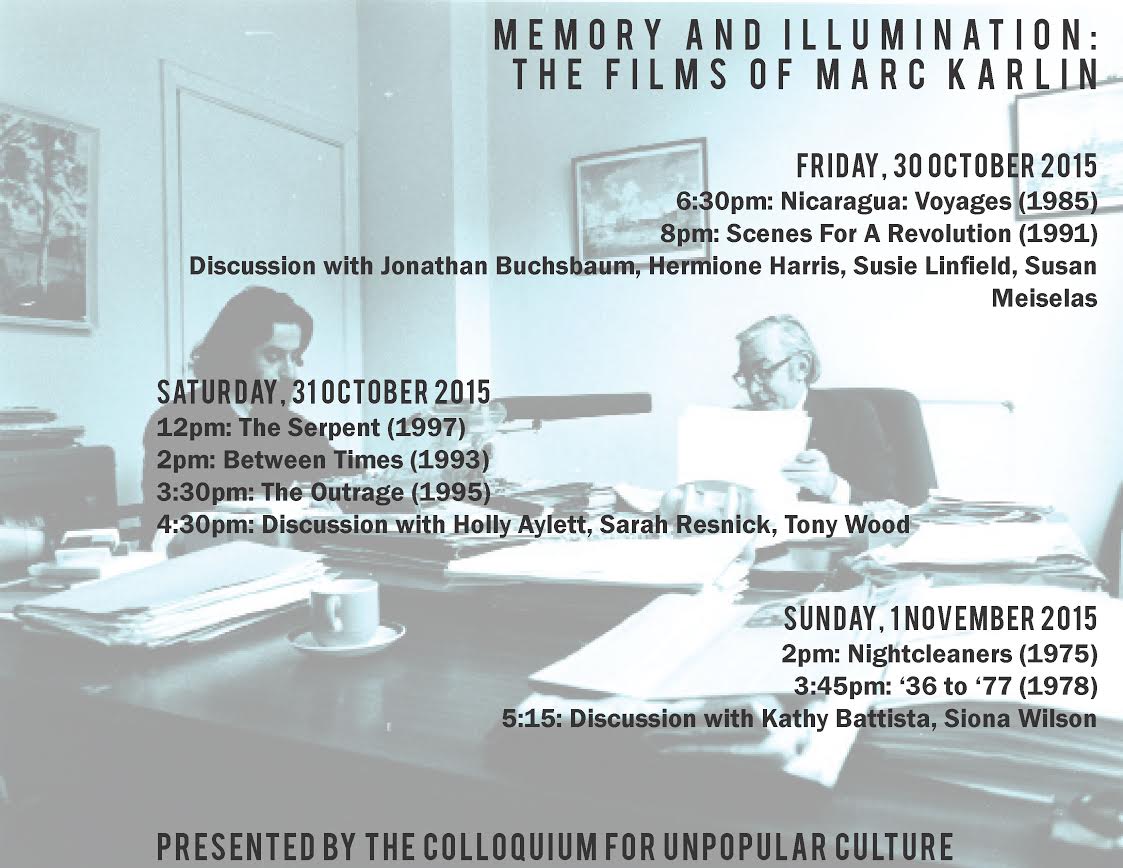
Memory And Illumination The Films of Marc Karlin – 30 OCT, King Juan Carlos I of Spain Center, NYU

serpent-01

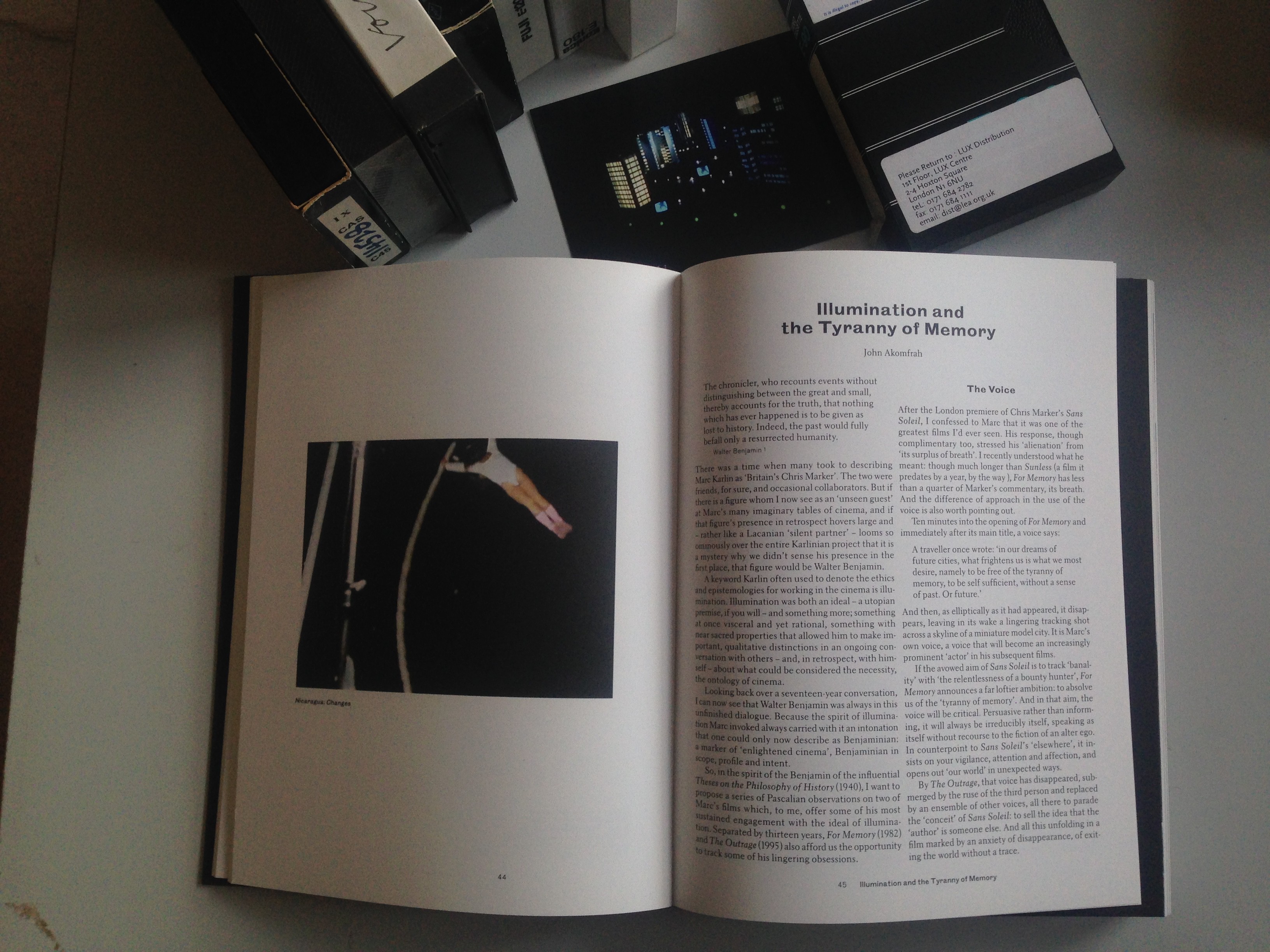
Marc Karlin (1943-1999) is widely regarded as Britain’s most important but least known director of the last half century. His far-reaching essay films deal with working-class and feminist politics, international leftism, historical amnesia and the struggle for collective memory, about the difficulty but also the necessity of political idealism in a darkening world.

Chris Marker hailed him as a key filmmaker, and his work has inspired or been saluted by moving-image artists and historians such as Sally Potter, Sheila Rowbotham, John Akomfrah, Luke Fowler and The Otolith Group. Yet, in large part because his passionate, ideas-rich, formally adventurous films were made for television, until recently they were lost to history.

Memory And Illumination: The Films of Marc Karlin, the first US retrospective of his work, offers a broad survey of what the latest issue of Film Comment calls “the most daring docu-essays the public at large has yet to appreciate”. They include explorations of the emergent women’s liberation movement he made as part of his early membership of the Berwick Street Film Collective, his chronicles of the 1980s aftermath of the Nicaraguan Revolution, and his enduringly resonant meditations on post-1989 politics.

SCHEDULE:

FRIDAY 30 OCTOBER 2015
King Juan Carlos I of Spain Center, 53 Washington Square South

6:30pm: NICARAGUA: VOYAGES (1985)
Voyages is composed of stills by renowned Magnum photographer Susan Meiselas taken in 1978 and 1979 during the overthrow of the fifty-year dictatorship of the Somoza family. Written in the form of a letter from Meiselas to Karlin, it is a ruminative and often profound exploration of the ethics of witnessing, the responsibilities of war photography and the politics of the still image.

8pm: SCENES FOR A REVOLUTION (1991)
A film about aftermaths and reckonings. Revisiting material for his earlier four-part series (1985), Karlin returns to Nicaragua to examine the history of the Sandinista government, consider its achievements, and assess the prospects for democracy following its defeat in the general election of 1990. (Sponsored by King Juan Carlos I of Spain Center)

SATURDAY 31 OCTOBER 2015
Room 674, 721 Broadway (at Waverley Place)

12pm: THE SERPENT (dir. Marc Karlin, 1997), 40 min
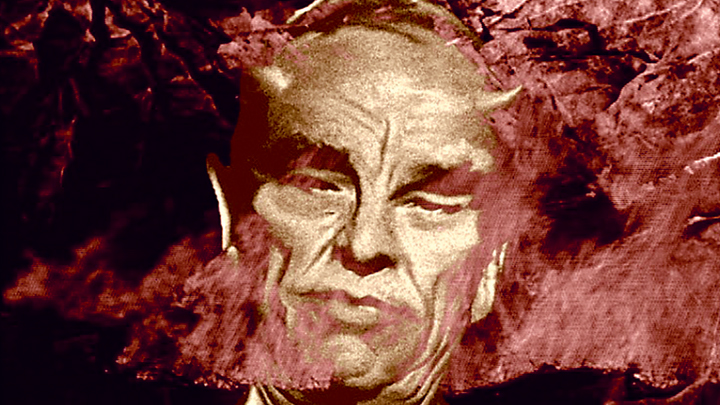
The Serpent, loosely based on Milton’s Paradise Lost, is a blackly funny drama-documentary about media magnate and fanatical scourge of the Left Rupert Murdoch. A mild-mannered architect dreams of destroying this Dark Prince, but is assailed by his Voice of Reason which reminds him of the complicity of the liberal establishment in allowing Murdoch to dominate public discourse.

2pm: BETWEEN TIMES (dir. Marc Karlin, 1993), 50 min
Room 674, 721 Broadway (at Waverley Place)
A strikingly resonant work, not least in the wake of the recent re-election of the Conservative party in Britain, this is a probing and sometimes agonised essay – partially framed as a debate between socialism and postmodernism – about the paralysis of the Left and the need to locate new energies, spaces and forms of being that speak to emergent realities.

3:30pm: THE OUTRAGE (dir. Marc Karlin, 1995), 50 min
Room 674, 721 Broadway (at Waverley Place)
Echoes abound of Mike Dibb and John Berger’s Ways of Seeing (1972) in this hugely compelling film about Cy Twombly, about art, about television itself. According to director Steve Sprung it’s a film not about “the art of the marketplace, but the art that most of us leave behind somewhere in childhood, in the process of being socialized into the so-called world. The art which still yearns within us.”

5-6:30pm: Roundtable – TBA

7:30pm: FOR MEMORY (dir. Marc Karlin, 1986), 104 min
Room 674, 721 Broadway (at Waverley Place)
Beginning with a powerful interview with members of the British Army Film Unit who recall the images they recorded after the liberation of Belsen concentration camp, and conceived as an antidote to the wildly successful TV series Holocaust, For Memory is a multi-layered exploration – pensive and haunted – of cultural amnesia in the era of late capitalism that features historian E.P. Thompson, anti-fascist activist Charlie Goodman and Alzheimers patients.

SUNDAY 1 NOVEMBER 2015
Room 674, 721 Broadway (at Waverley Place)

2pm: NIGHTCLEANERS (dir. Berwick Street Film Collective, 1975)
Made over three years by the Berwick Street Film Collective (Karlin, Mary Kelly, James Scott, Humphrey Trevelyan), Nightcleaners is a landmark documentary that follows the efforts of the women’s movement to unionize female night workers in London. It eschewed social realism and agit prop in favour of a ghostly, ambient and sonically complex fragmentage that elicited both hostile and ecstatic responses. Screen journal declared it the most “important political film to have been made in this country”, while Jump Cut claimed it was “redefining the struggle for revolutionary cinema”. (Sponsored by Gender and Sexuality Studies)

3:45pm: 36 TO 77 (dir. Berwick Street Film Collective, 1978)
Room 674, 721 Broadway (at Waverley Place)
Very rarely screened since its original release, this film was originally conceived as Nightcleaners Part 2. A portrait of Grenada-born Myrtle Wardally (b.1936), a leader of the Cleaners’ Action Group Strike in 1972, it features her discussing the partial success of that campaign and also her childhood in the Caribbean. It’s also an experiment – as probing as it is rapturous – in the politics of film form, and a fascinating deconstruction of the idea of Myrtle as a “symbol of struggle, the nightcleaners, working women, immigrants, mothers, blacks”.

MORE ON KARLIN:
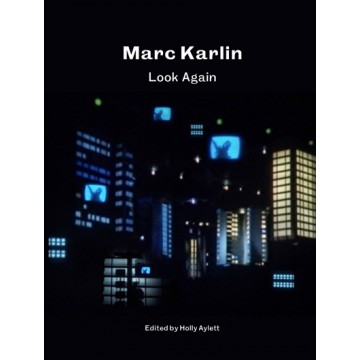
Look Again

Holly Aylett, Marc Karlin: Look Again (2015) http://liverpooluniversitypress.co.uk/products/60519

https://spiritofmarckarlin.com/

—–

Presented by the Colloquium for Unpopular Culture with the support of the Department of Cinema Studies, New York University

—–

QUERIES: ss162@nyu.edu

Close-ups on Revolution: the Nicaraguan Films of Marc Karlin, 30th Oct, organised by @autumnfarewells

MKNicaragua

Friday, October 30th  6:30pm

NYU KJCC

With SUSAN MEISELAS and HERMIONE HARRIS

VOYAGES (1985), 42 min.

SCENES FOR A REVOLUTION (1991), 110 min.

MARK KARLIN (1943-1999), one of the greatest British filmmakers of his generation, created an outstanding body of philosophically rich, formally bold work that explored themes of history, memory, labour, and political agency in a time of neoliberal despair.

Foremost among his achievements are the five films he made on the Nicaraguan revolution: spanning the Sandinista decade, focussing on rural and urban grassroots movements, attentive to the sadness and disappointments of the revolutionary process, they are a remarkable chronicle of a remarkable era.

MEMORY AND ILLUMINATION: THE FILMS OF MARC KARLIN, the first US retrospective of his work, begins with two works from this period. VOYAGES (1985) is composed of stills by renowned Magnum photographer SUSAN MEISELAS taken in 1978 and 1979 during the overthrow of the fifty-year dictatorship of the Somoza family. Written in the form of a letter from Meiselas to Karlin, it is a ruminative and often profound exploration of the ethics of witnessing, the responsibilities of war photography and the politics of the still image,

SCENES FOR A REVOLUTION (1991) is a film about aftermaths and reckonings. Revisiting material for his earlier 4-part series (1985), Karlin returns to Nicaragua to examine the history of the Sandinista government, consider its achievements, and assess the prospects for democracy following its defeat in the general election of 1990.

Post screening discussion with:

Susan Meiselas, Magnum photographer since 1980 and 1992 MacArthur Fellow.

Hermione Harris, Marc Karlin Archive

Jonathan Buchsbaum, author of Cinema Sandinista: Filmmaking in Revolutionary Nicaragua, 1979-1990.

Susie Linfield, author of The Cruel Radiance: Photography and Political Violence.

Organized by Sukhdev Sandhu. QUERIES: ss162@nyu.edu

Presented by THE COLLOQUIUM FOR UNPOPULAR CULTURE and KING JUAN CARLOS I OF SPAIN CENTER.