Studio: A Remembrance of Chris Marker
Published by OR Books
Photographs by Adam Bartos. Text by Colin McCabe. Introduction by Ben Lerner.
Published by OR Books
Photographs by Adam Bartos. Text by Colin McCabe. Introduction by Ben Lerner.
Tickets: £10 / £8 conc. / £6 Close-Up members
Box Office: 02037847975
Gareth Evans presents a special screening to mark the 15th anniversary of the untimely death of WG Sebald with readings by his close friend, poet Stephen Watts. Evans will be in conversation with director Grant Gee following the screening.
Patience (After Sebald)
Grant Gee
2012 | 83 min | Colour & B/W | Digital
A richly textured essay film on landscape, art, history, life and loss, Patience (After Sebald) offers a unique exploration of the work of internationally acclaimed writer W.G. Sebald via a walk through East Anglia tracking his most influential book, The Rings of Saturn. Grierson award winning filmmaker Grant Gee directs the first film about Sebald, with contributions from major writers, artists and film-makers including Tacita Dean, Robert Macfarlane, Sir Andrew Motion, Rick Moody, Iain Sinclair and Marina Warner, with a haunting soundtrack by acclaimed composer and sound artist The Caretaker.
Kindly supported by Soda Pictures.
More info:
www.sodapictures.com
via Close-Up
The Marc Karlin film collection available now on Vimeo On-Demand.
Marc Karlin (1943 – 1999)
On his death in 1999, Marc Karlin was described as Britain’s most significant, unknown filmmaker. For three decades, he was a leading figure within Britain’s independent film community, actively contributing to opening up television through Channel 4. He was a founding member of the Berwick Street Film Collective; a director of Lusia Films, a key influence in the Independent Filmmakers Association, and a creative force behind the group that published the independent film magazine, Vertigo (1993-2010)
His groundbreaking films for television in the 1980s and 1990s combine documentary and fiction film conventions to explore the themes of memory, history and political agency. Karlin was a committed political filmmaker, and his dense, yet subtle films are rich meditations on the nature of filmmaking, the impact of ideologies on political choice and formations, and the necessity for rigorous, open interpretation to safeguard the future of the creative, human spirit.
He filmed his way through three decades of huge change, wrestling with the challenges of Thatcher’s free market economics; the demise of manufacturing; the imagining of socialist ways forward after the fall of the Berlin Wall; the role of art in society and the shape-shifting impact of digital technologies: all key concerns relevant to our world today.
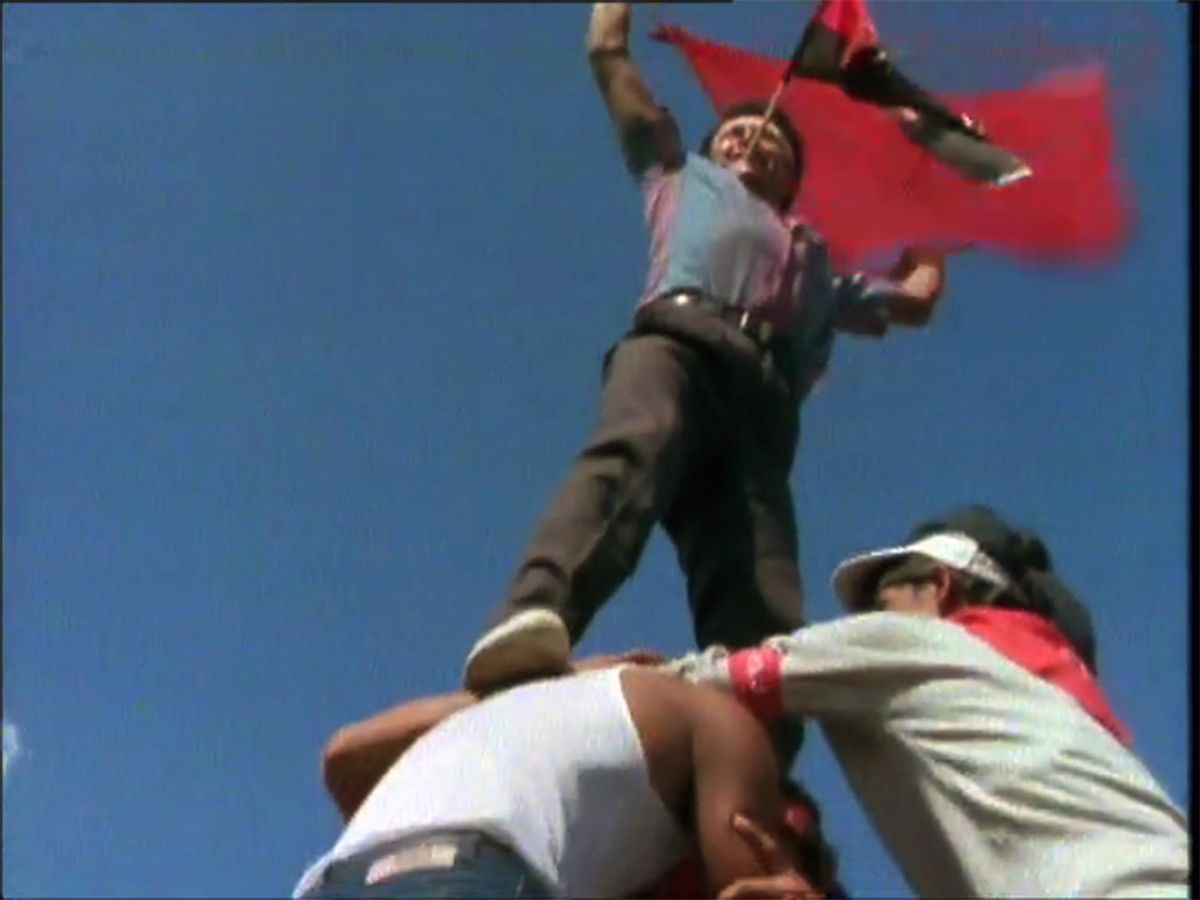
This collection consists of the films broadcast on Channel 4 from 1985 to 1997, predominately commissioned by Alan Fountain Senior Commissioning Editor at Channel 4’s Independent Film and Video Department (1981–1994). Although informed by an international perspective, most of Karlin’s work focuses on the UK. An exception was the remarkable series of five films on the Nicaraguan revolution encompassing the popular guerrilla war of the late 1970’s, the development of the Sandinista government, the effects of the US-backed contra war, and the defeat of the FSLN in 1989. Rather than foregrounding the Sandinista leadership, the films speak from the grassroots, both urban and rural. This rare perspective portrays a revolution for what it is – an exhausting, uneven process.
A documentary film about occupational diseases shot in 1957 at the Francolor factory in Oissel.
It takes the form of a scientific investigation to discover the origin of a mysterious illness that has infected a worker at the factory
Scénario : Chris Marker et Rémo Forlani
Réalisateur : André Heinrich et Alain Resnais
Avec Jean Burgot, Jean-Pierre Grenier, Yves Péneau
While the video essay form, in regards to its practice of exploring the visual themes in cinematic discourse, has seen a recent surge in popularity with viewers (thanks to invaluable online resources like indieWIRE’s Press Play, Fandor’s Keyframe and the academic peer-reviewed journal [in]Transition), its historical role as a significant filmmaking genre has long been prominent among film scholars and cinephiles.
From the start, the essay film—more affectionately referred to as the “cine-essay”—was a fusion of documentary filmmaking and avant-garde filmmaking by way of appropriation art; it also tended to employ fluid, experimental editing schemes. The first cine-essays were shot and edited on physical film. Significant works like Agnès Varda’s “Salut les Cubains” (1963) and Marc Karlin’s “The Nightcleaners” (1975), which he made in collaboration with the Berwick Street Film Collective, function like normal documentaries: original footage coupled with a voiceover of the filmmaker and an agenda at hand. But if you look closer and begin to study the aesthetics of the work (e.g. the prolific use of still photos in “Cubains,” the transparency of the “filmmaking” at hand in “Nightcleaners”), these films transcend the singular genre that is the documentary form; they became about the process of filmmaking and they aspired to speak to both a past and future state of mind. What the cine-essay began to stand for was our understanding of memory and how we process the images we see everyday. And in a modern technological age of over-content-creation, by way of democratized filmmaking tools (i.e. the video you take on your cell phone), the revitalization of the cine-essayists is ever so crucial and instrumental to the continued curation of the moving images that we manifest.
The leading figure of the cine-essay form, the iconic Chris Marker, really put the politico-stamp of vitality into the cine-essay film with his magnum-opus “Grin Without A Cat” (1977). Running at three hours in length, Marker’s “Grin” took the appropriation art form to the next level, culling countless hours of newsreel and documentary footage that he himself did not shoot, into a seamless, haunting global cross-section of war, social upheaval and political revolution. Yet, what’s miraculous about Marker’s work is that his cine-essays never fell victim to a dependency on the persuasive argument—that was something traditional documentaries hung their hats on. Instead, Marker was much more interested in the reflexive nature of the moving image. If we see newsreel footage of a street riot spliced together with footage from a fictional war film, does that lessen our reaction to the horrific reality of the riot? How do we associate the moving image once it is juxtaposed against something that we once thought to be safe or familiar? At the start of Marker’s “Sans Soleil” (1983), the narrator says, “The first image he told me about was of three children on a road in Iceland, in 1965. He said that for him it was the image of happiness and also that he had tried several times to link it to other images, but it never worked. He wrote me: one day I’ll have to put it all alone at the beginning of a film with a long piece of black leader; if they don’t see happiness in the picture, at least they’ll see the black.” It’s essentially the perfect script for deciphering the cine-essay form in general. It demands that we search and create our own new realities, even if we’re forced to stare at a black screen to conjure up a feeling or memory.
Flash forward to 1995: Harun Farocki creates “Arbeiter verlassen die Fabrik,” a video essay that foils the Lumière brothers’ “Employees Leaving the Lumière Factory” (1895) with countless other film clips of workers in the workplace throughout the century. It’s a significant work: exactly 100 years later, a cine-essayist is speaking to the ideas of filmmakers from 1895 and then those ideas are repurposed to show a historical evolution of employer-employee relations throughout time. What’s also significant about Farocki’s film is the technological aspect. Note how his title at this point in time is a “video essayist.” The advent of video, along with the streamlined workflow to acquiring digital assets of moving images, gave essayist filmmakers like Farocki the opportunity for creating innovative works with faster turnaround times. Not only was it less cumbersome to edit footage digitally, the ways for the works to be presented were altered; Farocki would later repurpose his own video essay into a 12-monitor video installation for exhibition.
Consider Thom Andersen’s epic 2003 video essay “Los Angeles Plays Itself.” In it, Andersen appropriates clips from films set in Los Angeles from over the decades and then criticizes the cinema’s depiction of his beloved city. It’s the most meta of essay films because by the end, Andersen himself has constructed the latest Los Angeles-based film. And although Andersen has more of an obvious thesis at hand than, say something as equally lyrical and dense as Marker’s “Sans Soleil,” both films exist in the same train of thought: the exploration of the way we as viewers embrace the moving image and then how we communicate that feeling to each other. Andersen may be frustrated with the way Hollywood conveys his city but he even he has moments of inspired introspection towards those films. The same could be said of Marker’s work; just as Marker can remain a perplexed and often inquisitive spectator of the moving images of poverty and genocide that surround him, he functions as a gracious, patient guide for the viewer, since it is his essay text that the narrator reads from.
Watching an essay film requires you to fire on all cylinders, even if you watch one with an audience. It’s a different kind of collective viewing because the images and ideas spring from an artifact that is real; that artifact can be newsreel footage or a completed, a released motion picture that is up for deeper examination or anything else that exists as a completed work. In that sense, the cine-essay (or video essay), remains the most potent form of cinematic storytelling because it invites you to challenge its ideas and images and then in turn, it challenges your own ideas by daring you to reevaluate your own memory of those same moving images. It aims for a deeper truth and it dares to repurpose the cinema less as escapist entertainment and more as an instrument to confront our own truths and how we create them.
via Balder & Dash
Marc Karlin – Look Again Edited by Holly Aylett £25
This book provides almost the only published material on the work of Marc Karlin. On his death in 1999, Karlin was commemorated as one of the visionaries of independent British film culture, with its roots in the seventies and its expansion in the first decades of Channel 4 television. This edited collection will profile his films and ideas, drawing exclusively on documents and correspondence from his recently recovered archive. It includes appraisals both from his collaborators and eminent film theorists, and is an illuminating addition to the sparse but rapidly expanding field of independent cinema studies. Marc Karlin was an incisive, witty man and a passionate advocate for an inclusive cultural space. He filmed his way through three decades of huge change, wrestling with the challenges of Thatcher’s free market economics; the demise of manufacturing; the imagining of socialist ways forward after the fall of the Berlin Wall; the role of art in society and the shape-shifting impact of digital technologies: all key concerns relevant to our world today. The book is structured through four contextualizing essays followed by twelve chapters expressing the focus and aesthetic of his documentaries and cultural politics. It combines academic analysis with memoir, and includes a recorded discussion on Karlin’s creative practice, his unpublished writings on cinema and over 150 images from his films. With a foreword by UK’s celebrated film director, Sally Potter MBE, this book presents the reader with an illustrated mosaic of encounters engaging with the spirit of this remarkable man, and will ensure that his work is restored to the canon of British cinema.
I missed this from a week ago, but it is fantastic to hear of a screening of Karlin’s Scenes for a Revolution (1991) at Ύλη[matter]HYLE in Athens last Sunday. It was screened in a new series of artist film programmed by Katerina Nikou, currently curatorial assistant of the public programs of documenta 14 based in Athens and artist Theo Prodomidis, currently based in Paris, in collaboration with Ύλη[matter]HYLE.
In an attempt to avoid the stereotypes of global financial and social crisis the film program aims to go far beyond status quo and address issues of contemporaneity as well as to examine the following basic parameters: the change of our perception of time, the redefinition of public space, the reconciliation of geopolitical boundaries and the position of individuals in a precarious society. We challenge the public to imagine new spatial conditions defined by social relationships and to question once more this era of social apathy and absence or suppression of passion, emotion and excitement. We aim to investigate tools that are constantly undermined: education, collective attempts of resistance, production of spiritual knowledge and raise of social consciousness.
The film series at Ύλη[matter]HYLE is a spontaneous reaction to the needs of the contemporary society. You are kindly invited to follow us in this attempt of gain and share knowledge.
|
Scenes For A Revolution (1991) SUNDAY NOV 27th, 7:00 pm
Director – MARC KARLIN* Courtesy: Marc Karlin Archive Scenes For A Revolution (1991) Subtitles: English Duration: 1 hour 44 minutes
|
| Marc Karlin returns to Nicaragua after five years to examine the history of the Sandinista government and the prospects for democracy following their defeat in the general election of 1990. A film about aftermaths and reckonings. Revisiting material for his earlier four-part series (1985), Karlin returns to Nicaragua to examine the history of the Sandinista government, consider its achievements, and assess the prospects for democracy following its defeat in the general election of 1990.
Marc Karlin (1943-1999) is widely regarded as Britain’s most important but least known director of the last half century. His far-reaching essay films deal with working-class and feminist politics, international leftism, historical amnesia and the struggle for collective memory, about the difficulty but also the necessity of political idealism in a darkening world. Chris Marker hailed him as a key filmmaker, and his work has inspired or been saluted by moving-image artists and historians such as Sally Potter, Sheila Rowbotham, John Akomfrah, Luke Fowler and The Otolith Group. Yet, in large part because his passionate, ideas-rich, formally adventurous films were made for television, until recently they were lost to history. |
Mark Kermode revisits Ken Loach’s acclaimed 1995 film, a rare departure from the director’s traditional British milieu that focuses on the Spanish Civil War. Kermode analyses how the director’s use of well-honed realist techniques results in a historical drama with a rare vitality and naturalism.
Britain’s foremost social chronicler Ken Loach ventured beyond the UK for this passionate polemic set during the Spanish Civil War. Ian Hart plays David Carne, an idealistic young Liverpudlian who joins the international brigade to fight Franco’s fascists in the 1930s. As David becomes more engaged with his own side’s internecine conflicts than he does on the battlefield, he begins to learn the compromises and necessities of a brutal war.
While Loach may have a reputation as the most British of filmmaking institutions, Land and Freedom was first of three films made towards the end of the 1990s to focus on issues of international socialism. As such is has a more expansive, cinematic feel to many of his films, with its fine period detail and dramatic battle scenes. But the intelligence and intimacy of his best work remains, much of it deriving from Jim Allen’s typically humanistic screenplay. Land and Freedom would be Allen’s last Loach collaboration and final screen credit before his death in 1999; and from that point on Loach established another longstanding writer-director relationship with screenwriter Paul Laverty.
“The Dockworker’s Dream” a film by Bill Morrison featuring “The Hustle” music by Lambchop co-written by Ryan Norris and Kurt Wagner.
“The Dockworker’s Dream developed from the idea that the archive is a port of call, a place where goods are loaded and unloaded and held until a dockworker carries them off. In some ways, the imagery is a metaphor for our process. As a film researcher and editor, I find myself seeking out hidden or elusive film material. In the film, there is the voyage, the expedition—and the hunt: we hunt these rare films in order to bring them back alive so that they can live, for awhile longer, on the screen.” – Bill Morrison.
A communist survivor in a capitalist world, Fidel Castro has held power in Cuba for over forty years. To some, he is a symbol of resistance and social justice but to others he is a dangerous demon. Fidel explores the complex life of this controversial figure.
For more information or to order this film please visit http://www.factionfilms.co.uk
Producer/Director: Estela Bravo
Executive Producers: Sylvia Stevens
& Alan Fountain
Dur. 78 mins
35mm/16mm/Digibeta
For Channel 4 (UK)/ Fort Point Entertainment (USA) 1999