A Kind of English (1986) Directed by Ruhul Amin

Ruhul Amin, was born in Northern Bangladesh (at that time East Pakistan) in 1956. He was brought by his family to the East End of London in 1970, where he worked for ten years in clothing factoroes. In 1979 he joined a film making workshop run by Wilf Thust and Paul Hallam of the local Four Corners film group. Ruhul made his first short film, ‘Purbo London’ with the support of the group in 1982. He made ‘Flame in my Heart’, a documentary about Bengali culture, for Channel Four television in 1983. Ruhul also worked as an assistant editor with Richard Taylor, who produced ‘A Kind of English’. The film was commissioned by Alan Fountain’s Independent Film and Video Department for Channel 4 in 1986. The film was written by Paul Hallam, based on an idea by Ruhul Amin. Jonathan Collinson (now Bloom) was the Director of Photography, who shot all of Marc Karlin’s films.

SYNOPSIS

A nine year old Bengali boy, Samir, (Jamil Ali) is taken out for the day by his older brother Tariq (Andrew Johnson) and his mother Mariom (Lalita Ahmed). They go boating on an English lake, an image that recalls the rural Bangladesh background of the family.
A return home to Brick Lane in Spitalfields, East London, suggests that the day out might have been an escape from Samir’s moody, forbidding father, Chan (Badsha Haq).

The ‘extended’ family also includes the boy’s grandmother Shahanara (Afroza Bulbul), the mother of Tariq and Chan. Chan is out of work, a frustrated, isolated and nostalgic man, unable to deal with money (he gambles), or with the idea that Mariom should get a job. Tariq, a minicab driver, is more adaptable – equally at home ferrying passengers to West end discos and running errands for the local Bengali community.

The film picks up on a complex set of relationships – the boy with his uncle, the two brothers, Mariom and her mother-in-law, the boy and his grandmother. Each character is involved to varying degrees with their Bangladesh past, from dispalcement and dislocation to adjusting to / settling in England, or the assertion of their own culture here. That past is evoked through letters home, music, and a model village house made by the boy and his grandmother.
If there is strength and variety in the family relationships, there are also fundamental tensions, gradually revealed. Only when the boy goes missing after a parental row is there unity – the family fearing for the boy, alone, at night, wandering the city streets…

REVIEW OF ‘A KIND OF ENGLISH’ from the London Film Festival programme, 1986

“Ruhul Amin’s quiet, humane dramatic feature explores the conflicting influences on the life of Samir, a nine year old Bengali boy growing up in the East End of London. Samir’s unemployed father is a man crushed by his inability to make a place for himself in England. His mother mainatims the traditional role of the dutiful wife, having little contact with the world outside the family home. The most Westernised member of the extended family, the father’s younger brother Tariq, shares the attitudes and ambitions of most English boys his age, but remains bound to the Asian community by his awareness of the ever-present threat of racism.

Directed with restraint and played with enormous sensitivity by the cast (especially young Jamil Ali as Samir), Amin’s film examines the family’s realtionships with each other and the world outside through a series of understated, carefully observed incidenst, from which the themes and the drama of the situation gradually emerge. Devoid of the conventions of the British ‘;social realist’ tradition, A KIND OF ENGLISH recalls the early films of de Sica and Satyajit Ray; and it withstands such comparisons admirably.”
– Clive Hodgson.



Cinema in China: Visions, Channel 4 UK 1983 (pt 1)

History of filmmaking in China from its beginnings in the 1920s to 1982, featuring Shanghai cinema of 1930s; the progressive filmmakers; the organisation of filmmaking under the post-war communist government; the impact of the Cultural Revolution; the work of Xie Jin. Presenter: Tony Rayns. Director: Ron Orders. Producers: John Ellis Simon Hartog, Keith Griffiths. Channel 4 Visions series. Total length 57 mins


Havana Report (1986) documentary report on the 7th Havana Film Festival directed by Michael Chanan and Holly Aylett

A documentary report on the 7th Havana Film Festival, produced and directed by Michael Chanan and Holly Aylett, commissioned by Alan Fountain’s Independent Film and Video Department for the weekly Eleventh Hour slot on 30th June 1986 as part of the channel’s second season on New Cinema of Latin America. The festival focused on new Latin American Cinema and features a speech by Fidel Castro at the closing ceremony.


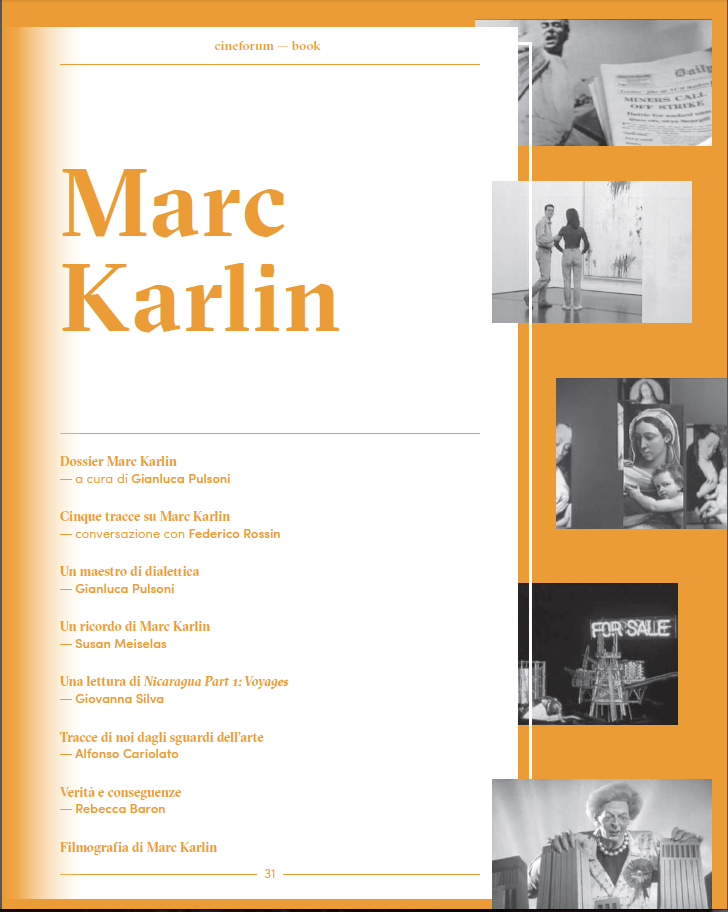
Out Now! Dossier Marc Karlin edited by Gianluca Pulsoni in Cineforum/557

screen-shot-2016-10-05-at-14-06-42

Dossier Marc Karlin/a cura di Gianluca Pulsoni p. 32
Cinque tracce su Marc Karlin/Conversazione con Federico Rossin p. 33
Gianluca Pulsoni/Un maestro di dialettica p. 38
Susan Meiselas/Un ricordo di Marc Karlin p. 42
Giovanna Silva/Una lettura di Nicaragua Part 1: Voyager p. 44
Alfonso Cariolato/Tracce di noi dagli sguardi dell’arte p. 45
Rebecca Baron/Verità e conseguenze p. 47

Cineforum 557

Buy the Marc Karlin dossier here

The Bristol Radical Film Festival 7th – 9th October 2016

The Bristol Radical Film Festival returns this October for its fifth year celebrating political, activist and experimental filmmaking. This season’s programme promises an exciting blend of some of the newest and provocative features, including the winners of our international short film competition, alongside a number of rarely screened classics. There is a timely showing of A VERY BRITISH COUP, the 1980s made for TV drama about the obstacles facing a newly elected left wing labour government; and rare screenings of BLACK IS… BLACK AIN’T and SYMBIOPSYCHOTAXIPLASM by the legendary US filmmakers, William Greaves and Marlon Riggs. Two outstanding contemporary feature films: SLEAFORD MODS – INVISIBLE BRITAIN, about the radical post-punk band, Sleaford Mods; and LIGHT YEARS, the acclaimed first feature from Bristol-based director Esther May Campbell, offer reflections and explorations of life in contemporary Britain.

Bristol Radical Film Festival was set-up in 2011 to provide a platform for politically-engaged, aesthetically innovative cinema, and is now part of The Radical Film Network, an international network of similar organisations involved in progressive, alternative film culture.

The Old Malt House, Little Ann Street, BS2 9EB

Festival Pass: £30, individual screenings: £6/4.

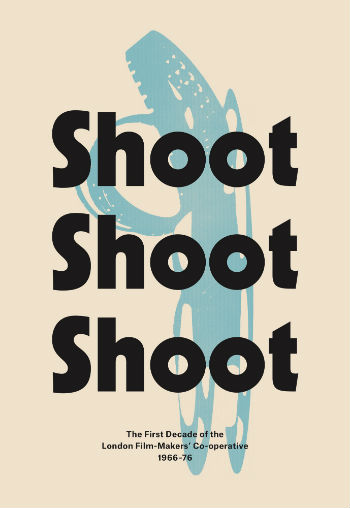
SHOOT SHOOT SHOOT / Soft Floor, Hard Film Celebrating 50 Years of the London Film-Makers’ Co-op ICA, London

sss-front-cover-shop

SHOOT SHOOT SHOOT / Soft Floor, Hard Film
Celebrating 50 Years of the London Film-Makers’ Co-op

ICA, London
Thursday 13 October 2016, 7:00pm
Tickets are available via ICA, £5 or free for ICA members

To mark the 50th anniversary, to the day, since the founding of the London Film-makers’ Co-operative (LFMC), LUX launches a new publication at ICA: Shoot Shoot Shoot: The First Decade of the London Film-Makers’ Co-operative 1966-76, edited by Mark Webber (now available for pre-order here).

Organised in conjunction with Frieze Video and the ICA’s Artists’ Film Club, the evening will feature a newly commissioned short film about the LFMC, produced by Frieze in collaboration with artist and writer Matthew Noel-Todd, who will also chair a discussion with Mark Webber, Malcolm Le Grice and Lis Rhodes on the organisation’s early ideals and ongoing legacy. The panel will be followed by a special presentation of Lis Rhodes’ seminal expanded cinema piece Light Music (1975-77).

The 1960s and 1970s were a defining period for artists’ film and video, and the LFMC was one of its major international centres as an artist-led organisation that pioneered the moving image as an art-form across the UK. Shoot Shoot Shoot: The First Decade of the London Film-Makers’ Co-operative 1966-76documents its beginnings, tracing its development from within London’s counterculture towards establishing its own identity within premises that uniquely incorporated a distribution office, cinema space and film workshop.

Shoot Shoot Shoot began as a major survey of the first decade of the London Film-Makers’ Co-operative, curated by Mark Webber and organised by LUX in 2002. Consisting of 8 programmes of single screen films, double projections and expanded cinema, it premiered at Tate Modern in May 2002 and then toured internationally to 19 cities worldwide over the next two years, heralding a resurgence of interest in the historic work of British filmmakers. A smaller touring programme in 2006-08 accompanied a DVD release of 13 films. For the LFMC’s 50th anniversary in 2016, an exhibition of archival documents, also titled Shoot Shoot Shoot, was on display at Tate Britain from April to July 2016.

(1971) The Train Rolls On Chris Marker Le Train En Marche (1971)

First the eye, then the cinema, which prints the look….

“If Chris asked you to do something you did it: There was no question”, recalls Marc Karlin in one of his last interviews before his death in 1999.  ‘Chris’, needless to say, was Chris Marker, Karlin’s friend who he called ‘le maitre’. The task was to provide an English version of Marker’s recent film Le train en marche (1971) – a celebration of the Soviet era filmmaker Alexander Medvedkin and his mythical ‘kino-poezd’ – a ‘cine train’ re-fitted with cameras, editing tables and processing labs, that travelled the breadth of Russia to make films for and with the workers. Films made on the spot, in collaboration with the local people, (workers in factories, peasants in kolhozs), shot in one, day, processed during the night, edited the following day and screened in front of the very people who had participated to its making… Contrarily to the agit-prop trains which carried official propaganda from the studios to the people, here the people was his own studio. And at the very moment bureaucracy was spreading all over, a film unit could go and produce uncensored material around the country. And it lasted one year (1932)!

This train that pulled out of Moscow January 25th 1932… 

Medvedkin saw his kino-poezd (294 days on the rails, 24,565m of film projected, 1000km covered) as a means of revolutionising the consciousness of the Soviet Union’s rural dwellers. Marker hoped his recent unearthing would incite similar democratic film-making. In tribute, Karlin and other kindred spirits in London joined Cinema Action.” There was a relationship to the Russians. Vertoz, the man and the movie camera, Medvedkin, and his agitprop Russian train; the idea of celebrating life and revolution on film, and communicating that. Medvedkin had done that by train. SLON and Cinema Action both did it by car. Getting a projector, putting films in the boot, and off you went and showed films – which we did”.

The people were brought the filmmaker’s cinema, in the same way they were brought the artist’s art and the expert’s science. But in the case of this train the cinema was to become something created with contact through the people and was to stimulate them to make their own intervention.

…the train of revolution, the train of history has not lacked reverse signals and switched points but the biggest mistake one could make was to believe that it had come to a halt.

Screen Shot 2016-05-18 at 16.52.05Screen Shot 2016-05-18 at 16.52.19Screen Shot 2016-05-18 at 16.52.43

A big thanks you to Espaço Sétima Arte for posting this great find.

https://grunes.wordpress.com/2007/12/23/the-train-rolls-on-chris-marker-1971/

The Last Bolshevik by Chris Marker

http://www.film-philosophy.com/index.php/f-p/article/viewFile/206/204

Click to access mayer.pdf

Marc Karlin – Look Again edited by Holly Aylett published by @LivUniPress

CSkDz-iWIAA7fxn


“a meticulously researched treasure of a book.”

“This is a volume not only to read but also to experience with almost tactile pleasure.” 

Giovanni Vimercati, Film Comment – September/October 2015

“…what Ezra Pound called an ‘active anthology’ – a book that sets ideas in motion, and establishes a complex network of internal cross-references, concerning Karlin and his ideas, images, politics, collaborators and films.”

“...the future of Channel 4, whose existence owes so much to the campaigning activities of Karlin and his colleagues in the Independent Filmmakers Association in the 1970s and early 1980s, lies in doubt due to the government’s apparent privatisation plans. In tackling the issues of how to protect Channel 4’s remit and how to make films in a hostile funding climate, the current generation could learn a very great deal from Marc Karlin.”

Ieuan Franklin (Bournemouth University)Journal of British Cinema and Television, Volume 13, Issue 2, April, 2016

“Overdue reader on British independent filmmaker and advocate Marc Karlin”.

Artist’s Moving Image Publications of the Year, 2015 LUX Artist Moving Image

Marc Karlin – Look Again. Edited by Holly Aylett. Available here

Watch the Marc Karlin Collection here