Cinema Action – Struggles of the Sixties and Seventies: A Film Festival at Marx Memorial in collaboration with Platform Films

Between 1968 and 1981, the London-based collective Cinema Action produced numerous “socialist campaign films,” on themes including housing, workers’ rights and international questions. A selection of these films will be shown at Marx Memorial Library’s Main Hall on Saturday afternoons in the coming months. The films themselves carry a unique, contemporary perspective of the class struggles of this era. For only £5 per session, participants can watch original archive films and take part in an informed discussion with a guest chair.

The first screening will take place on Saturday January 30th 2016 at 3pm:

A short silent campaign piece called “White Paper” will be shown, alongside two longer films, “Fighting the Bill” and “Arise Ye Workers.”

White Paper” deals with the Labour government’s proposal to reduce the power of Trade Unions, titled “In Place of Strife,” and uses animation and stills to argue against the suggested plan.

After that, “Fighting the Bill” details the overwhelming trade union movements campaigning against the Conservative government’s 1971 Industrial Relations Act. The film sets the struggle in the context of the time, when international disdain with capitalism was increasing, and when trade unions in Britain had to push back once again against threats of state suppression. The film uses historical footage and interviews to demonstrate the will of working people in 1971 to oppose such a bill. “Arise Ye Workers” also deals with the same Act but instead follows the dockworkers’ fight against redundancy and wage cuts caused by containerisation. The film moves from the struggles against land speculation and profiteering, to police harassment of pickets, and finally to the arrest of the Pentonville Five after the enforcement of the Industrial Relations Act, which led to the TUC calling a general strike. After successful demonstrations of solidarity with those arrested, the Act was effectively dismantled, showing the power of the working class. This film showcases notable historical footage of police harassment and dockers successfully convincing Fleet Street printworkers to strike with them.

Carolyn Jones, from the Institute of Employment Rights, will chair the discussion and analysis of these films.

Subsequent events will follow each month:


  • Saturday February 27th at 3pm: Showing of “The UCS Struggle,” a film about workers fighting to retain their jobs at Upper Clyde Shipyards, and “Class Struggle – Film from the Clyde,” a documentary made about the occupation and work-in at the same Shipyard from July 1971 to October 1972.
  • Saturday March 26th at 3pm: Showing of “GEC1,” a short supporting GEC Merseyside stewards calling for factory occupation; “Vauxhalls,” a partly animated short film against the introduction of Measured Day Work at the company, and “The Miners’ Film,” which documents the industrial action of miners in the winter of 1973-4 that altered the political landscape by helping to bring down Edward Heath’s Conservative government.
  • Saturday April 30th at 3pm: Showing of “Not a Penny on the Rents,” a campaign film opposing GLC attempts to raise council rents which includes footage of tenants’ demonstrations; “Squatters,” a film that shows support for squatters in various London boroughs resisting eviction by private landlords, and “Hands off Student Unions,” which documents students’ struggle to preserve the autonomy of their union from state control under Thatcher.
  • Saturday May 28th at 3pm: Showing of “People of Ireland,” a full-length documentation of the 1969 self-declared autonomous area of Free Derry, including interviews with militants, community leaders, ministers and unemployed workers.
  • Saturday June 25th at 3pm: “Viva Portugal,” a full-length film tracing the first year of the Portuguese Revolution, including the effects the revolution had on the people and the infrastructure of Portugal.

The MML is keen to develop its facilities to host events like this. Donate to our audiovisual fundraising appeal – we need £700 for a new projector and screen.

For information on these film events and other lecture, evening classes and book sales, please see MML website:

http://marx-memorial-library.org.uk/education/upcoming-events

Preserve film culture and its history, preserve art, support Close-Up!

5864

Support independent cinema film culture! An appeal from Close-Up cinema. Preserve film culture & history, preserve art, support!

“It is very important for me that those fragments of beauty, of paradise, are brought to the attention of friends and strangers equally.” – Jonas Mekas

In July 2015 we opened our independent state-of-the-art 40-seat cinema, film library and resource centre with the help of your continuous support. Thanks to you all who came and watched films on the big screen, used and discovered the wonders of our library, and expressed in so many different ways your love for our work!

Our ever-expanding library’s unique collection of over 19,000 titles covers the whole spectrum of film history and the moving image. Our film programmes explore the history of the medium from early to auteur cinema and contemporary artists’ films. And whilst all other cinemas are converting to digital only, we continue to offer the opportunity to see films as filmmakers intend them to be screened, on 35mm and 16mm prints as well as high quality digital projection.

At Close-Up we pride ourselves on presenting a distinctive programme of films otherwise rarely seen or unavailable in London. However, as the means of accessing and watching films have dramatically changed over the last decade, with the ever growing expansion of new technologies, we see a risk in the future of access to film culture, its exhibition and the general quality of programming.

We believe that if independent resources such as Close-Up were to disappear from London’s cultural landscape, it is a fundamental access to film history, culture and its unfathomable diversity that would be lost. Our commitment and dedication to present in-depth and uncompromising programmes to general audiences makes Close-Up a difficult if not impossible resource to replace.

The absence of funding means that our relentless work and passion cannot survive the bulldozing of culture by corporate entertainment and the growing complacent acceptance of poorer & more limited ways of watching films. The rumour that everything is available on the net is a myth, carefully curated programmes are becoming a rarity, and London more than ever needs serious resources like Close-Up.

“We must support these spaces and I cannot believe how they are disappearing in London. London is an important capital of culture it is not only a culture of capital.” – Jem Cohen

via Close-Up

BIMI presents Screenings and discussion: Jean-Luc Godard: Out-takes from a Retrospective, Feb 27

godard-season-page-01

Screenings and discussion: Jean-Luc Godard: Out-takes from a Retrospective

Michael Witt and Michael Temple, curators of the Jean-Luc Godard season at the BFI January-March 2016, will present and show a range of material that did not make it into the main retrospective. This will include a selection of trailers made by Godard for his own films, and several documentaries made about Godard at different moments of his long and eventful career (titles to be confirmed):

  • Le Parti des choses: Bardot et Godard, Jacques Rozier, 1963, 10 minutes
  • Paparazzi, Jacques Rozier, 1964, 22 minutes
  • One to One: Jean-Luc Godard Speaks, Mike Dibb, 1968, 10 minutes
  • Jean-Luc Godard in America, Ralph Thanhauser, 1970, 45 minutes
  • Godard 1980, Jon Jost and Donald Ranvaud, 1980, 17 minutes
  • Godards Kameramänner, Michael Klier, 1981, 20 minutes
  • François Musy on Sound, Direct Sound, Godard, Larry Sider, 2003, 40 minutes
  • Marcel Ophuls & Jean-Luc Godard: The Meeting in St Gervais, Frédéric Choffat and Vincent Lowy, 2011, 44 minutes.

Godard’s work of the past six decades has consistently innovated, provoked and inspired. His vast and varied output includes short films, video essays, self-portraits, commercial commissions, TV films and series, books, a major exhibition, and 35 features. Born in 1930, and active as a critic from 1950, his level of creativity remains undimmed: his 2014 foray into 3D, Adieu au langage, is as fresh and inventive as anything he made since his landmark features of the 60s, his TV work of the 70s and his video essays of the 80s and 90s. This retrospective offers a wonderful opportunity to take stock of Godard’s achievement to date, and to consider his feature films anew within the context of his output as a multifaceted poet of word, image and sound.

Michael Witt is Professor of Cinema at the University of Roehampton and author of Jean-Luc Godard, Cinema Historian. Michael Temple is Reader in Film and Media at Birkbeck and co-editor of several books on Godard

To attend this event, please visit: https://www.eventbrite.co.uk/e/bimi-presents-screenings-and-discussion-jean-luc-godard-out-takes-from-a-retrospective-tickets-19967768132


BETWEEN TIMES: MARC KARLIN WEEKEND Fri 4 – Sun 6 March 2016 AV Festival, 2016

Whataboutsocialism

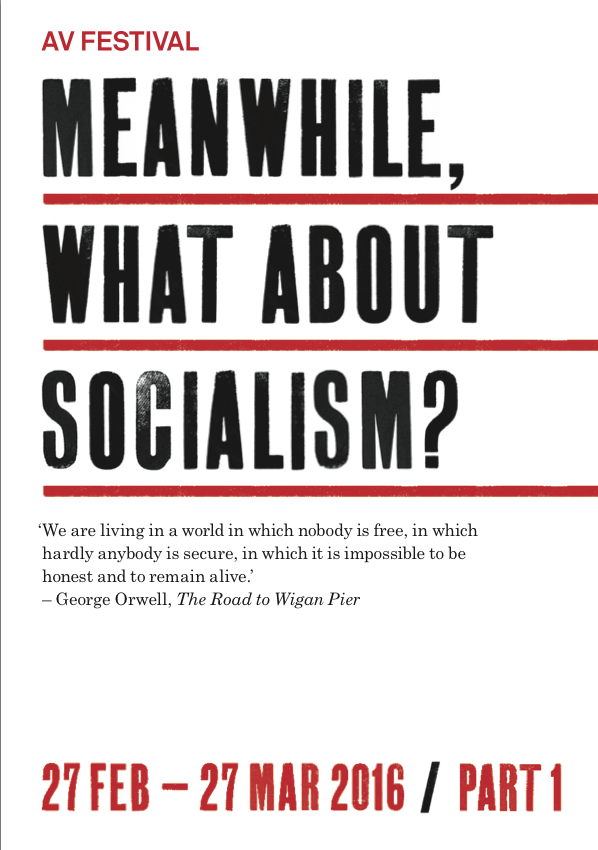
AV FESTIVAL 2016: MEANWHILE, WHAT ABOUT SOCIALISM?
Sat 27 February – Sun 27 March 2016

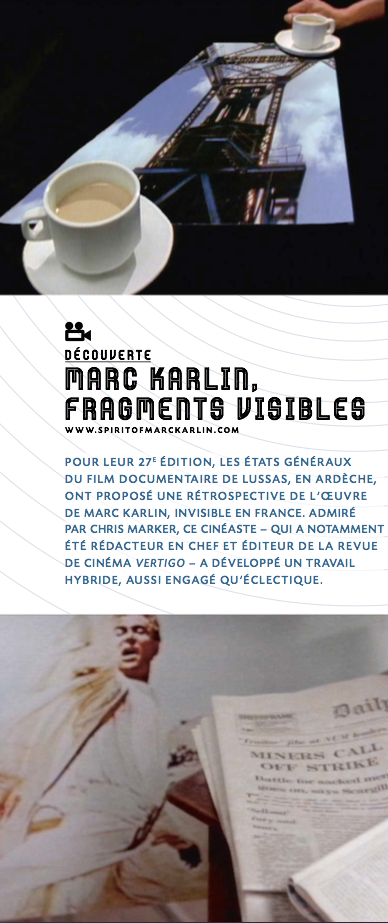
This weekend includes screenings of eleven films by Marc Karlin including talks and discussions in collaboration with the Marc Karlin Archive.

In the 1980s–90s Karlin’s work was persistent in its questioning of the future of the British Left. It takes us on journeys through socialism, political change and cinema itself, critiquing both Thatcherism and Blair’s New Labour. Undeterred by these fundamental societal shifts and the crippling confusion affecting the Left, Karlin invested himself in the continued exploration of socialist themes.

On his death in 1999, Karlin was described as Britain’s most significant, unknown filmmaker. Present in Paris around the events of May 1968 and inspired by the work of Chris Marker, Karlin submerged himself into London’s newly formed independent film collectives. Although informed by an international perspective, most of Karlin’s work focuses on the UK. An exception was the remarkable series of five films on the Nicaraguan revolution, presented in full here on Sun 6 March.

A Film Pass is available with special discounted tickets for all the weekend screenings. AV Festival


Meanwhile, What About Socialism? – AV Festival 27 Feb- 27 Mar/Part 1, 2016

AV FESTIVAL 2016: MEANWHILE, WHAT ABOUT SOCIALISM?
Sat 27 February – Sun 27 March 2016

Whataboutsocialism

Socialism was the most looked-up word in 2015. Largely attributable to the popularity of US presidential candidate Bernie Sanders and the rise of Jeremy Corbyn to the leadership of the Labour Party, it reflects a year of political alternatives becoming reality.

George Orwell’s polemical book The Road to Wigan Pier is the thematic framework for the next two editions of AV Festival. Eighty-years ago in 1936, Orwell was commissioned by the Left Book Club to write on the depressed areas of the North of England and spent two months living in the industrial North. The book is his account of working-class life amidst growing social injustice, poverty, unemployment and class division. The experience clarified his ideas about socialism, concluding that the basis for a democratic socialism is equality and fairness.

Mirroring the structure of the book the 2016 edition of the Festival is Part One followed by Part Two in 2018, representing a new way of curating a biennial Festival. AV Festival 2016 initiates this approach, presenting work by artists and filmmakers who situate themselves in relation to historic and contemporary political struggle, revolution and social movements, creating new forms of resistance to neoliberal capitalism.

Festival Director: Rebecca Shatwell, AV Festival


Lunds konsthall – Our Work Exhibition – January 23–May 1, 2016

95e08_9101_16847097f3ba77a51f6c77dcfabadc5b

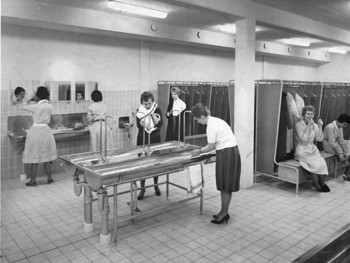
Michala Paludan, Cyclus, 2016. Image from Malmö City Archive: Suell Factory 1962.

Artists: Maja Bajević, Berwick Street Film Collective, KP Brehmer, Revital Cohen & Tuur Van Balen, Jeuno Kim, Michala Paludan, Esther Shalev-Gerz, Mladen Stilinović, Oliver Walker

Lunds konsthall is very happy to be able to present Our Work, an exhibition that investigates how work organises our existence and defines our characters. Today salaried work determines not only the working time; contemporary work creates roles and modes of being that have a deep impact also on what may be called leisure, values, life. The exhibition reflects how work regulates how we live but also how it may be used as a political tool.

The exhibition title, Our Work, references the history of Lunds konsthall. In 1978 a group exhibition with this title was produced, but then the emphasis was on the worker’s body and the perspective mainly Swedish. In 2016, Our Work incorporates two points of view: that of contemporary reality and that of the 1970s. The exhibition moves between the dichotomy that dominated the Cold War period and today’s globalised outlook, between the pioneers of women’s liberation and contemporary feminist consciousness.

There is a long tradition in art of depicting and influencing how we work. Here nine rather different artists are brought together, each with a specific approach to the theme of work. Some of their works are ongoing projects, which started before this exhibition and will continue after it is over.

Lunds konsthall wishes to first thank all the artists for their extraordinary works and our excellent collaboration. We also warmly thank all the lenders for their generous contributions to the exhibition, among them Sebastian Brehmer at KP Brehmer Sammlung und Nachlass in Berlin, Galerie Peter Kilchmann in Zurich, René Block in Berlin and Galerie nächst St. Stephan in Vienna. We also thank the Labour Movement’s Archive in Malmö and the City Archives of Lund and Malmö. Special thanks to Inter Arts Center in Malmö.

Berwick Street Film Collective, active in 1970–78 in London, consisted of Marc Karlin, 1943–99, and James Scott, born in 1941. The film Nightcleaners was a collaboration with Mary Kelly, born in 1941, and Humphry Trevelyan, born in 1944; KP Brehmer, born in 1938 in Berlin and died in 1997 in Hamburg; Revital Cohen, born in 1981 in Jerusalem and Tuur Van Balen, born in 1981 in Leuven, works in London; Jeuno Kim, born in 1976 in Seoul, works in Berlin and Malmö; Michala Paludan, born in 1983 in Copenhagen, where she also works; Esther Shalev-Gerz, born in 1948 in Vilnius, works in Paris; Mladen Stilinović, born in 1947 in Belgrade, works in Zagreb; Oliver Walker, born in 1980 in Liverpool, works in Berlin.

Via e-flux

LUX’s Artists’ Moving Image Publications of the Year 2015 – Marc Karlin – Look Again

Screen Shot 2015-12-16 at 11.02.5041401_original-2

Marc Karlin – Look Again, edited by Holly Aylett. Book published by Liverpool University Press.

‘Overdue reader on British independent filmmaker and advocate Marc Karlin’.

Artist’s Moving Image Publications of the Year, 2015

Many thanks to LUX Artist Moving Image

State of the Estate II – Chris Marker

The good folk at chrismarker.org have provided an brief update to the on going acquisition of the Chris Marker estate by the Cinémathèque française. Captured in an interview between journalist Louis Guichard and the Cinémathèque’s head Serge Toubiana, focusing on the Cinémathèque’s current project with Jacques Demy’s archive, Toubiana provides a little glimpse inside the Marker collection.

Chris Marker atelier with Guillaume by Agnès Varda

Here’s the excerpt that fills in some details to the already reported State of the Estate, back in June. You can follow Serge Toubiana’s blog at blog.cinematheque.fr.

L’acquisition d’archives payantes est-elle une option ?

[…]

Il y aussi le cas de Chris Marker, qui n’a pas fait de testament. Au cours des dernières années de sa vie, il était logé chez Costa-Gavras, président de la Cinémathèque, et il avait dit qu’il laisserait une lettre précisant ce qu’il voulait faire de ses archives. Mais on n’a rien trouvé de tel. A sa mort, il y a donc eu un inventaire sommaire et une recherche de descendance qui a identifié six personnes au 5e et 6e degrés… Nous leur avons fait une proposition qui a été retenue et nous avons acquis le fonds pour 40 000 euros. Nous nous sommes trouvés face à une sorte de gigantesque foutoir avec des lots énormes de photos, de négatifs, de disques durs, d’ordinateurs, tout le travail qu’il faisait sur Second Life, des centaines de petits objets, de collages, de journaux… Il gardait tout. Mais qu’en faire ? C’est un travail considérable. Nous avons constitué une équipe en interne chargée de poursuivre l’inventaire et de travailler sur le fonds numérique. De plus, un comité scientifique se réunit régulièrement. Comment montrer l’arborescence de cette œuvre hybride? Chris Marker était un média à lui tout seul. Peut-être faudra-t-il associer des ingénieurs à cette réflexion… Il y aura sans doute un événement Marker à la Cinémathèque en 2017 ou 2018.Serge Toubiana, interviewed by Louis Guichard, “Serge Toubiana : “Le don des archives Demy à la Cinémathèque est un geste de confiance et d’amitié”, www.telerama.fr

        ROUGH ENGLISH TRANSLATION

       Is paying for archival acquisitions an option?

[…]

There is also the case of Chris Marker, who did not create a will. In the course of the last years of his life, he was living with Costa-Gavras, President of the Cinémathèque, and he had said that he             would leave a letter specifying what he wished to do with his archives. But nothing like this was found. With his death, a summary inventory took place, along with research into his heirs that identified six persons removed by 5 or 6 degrees… We made them a proposition that was agreed upon and we acquired the estate for 40,000 Euros. We found ourselves faced with a sort of gigantic shambles, with enormous stacks of photos, negatives, hard drives, computers, all the work that he conducted in/on Second Life, hundreds of small objects, collages, journals… He kept everything. But what to do with it? It’s a considerable piece of work. We put together a team internally, charged with pursuing the inventory and working on the digital archive. In addition, a scientific committee meets regularly. How to present the tree structure of this hybrid work? Chris Marker was a media [enterprise] unto himself. Perhaps it will be necessary to have engineers consider this reflection… There will be without a doubt a Marker event at the Cinémathèque in 2017 or 2018.

Via chrismarker.org Many Thanks.