Category: News
(Read) Cinéma Militant Political Filmmaking and May 1968

This history covers the filmmaking tradition often referred to as cinéma militant, which emerged in France during the events of May 1968 and flourished for a decade. While some films produced were created by established filmmakers, including Chris Marker, Jean-Luc Godard, and William Klein, others were helmed by left-wing filmmakers working in the extreme margins of French cinema. This latter group gave voice to underrepresented populations, such as undocumented immigrants (sans papiers), entry-level factory workers (ouvriers spécialisés), highly intellectual Marxist-Leninist collectives, and militant special interest groups. While this book spans the broad history of this uncharted tradition, it particularly focuses on these lesser-known figures and works and the films of Cinélutte, Les groupes medvedkine, Atelier de recherche cinématographique, Cinéthique, and the influential Marxist filmmaker Jean-Pierre Thorn. Each represent a certain tendency of this movement in French film history, offering an invaluable account of a tradition that also sought to share untold histories.
Chris Marker’s Description d’un Combat (1960) trailer
Winner of the Golden Bear at the Berlin Film Festival, Marker’s documentary film, Description d’un combat/Description of a Struggle, examines the condition and circumstances of the young state of Israel and its citizens. The film was made at the time when the Israeli state was 12 years old, and borrows its title from Kafka’s short story It explores the historical, social, cultural and ethical contexts at the heart of Israel’s existence, and the impact of the tragic and not so distant past on the collective psyche of the nation.
Read more from Boris Trbic ‘s article on Senses of Cinema
Chris Marker prevented the broadcast description of a fight a few years after his shooting. In his article “The film hidden by Chris Marker,” published in Cahiers du Cinema from October 2013 (. No. 693, p 59), Ariel Schweitzer believes that this decision is probably for political reasons; He writes in 1967, Israel no longer represents this utopia which attracted Marker in the early 1960s, during which time he also went to China and Cuba to search for models of alternative society.
Large Door – a fantastic look into early Channel 4 programming

Large Door was founded in 1982 by Keith Griffiths, Simon Hartog and John Ellis as an independent production company to make programmes for the then new Channel 4. Large Door’s first commission was for Visions, an adventurous series of 15 programmes about world cinema. Visions eventually ran for 32 episodes until 1985, and subjects included a history of cinema in China, the work of Jan Svankmajer, contemporary cinema in Africa. Visions reported from the Cannes and Ouagadougou festivals and commissioned shorts from filmmakers including Chantal Akerman and Marc Karlin. Keith Griffiths left the company in 1984, but continued to make occasional films about cinema through Large Door including shorts on Raul Ruiz and the opening of the Frankfurt Film Museum.
First Part of Marc Karlin’s extraordinary Nicaragua series – Nicaragua Part 1: Voyages (1985)
Monday 14 October 1985, 10.00-10.50pm on Channel Four
With current speculation about the future of the Sandinista government in Nicaragua – under constant pressure from Washington – these four documentaries offer timely insights into the country and its situation. They were made by British independent Marc Karlin and commissioned for The Eleventh Hour, but have now been given a slightly earlier Monday slot.
Tonight’s opening programme looks at Nicaragua through the testimony and the photographs of American Susan Meiselas, hailed as the star photographer of the world-renowed Magnum agency, who became personally involved with the Sandinista forces while capturing their revolution on film. Between 1978 and 1979 she was in Nicaragua where she photographed the two revolutionary insurrections which led to the overthrow of the Somoza family, who for 50 years had led the dictatorship of the country. Her photographs were the means by which many people glimpsed what the Nicaraguan people were experiencing as the revolution developed.
Voyages which is in the form a letter written to the filmmakers by Susan Meiselas, also examines the inherent contradictions which inevitably result from being an outsider in the middle of someone else’s political struggle.
Writer: Susan Meiselas
Prod/dir: Marc Karlin
Prod co: Lusia Films
Commissioning editor: Alan Fountain, Independent Film and Video Department
Text taken from Channel Four’s Press Packs – read more here
Marc Karlin in Marker’s Studio
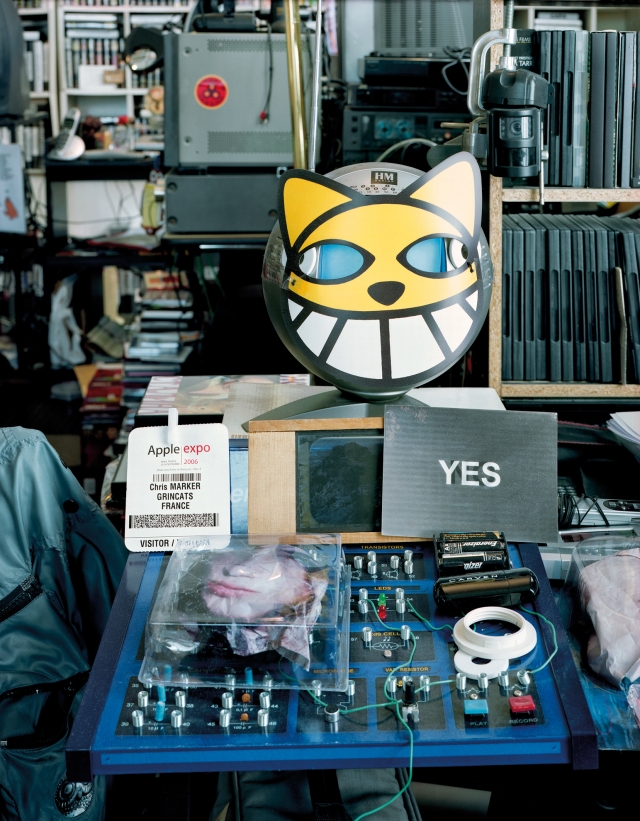
Marker Studio, 2007 © Adam Bartos
“Chris had a garage, a huge studio with drainpipes all across it. It was vast, and he put these little rolls of films all along the drainpipes, and then divided it onto countries, so you had Columbia, Peru, Cuba, Africa and so on. I entered this garage to find all these films from all these countries: the whole world was there. Right at the end there was Chris Marker on a platform with his editing table, and he looked like God. You had to walk past these films to reach him and sit down”.
Marc Karlin, (1999)
Looking at Class. Film, Television and the Working Class in Britain, S, Rowbotham & H, Beynon, (Rivers Oram Press:2001)
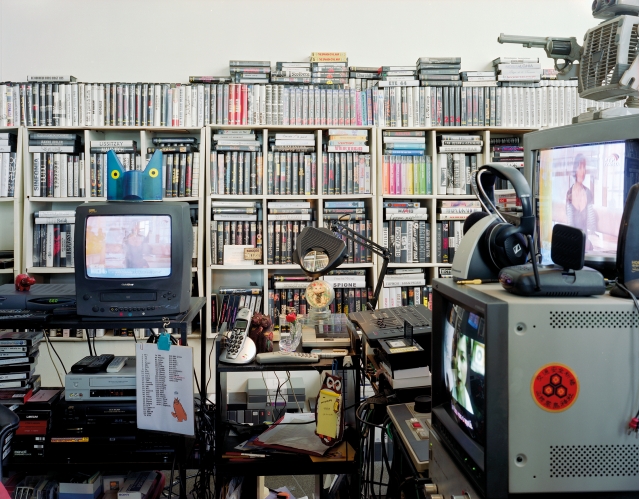
Marker Studio, 2007 © Adam Bartos
Colin MacCabe Visits the Atelier (or when Colin MacCabe visited Chris Marker)
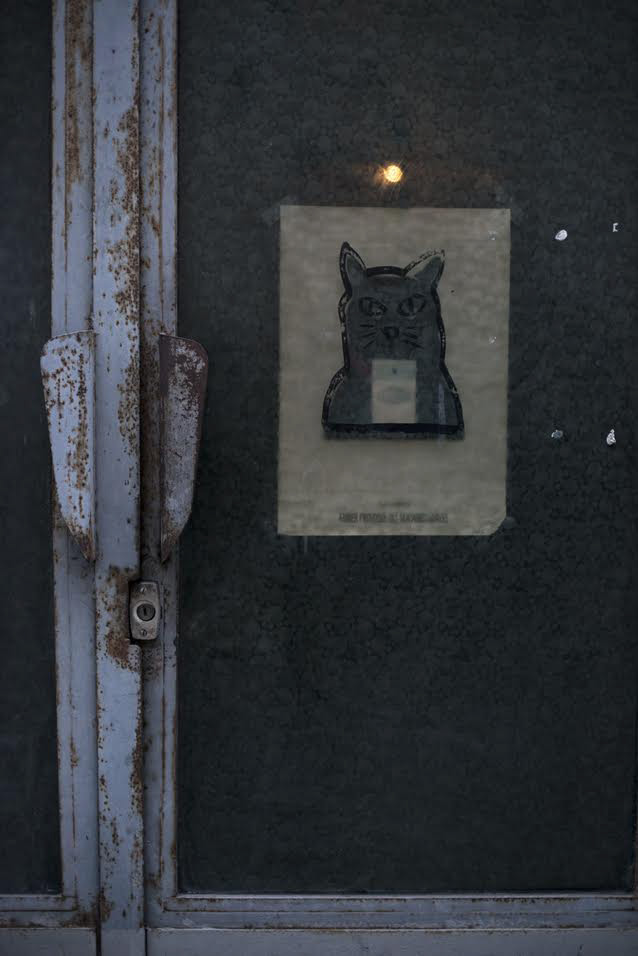
Marker Studio Front Door, 2008 © Adam Bartos
It was early 2002 and people still used answering machines rather than mobile phones. The recording clicked in and an extraordinary voice that sounded as if it had been mechanically produced asked the caller to leave a message “if you have something interesting or amusing to say”. I was already nervous that I was cold calling Chris Marker, legendary recluse and indeed general artistic legend. My anxiety intensified and I started to stutter out my message. “I am in Paris and I have a VHS copy of a film called The Magic Face and…” The receiver was picked up (I learned later that Chris screened all his calls) and a very human voice said, “You are the Messiah”. I have never been more startled by any single sentence addressed to me.
If I was the Messiah then John the Baptist was Tom Luddy. It was a few days earlier that I had seen Tom in Berkeley and asked him if he could get me an introduction to Marker. “I have the perfect calling card”, he said. “Chris has been looking for a copy of a film called The Magic Face for 50 years and I have just found a poor VHS copy. Here – deliver it.” And deliver it I now did. Marker said that he would be in the Latin Quarter, where I was living, the next Tuesday but his enthusiasm for the film was so overpowering that I insisted that I would bring it immediately to him. His instructions were both precise and disorienting. I had to go to a Metro station I had never heard of, cross under a disused railway I had never seen, walk down a narrow street, the rue Courat, find a huge house with an array of bells and names. Then I was to choose the bell without any name and ring three times.
The Metro was Maraichers and over the next decade I was to come to know it and that part of the 20th arrondissement well. No tourist has ever set foot there and it corresponds to none of the conventional pictures of Paris but with its completely mixed and relatively poor population it is as good an image of contemporary France profonde as you can find. But that first day it was terra incognita. As I stood at the door of the house I wondered if I had wandered into a parallel universe.
Of course I had and in time I would feel at home there. But, for now, I felt extremely uncomfortable and slightly terrified as I waited for the door to open. Everybody knew Marker’s name (although Marker wasn’t his real name) but unlike almost any other twentieth century name there was no accompanying image. I had no idea what to expect. Suddenly, bounding down the steps came what at very first impression was a huge and agile monkey. Indeed I wouldn’t have been surprised if there had been a long and bushy tail to go with the completely bald head. Certainly he bounded back up the stairs with long agile leaps leaving me, thirty years his junior, toiling in his wake.
And then we were in his studio …
Colin MacCabe, http://www.orbooks.com
Studio: A Remembrance of Chris Marker

Published by OR Books
Photographs by Adam Bartos. Text by Colin McCabe. Introduction by Ben Lerner.
Adaptations: Patience (After Sebald) 16 December 2016 @closeupcentre
Tickets: £10 / £8 conc. / £6 Close-Up members
Box Office: 02037847975
Gareth Evans presents a special screening to mark the 15th anniversary of the untimely death of WG Sebald with readings by his close friend, poet Stephen Watts. Evans will be in conversation with director Grant Gee following the screening.
Patience (After Sebald)
Grant Gee
2012 | 83 min | Colour & B/W | Digital
A richly textured essay film on landscape, art, history, life and loss, Patience (After Sebald) offers a unique exploration of the work of internationally acclaimed writer W.G. Sebald via a walk through East Anglia tracking his most influential book, The Rings of Saturn. Grierson award winning filmmaker Grant Gee directs the first film about Sebald, with contributions from major writers, artists and film-makers including Tacita Dean, Robert Macfarlane, Sir Andrew Motion, Rick Moody, Iain Sinclair and Marina Warner, with a haunting soundtrack by acclaimed composer and sound artist The Caretaker.
Kindly supported by Soda Pictures.
More info:
www.sodapictures.com
via Close-Up
Marc Karlin Collection – Available on Vimeo On Demand
The Marc Karlin film collection available now on Vimeo On-Demand.
Marc Karlin (1943 – 1999)
On his death in 1999, Marc Karlin was described as Britain’s most significant, unknown filmmaker. For three decades, he was a leading figure within Britain’s independent film community, actively contributing to opening up television through Channel 4. He was a founding member of the Berwick Street Film Collective; a director of Lusia Films, a key influence in the Independent Filmmakers Association, and a creative force behind the group that published the independent film magazine, Vertigo (1993-2010)
His groundbreaking films for television in the 1980s and 1990s combine documentary and fiction film conventions to explore the themes of memory, history and political agency. Karlin was a committed political filmmaker, and his dense, yet subtle films are rich meditations on the nature of filmmaking, the impact of ideologies on political choice and formations, and the necessity for rigorous, open interpretation to safeguard the future of the creative, human spirit.
He filmed his way through three decades of huge change, wrestling with the challenges of Thatcher’s free market economics; the demise of manufacturing; the imagining of socialist ways forward after the fall of the Berlin Wall; the role of art in society and the shape-shifting impact of digital technologies: all key concerns relevant to our world today.
This collection consists of the films broadcast on Channel 4 from 1985 to 1997, predominately commissioned by Alan Fountain Senior Commissioning Editor at Channel 4’s Independent Film and Video Department (1981–1994). Although informed by an international perspective, most of Karlin’s work focuses on the UK. An exception was the remarkable series of five films on the Nicaraguan revolution encompassing the popular guerrilla war of the late 1970’s, the development of the Sandinista government, the effects of the US-backed contra war, and the defeat of the FSLN in 1989. Rather than foregrounding the Sandinista leadership, the films speak from the grassroots, both urban and rural. This rare perspective portrays a revolution for what it is – an exhausting, uneven process.
Le Mystère de l’atelier quinze (1957) – Alain Resnais et André Heinrich
A documentary film about occupational diseases shot in 1957 at the Francolor factory in Oissel.
It takes the form of a scientific investigation to discover the origin of a mysterious illness that has infected a worker at the factory

Scénario : Chris Marker et Rémo Forlani
Réalisateur : André Heinrich et Alain Resnais
Avec Jean Burgot, Jean-Pierre Grenier, Yves Péneau
 marckarlin