Category: Uncategorized
RETURN TO NICARAGUA – The process of revolution through Marc Karlin’s remarkable documentary series

Marc Karlin Archive with Open City Docs, supported by University College London’s Institute of the Americas, presents:
RETURN TO NICARAGUA
The process of revolution through Marc Karlin’s remarkable documentary series
Free screenings, panels and dialogues
Fri 21 – Sun 23 November 2014
UCL, Darwin Building, Gower Street, London, WC1E 6BT
Nearest tube: Euston Square/Russell Square
35 years on from the Sandinista revolution, a very rare opportunity to view one of the most committed documentary projects of the late twentieth century in its entirety – Marc Karlin’s Nicaragua series (1985/1991).
International guests, including world-renowned photographer Susan Meiselas, and Nicaraguan journalist Carlos Fernando Chamorro, offer first hand testimony together with Karlin’s film-making team:cinematographer Jonathan Bloom, former Channel 4 Commissioning Editor, Alan Fountain, researcher Hermione Harris and editor Monica
Henriquez.
Friday 21st
19.00 Welcome – Hermione Harris
Nicaragua Part 1: Voyages (1985)
20.15- 21.00 Q&A with Susan Meiselas
Saturday 22nd
09.30 Tea and Coffee
10.00 Introduction by Andy Robson
10.15 Nicaragua Part 2: The Making of a Nation (1985) (80mins)
11.45 Q&A with Jonathan Bloom.
12.30 Lunch
13.30 Nicaragua Part 3: In Their Time (1985) (70mins)
14.40 Nicaragua Part 4: Changes (1985) (89mins)
16.10 Break
17.00-18.30 Platform 1: Revolution and Memory. Chaired by Holly Aylett,
with Jonathan Bloom, Carlos Fernando Chamorro, Alan Fountain, Hermione
Harris, Monica Henriquez and Susan Meiselas.
Sunday 23rd
10.00 Scenes For A Revolution (1991) (110mins)
12.00–13.30 Platform 2: Open discussion. Chaired by Holly Aylett
with guest speakers.
To book your place
http://www.eventbrite.co.uk/e/return-to-nicaragua-the-process-of-revolution-through-marc-karlins-remarkable-documentary-series-tickets-13024537743
Marc Karlin (1943-1999)
On his death in 1999, Marc Karlin was described as Britain’s most significant, unknown film-maker. For three decades, he had been a key figure within Britain’s independent film community; he was a founding member of the influential seventies collective, the Berwick Street Film Collective; a leading player in the Independent Filmmakers Association, which played a critical role in opening up television through Channel 4, and a founding member of the group that published the independent film journal, Vertigo, (1993 – 2010).
Marc Karlin: Look Again, focusing on Karlin’s twelve essay documentaries between 1980 –1999, will be published by Liverpool University Press in Spring 2015. This is one of the outputs of The Marc Karlin Archive, set up by Holly Aylett, fellow documentarist and founder member of Vertigo; anthropologist, Hermione Harris, partner of Marc Karlin, and film archivist, Andy Robson. Since 2011, the Archive has organised and preserved Marc Karlin’s film and paper archive, and introduced new audiences to his work through events and screenings.
Please contact Andy Robson, Film Archivist at the Marc Karlin Archive
for more details.

Icarus Films Presents: On Strike!: Chris Marker and The Medvedkin Group
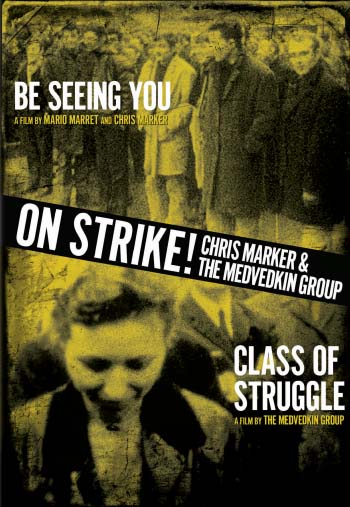
In 1967, Chris Marker and Mario Marret filmed BE SEEING YOU (À BIENTÔT J’ESPÈRE), about a strike and factory occupation-the first in France since 1936-by textile workers in the city of Besancon, the goals of which were unusual because the workers refused to disassociate their salary and job security demands from a social and cultural agenda.
Nevertheless when the film was completed, and the filmmakers returned to screen it for the workers in Besancon, many of them were not happy with it. LA CHARNIERE, the audio recording of their intense debate after the screening, is included on this disc as an extra, accompanied by photographs of the film workshops, shot by Ethel Blum.
In response Marker and his colleagues reorganized their efforts, and began training workers to collaboratively make their own films, under the name “The Medvedkin Group”, after Alexander Medvedkin, who invented the cine-train, a mobile production unit that toured the USSR in 1932 filming workers and farmers. CLASS OF STRUGGLE, their first film, picks up a year later and focuses on the organizing efforts of workers at a nearby watch factory, particularly the story of one recently radicalized woman, Suzanne Zedet. She articulates the radical scope of the workers’ demands, which include access to the tools of cultural production.
76 minutes / b&w
French
Release: 2014
Copyright: 1969
Praise for A BIENTOT, J’ESPERE:
“Terrific!” —Professor Ellen Furlough, History Dept., University of Kentucky
“Effectively places us in the middle of the strike and offers intriguing insights into the motives of the workers and organizers…” —New York Magazine
Praise for CLASS OF STRUGGLE:
“One of the finest examples of the politically engaged French documentary cinema of the late Sixties. “—Sam DiIorio, Film Comment
“Fluent, energetic, and wide-ranging!” —Catherine Lupton, Chris Marker: Memories of the Future
“One of the great films of May of 1968.” —Paul Douglas Grant, Directory of World Cinema: France
“[The Medvedkin Group] would go on to make nearly a dozen films, some of them stunningly beautiful, most notably CLASS OF STRUGGLE.” —Min Lee, Film Comment
Werner Herzog’s favourite English footballers (excerpt from The Southbank Show)
The legendary German director picks his three favourite English footballers.
1. Bobby Charlton – “The man is a genius, who brought football back to it’s very basic simplicity”.
2. Nobby Stiles – “What a character he was”.
3. Glenn Hoddle – “If you want to see an earthquake in the stadium, just go and see him play”.
The full Werner Herzog South Bank Show documentary (directed by Jack Bond) is included on the BFI’s deluxe THE WERNER HERZOG COLLECTION box set – released July 2014.
via BFI.
LEVEL FIVE Trailer – New Restoration by Icarus Films
The Sixth Side of the Pentagon (La sixième face du Pentagone) + Far from Vietnam (Loin du Vietnam) + Introduction by Kodwo Eshun
Barbican 7.30pm 13 May 2014 Cinema 2/ Introduction by Kodwo Eshun

On October 21 1967, over 100,000 marchers assembled in Washington D.C. for the Mobilization to End the War in Vietnam protest. It was the largest anti-war gathering yet, bringing together a wide cross-section of liberals, radicals and hippies. For many, this marked the transition from simple anti-war demonstration to direct action that aimed to stop the war machine. Chris Marker was there with a camera.
France 1968 Dir Chris Marker 28 min
During the chilling and feverish year of 1967, an international collective of world-renowned filmmakers (including Jean-Luc Godard, Joris Ivens, William Klein, Claude Lelouch, Alain Resnais and Agnès Varda) came together in a spirit of bonhomie and common purpose to make this profoundly unapologetic anti-war film, which captured the mood of events to come in 1968.
France 1967 Dirs Jean-Luc Godard, Joris Ivens, William Klein, Claude Lelouch, Chris Marker, Alain Resnais, Agnès Varda 115 min
In collaboration with Whitechapel Gallery and Ciné Lumière. The Whitechapel hosts the first UK retrospective gallery exhibition of his work.
Chris Marker: A Grin Without a Cat – Curator’s Introduction, Whitechapel Gallery
Chris Marker is co-curated by Christine van Assche, Chief Curator, Centre Pompidou, Paris, writer and film critic Chris Darke, and Whitechapel Gallery Chief Curator Magnus Af Petersens.
Symposium: Chris Marker: In Memory, Part 1, Saturday 10th May
Holly Aylett will be introducing extracts from Marc Karlin’s For Memory (1982) in the Whitechapel Gallery’s Symposium: Chris Marker: In Memory, Part 1, Saturday 10th May – a series of presentations, screenings and discussions respond to the theme of memory, illustrating how the concept is interwoven throughout Marker’s life and work, providing new approaches to understanding Marker’s practice.
Class of Struggle (1969)
Cinema is not a magic.
It is a technic and a science.
A technic born from a science and set to a will.
Will that have the workers to release themselves.
In 1967, Chris Marker and Mario Marret (under the aegis of SLON) produced À BIENTÔT J’ESPÈRE, which documented a strike and factory occupation—the first in France since 1936—by textile workers at the Rhodiaceta textile plant in Besançon, the goals of which prefigured many of the demands that would come to define May 1968.
via Icarus Films
Riddles of Marc Karlin and the Motion Analyser Projector
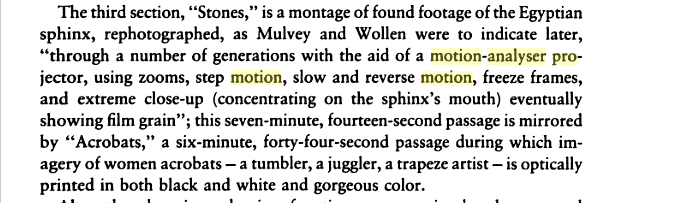
Here is a fascinating excerpt from the audio commentary track on the British Film Institute’s Dual Format Edition of Riddles Of The Sphinx (Laura Mulvey and Peter Wollen, 1977). In this sequence, Mulvey recalls the technique of re-filming found footage material using a motion analyser projector borrowed from Marc Karlin while he was filming 36′ to 77′ (known then as Nightcleaners Part 2) with the Berwick Street Film Collective.
 Via www.studycollection.org.uk
Avant-Garde Film: Motion Studies by Scott MacDonald (Cambridge Film Classics:1993)
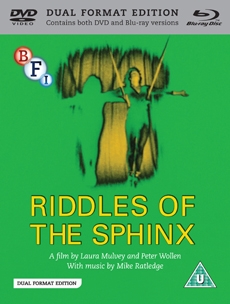
Laura Mulvey and Peter Wollen’s visually accomplished and intellectually rigorous Riddles of the Sphinx is one of the most important avant-garde films to have emerged from Britain during the 1970s. The second collaboration between Mulvey and Wollen, both of whom are recognised as seminal figures in the field of film theory, Riddles of the Sphinx explores issues of female representation, the place of motherhood within society and the relationship between mother and daughter. Composed of a number of discrete sections, many of which are shot as continuous circular pans, the film takes place in a range of domestic and public spaces, shot in locations which include Malcolm LeGrice’s kitchen and Stephen Dwoskin’s bedroom. BFI
This exclusive extract was produced by Catherine Grant for the scholarly website FILM STUDIES FOR FREE with the kind permission of Laura Mulvey and the BFI in September 2013.
Icarus Films acquires Chris Marker’s LEVEL FIVE
April 09, 2014, New York: ICARUS FILMS today announced its acquisition of all North American distribution rights, including theatrical, non-theatrical, home entertainment, and television rights, to the LEVEL FIVE (106 minutes), Chris Marker’s 1996 feature film about a female video game developer, computer networks, and the Battle of Okinawa, in a new restoration.
While working on a game about the Battle of Okinawa, Laura, played with quiet intensity by Catherine Belkhodja, becomes increasingly drawn into her work and fascinated by the WWII battle that took place there, in which 150,000 Japanese were killed, many by suicide.
An elaborate, colorful patchwork of mesmerizing, pixelated images, fiction sequences with Belkhodja, archives, history, interviews (including with the Japanese director Nagisa Oshima), and quasi-science fiction, LEVEL FIVE prefigures the legendary auteur’s fascination with digital worlds, which he also explored in installations, interactive CD-ROMs, and later, digital platforms.
ICARUS FILMS plans a long-awaited LEVEL FIVE U.S. theatrical premiere release later this summer 2014 at BAMcinématek in New York, followed by a consumer DVD and digital release for home entertainment audiences. 
The deal for North American distribution was negotiated by Jonathan Miller for Icarus Films and Florence Dauman of Argos Films (Paris, France).
LEVEL FIVE joins eighteen other films by Chris Marker that are distributed by Icarus Films, including LE JOLI MAI, FAR FROM VIETNAM, A GRIN WITHOUT A CAT, and ONE DAY IN THE LIFE OF ANDREI ARSENEVICH.
Via Icarus Films.
The Marc Karlin Archive Marker

We are pleased to unveil the Marc Karlin Archive logo, designed by Yossi Bol.
 marckarlin