Tagged: Marc Karlin
Vagrancy and drift: the rise of the roaming essay film

Freedom and possibility … a still from Grant Gee’s Patience (After Sebald) from 2011
by Sukhdev Sandhu. The Guardian, Saturday 3 August 2013
For years the essay film has been a neglected form, but now its unorthodox approach to constructing reality is winning over a younger, tech-savvy crowd.
For a brief, almost unreal couple of hours last July, in amid the kittens and One Direction-mania trending on Twitter, there appeared a very surprising name – that of semi-reclusive French film-maker Chris Marker, whose innovative short feature La Jetée (1962) was remade in 1995 as Twelve Monkeys by Terry Gilliam. A few months earlier, art journal e-flux staged The Desperate Edge of Now, a retrospective of Adam Curtis‘s TV films, to large audiences on New York’s Lower East Side. The previous summer, Handsworth Songs (1986), an experimental feature by the Black Audio Film Collective Salman Rushdie had once attacked as obscurantist and politically irrelevant, attracted a huge crowd at Tate Modern when it was screened shortly after the London riots.
Marker, Curtis, Black Audio: all have made significant contributions to the development of an increasingly powerful and popular kind of moving-image production: the essay film. Currently being celebrated in a BFI Southbank season entitled The Art of the Essay Film – curated by Kieron Corless of Sight and Sound magazine – it’s an elusive form with an equally elusive and speculative history. Early examples proposed by scholars include DW Griffith’s A Corner in Wheat (1909), Dziga Vertov’s Man with a Movie Camera (1929) and Jean Vigo‘s A Propos de Nice(1930), but some of its animating principles were identified in a key text, “The Film Essay” (1940) by the German artist Hans Richter, which called for documentaries “to find a representation for intellectual content” rather than merely “beautiful vistas”.
Essay films, unlike conventional documentaries, are only partly defined by their subject matter. They tend not to follow linear structures, far less to buttonhole viewers in the style of a PowerPoint presentation or a bullet-pointed memo; rather, in the spirit of Montaigne or even Hazlitt, they are often digressive, associative, self-reflexive. Just as the word essay has its etymological roots in the French “essai” – to try – essay film-makers commonly foreground the process of thought and the labour of constructing a narrative rather than aiming for seamless artefacts that conceal the conceptual questions that went into their making. Incompletion, loose ends, directorial inadequacy: these are acknowledged rather than brushed over.
Aldous Huxley once claimed an essay was “a literary device for saying almost everything about almost anything”. Essay films exploit this freedom and possibility, exulting in the opportunity to avoid the hermetic specialisation that characterises much academic scholarship, and to draw on ethnography, autobiography, philosophy and art history. A case in point is Otolith I (2003) by the Turner prize-nominated Otolith Group, whose co-founder Kodwo Eshun will deliver a keynote speech at BFI Southbank: it uses the mass demonstrations against the second Iraq conflict in London as an occasion to think about political collectivity, and deploys an elusive, eerily compelling compound of science fiction, travelogue, epistolary writing and leftist history to do so.
This roaming or tentacular approach to structure can be seen as a kind of territorial raid. Or perhaps essay film-makers are aesthetic refugees fleeing the austerities and repressions of dominant forms of cinema. It’s certainly striking how many essay films grapple with landscape and cartography: Patrick Keiller‘s London (1994) uses a fixed camera, a droll fictional narrator named Robinson and near-forensic socio-economic analysis to explore the “problem” of England’s capital; Los Angeles Plays Itself (2003) is an extraordinary montage film by Thom Andersen in which, sampling almost exclusively (unlicensed) clips from 20th-century cinema and with drily damning commentary, he critiques representations of his home city.
Essay films sometimes exhibit a quality of vagrancy and drift, as if they are not wholly sure of what they want to say or of the language they need to say it, which may stem from their desire to let subject matter determine – or strongly influence – filmic form. Here, as in the frequent willingness to blur the distinction between documentation and fabulation, the essay film has much in common with “creative non-fiction”. The literary equivalents of Hartmut Bitomsky, director of a mysterious investigation of dust, and Patricio Guzmán whose Nostalgia for the Light (2010) draws on astronomy to chart the poisonous legacies of Pinochet‘s coup d’etat in Chile, are writers such as Sven Lindqvist, Eduardo Galeano and Geoff Dyer. Perhaps it’s no coincidence that one of the most celebrated modern creative non-fiction authors was the subject of an equally ruminative, resonant essay film – Grant Gee’s Patience (After Sebald) (2011).
Essay film-makers – among them the Dziga Vertov Group (whose members included Jean-Luc Godard and Jean-Pierre Gorin) or the brilliant Santiago Álvarez – are often motivated by political concerns, but their work is never couched in the language of social realism or the journalistic dispatch. It is never purely utilitarian and is more likely to offer invitations to thought than clarion calls for action: Godard and Gorin’s Letter to Jane (1972) decodes at length a single still photograph of Jane Fonda on a trip to Vietnam; Black Audio Film Collective’sHandsworth Songs proposes that behind the blaring headlines of riot footage in the British media there lie the “ghosts of other stories”; Harun Farocki‘s Images of the World and Inscription of War (1988) explores the interplay of technology, war and surveillance. Essay films can be playful, but even when they are serious – as these three are – their approaches, at once rigorous and open-ended, are thrilling rather than pedagogic.
Just as literary critics used to lament that critical theory was taken more seriously in France than in the UK, the renown of essayists such as Marker, Godard and Agnès Varda (whose The Gleaners and I, a witty and moving meditation on personal, technological and socio-political obsolescence is a masterpiece) has served to obscure the range and history of British contributions to the genre: the sonically exploratory, surrealism-tinged likes of Basil Wright’s Song of Ceylon (1934) and Humphrey Jennings’s Listen to Britain (1942); Mike Dibb and John Berger’s Ways of Seeing (1972), which bears the imprint of Bertolt Brecht and Walter Benjamin; BS Johnson’s self-deconstructing Fat Man on a Beach (1973); Derek Jarman‘s exquisitely crepuscular Blue (1992), in which the director talks about and through his fading eyesight; and Marc Karlin’s resonant disquisition about cultural amnesia in For Memory (1986).
Some of these films started life on television, but these days it is the gallery sector that is more likely to commission or screen essay films, which are attracting ever more sizable audiences, especially younger people who have been weaned on cheap editing software, platforms such as Tumblr and the archival riches at YouTube and UbuWeb. Visually literate and semiotically savvy, they have tools – conceptual as well as technological – not only to critique and curate (moving) images, but to capture and assemble them. Having grown up in the era of LiveJournal and Facebook, they are also used to experimenting with personal identity in public; RSS feeds and news filters have brought them to a point where the essay film’s fascination with investigating social mediation and the construction of reality is second nature. It could well be that the essay film – for so long a bastard form, an unclassifiable and barely studied hybrid, opaque even to cinephiles – is ready to come into its own.
Sans Soleil – Chris Marker (30th Anniversary Trailer)
‘Utopias’ – Part 1. Opening Sequence A/V Script

Utopias’ Treatment ©The Marc Karlin Archive
(Music) Edward Elgar-Cello Concerto in E minor

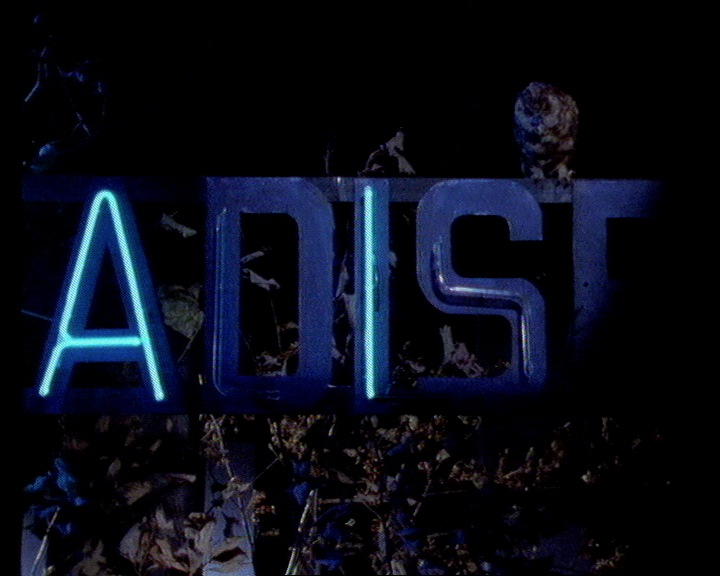
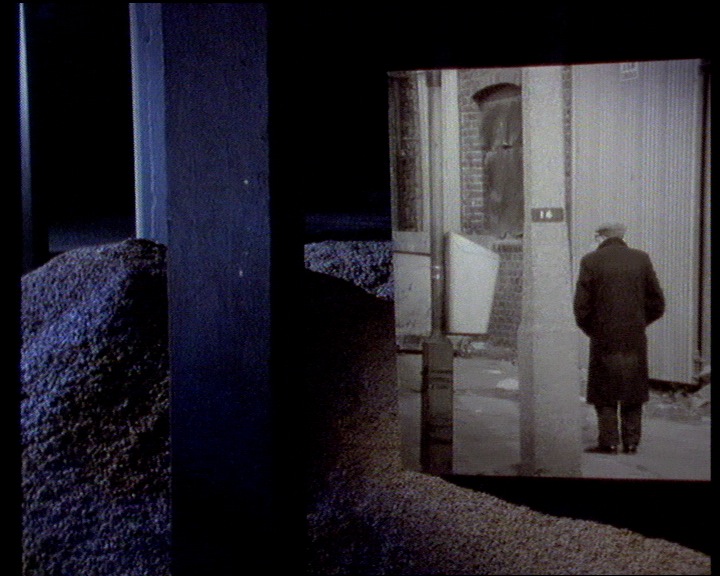
V/O (Archive) Socialism is a very attractive idea and could remain a very attractive idea so long as there were not many,at best none, socialist governments.


V/O (Archive) If you begin to tamper with economic freedom, you find it doesn’t work very well, therefore you have to go further and impose further controls on the economic activities in order to get the result you want. And in doing that you run up against increasing resistance from ordinary people and in order to beat down that resistance you have to limit their political freedoms too.
V/O (Archive) It is hard to access the damage the welfare state has done in Britain to the spirit of independence and social conventions that impel people to overcome their own poverty.
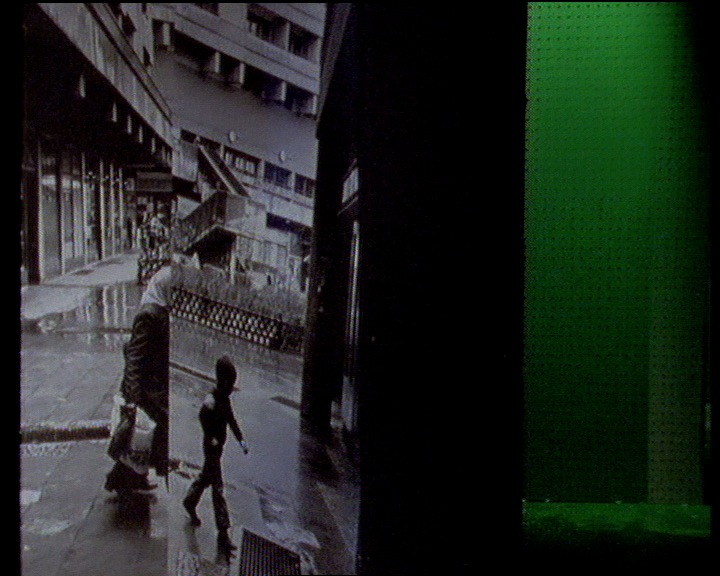


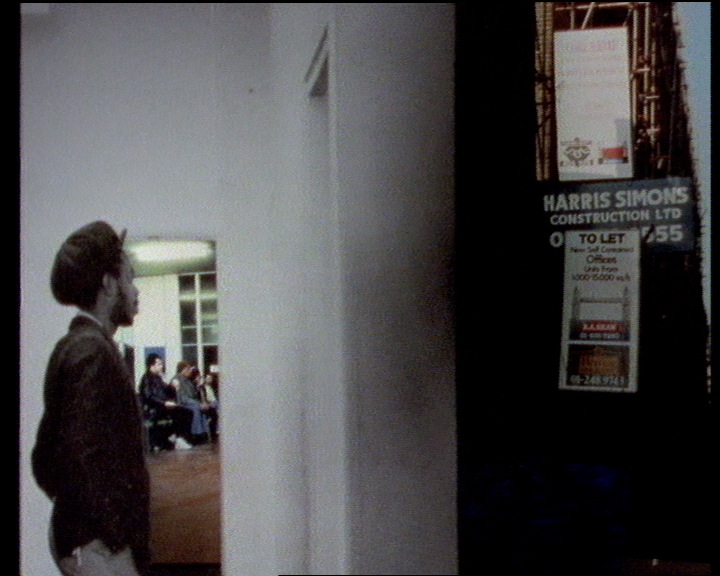
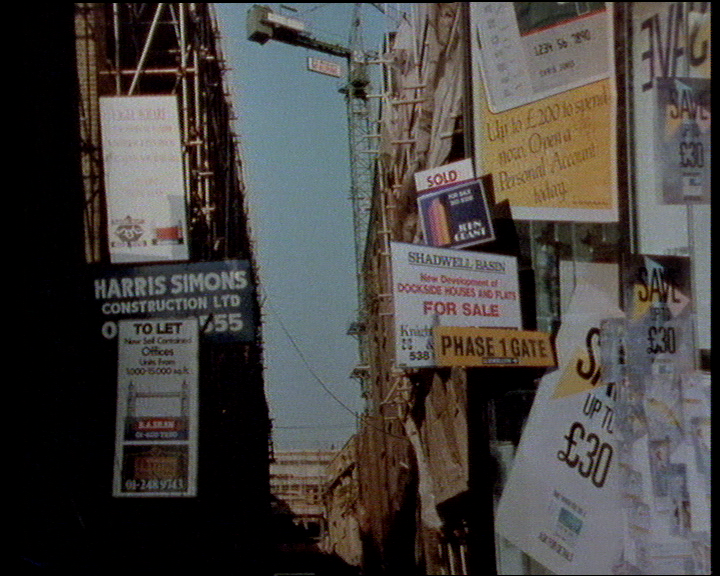


V/O (Marc Karlin) The one crisis Socialists were not able to predict was their own. Socialism once thought of being inevitable is now replaced as a socialism that is remote, at best half remembered. Unable to state confidently a vision of the future, yet in the name of renewal and adaptation, impatient to shed its past.
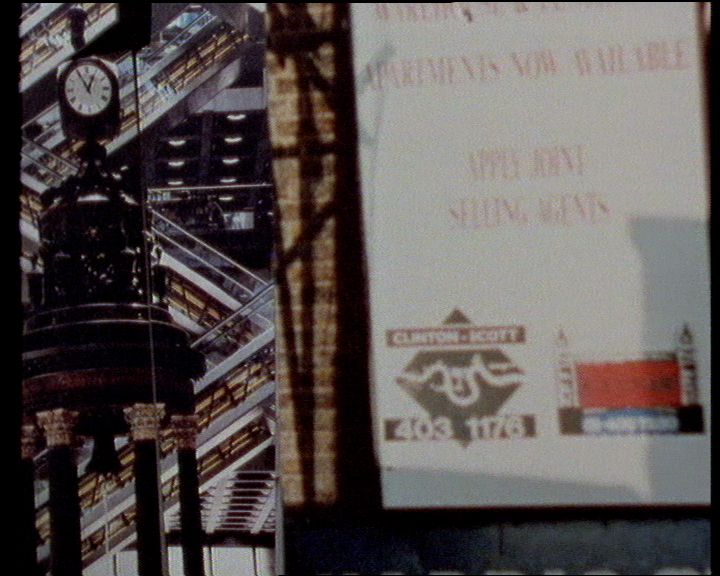
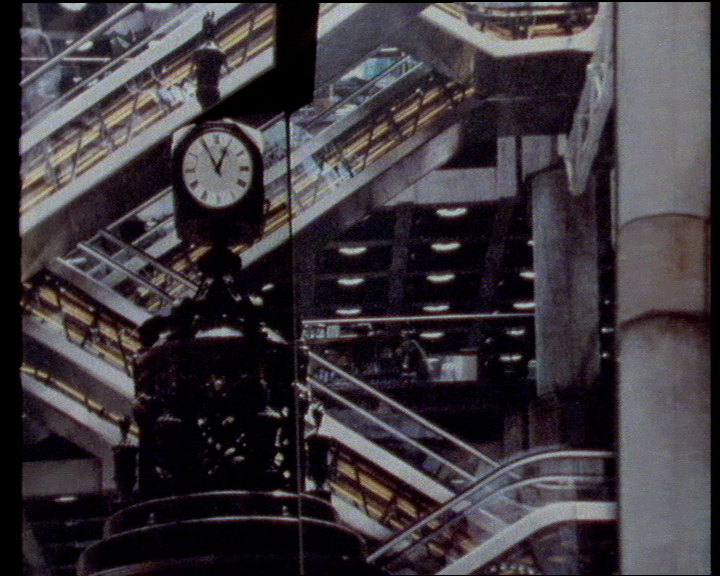


V/O (Marc Karlin) Everyone speaks about socialism as if we all know what it is – for it or against it. When people are saying farewell to socialism, this is a film about what it is they are saying farewell to, a series of portraits of individuals and their ideas one might encounter on a journey through the life of socialism in Britain today.

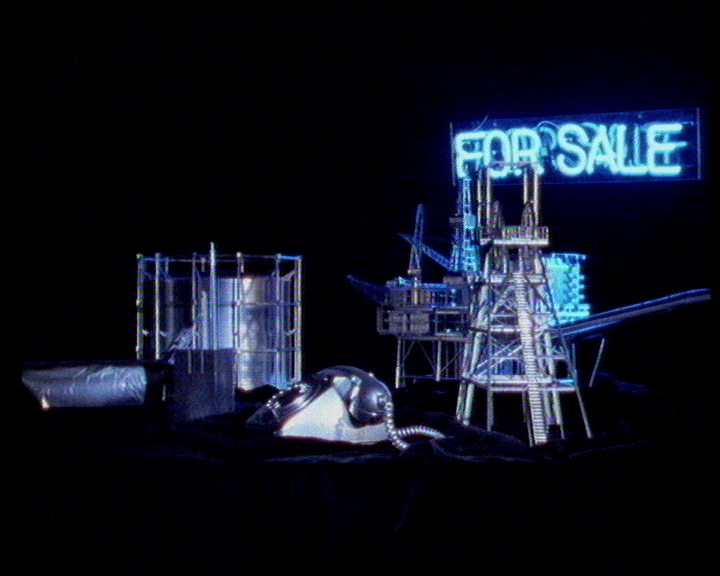


V/O (Marc Karlin) The film is not about definitions it is more an invitation to see whether there is still a place for the word us in the current political vocabulary.
Channel 4 broadcast ‘Utopias’ on Monday 1st May 1989 at 10.45pm.

Chris Marker: Marc 2
In a post last year, I traced the lost history of Marc Karlin’s collaborations with Chris Marker. It is over a year since Marker’s death and in tribute, stirred by the BFI’s Film Essay season in August, here is a collection of Marker related videos. Firstly, a visual essay from Criterion exploring the soundscape of Chris Marker’s 1962 landmark La Jetée, written by Michael Koresky of Reverse Shot.
Codirected by Frank Simeone and John Chapman, Junkopia was filmed at the Emeryville Mudflats outside of San Francisco while Chris Marker was also shooting the Vertigo sections of Sans Soleil.
Toute la mémoire du monde (1956) is a 20 minute bout of archive fever administered by Alain Resnais. Resnais takes us behind the scenes of the Bibliothèque nationale de France in Paris, conceiving a key theme of the film essayist; the fragility of memory and the need to remember. In the opening credits Marker, a man of many aliases, is introduced as Chris the Magic Marker – that most democratic of public writing tools as Finn Burton puts it in Future Anterior,
That Resnais documentary follows one book into the Bibliothèque Nationale and thence into the hands of a reader, and the book happens to be one of the Petite Planète series of travel books, a series founded and edited (1954–58) by Marker. ‘Not a guidebook,’ Marker promised, ‘not a history book, not a propaganda brochure, not a traveller’s impressions, but instead equivalent to the conversation we would like to have with someone intelligent and well-versed in the country that interests us.’ Perhaps, then, something like the letters Sandor Krasna sends from his travels to his unnamed correspondent (voiced with limpid calm by Alexandra Stewart) in Sans-soleil (1983). Marker did much of the graphic design and layout work for the series as well, and every cover was a different picture of a woman, some looking away and lost in their own thoughts, others gazing into the camera, reserved and enigmatic. In Remembrance of Things to Come (2001), Alexandra Stewart, speaking again on behalf of Marker, says of the work of Denise Bellon, ‘Being a photographer means not only to look but to sustain the gaze of others.’ ‘Have you heard of anything stupider’, she says, quoting a letter of Krasna’s from Fogo in the Cape Verde islands, ‘than to say to people, as they teach in film schools, not to look at the camera?’ There is a woman, gazing slightly off-camera, on the cover of the Petite Planète edition (#25) that has arrived for cataloging in the Resnais film. Her hair is in an elegant black bob, she wears a simple black garment; the book, its title announces, is a traveller’s guide to Mars. She is perhaps the first of Marker’s many characters who address us, unexpectedly, from the future. They look back on our present moment and, in doing so, transform it, as we now transform the past, our memories, our recordings. (‘I wonder how people remember things who don’t film, don’t photograph, don’t tape.’)
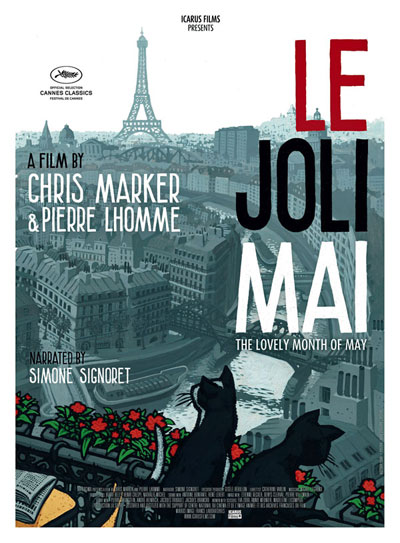
In April Icarus Films announced its acquisition of all North American distribution rights to Chris Marker and Pierre Lhomme’s landmark 1963 film Le joli mai. This film had been unavailable for many years and it is now newly restored. It will be screened at several major film festivals and premiered in New York at Film Forum on September 13, 2013, presented in DCP, made from a new 2K scan. The restoration work on Le joli mai was done according to the wishes of Chris Marker and supervised by Pierre Lhomme, the film’s cinematographer and co-director. First off is Lhomme commenting on the restoration process, followed by the new trailer.
LE JOLI MAI is a portrait of Paris and Parisians shot during May 1962. It is a film with several thousand actors including a poet, a student, an owl, a housewife, a stockbroker, a competitive dancer, two lovers, General de Gaulle and several cats. Filmed just after the March ceasefire between France and Algeria, LE JOLI MAI documents Paris during a turning point in French history: the first time since 1939 that France was not involved in any war. Icarus Films
In Sight & Sound’s glorious celebration of the life and work of Chris Marker last year (Vol. 22 Issue 10 Oct 2012), a number of filmmakers, including Jem Cohen, Thom Anderson, Patrick Keiller, Chris Petit, Sarah Turner and Kodwo Eshun, paid tribute to the man. The US filmmaker John Gianvito proclaimed that any filmmaker who has ventured into the film essay territory in the past 55 years owes a great debt to Marker, and befittingly includes Marc Karlin. Introduced to Karlin’s work by Marker, Gianvito states Karlin is in need of the same recovery Marker bestowed the Soviet filmmaker Alexander Medvedkin.

John Gianvito’s most recent ouput is the collective film Far From Afganistan (2012), made with filmmakers Travis Wilkerson, Jon Jost, Minda Martin and Soon-Mi Yoo. The film is clearly inspired by Loin Du Vietnam (Far from Vietnam) (1967), a collaboration between Alain Resnais, Claude Lelouch, Jean-Luc Godard, William Klein, Joris Ivens, and Agnès Varda, conceived as an outcry against the Vietnam War. Marker edited together William Klein’s films of pro- and anti-war protests in New York, Joris Ivens’ own North Vietnam footage; additional material by Agnès Varda and Claude Lelouch and Resnais and Godard’s self-contained sequences. From this prototype, Far From Afghanistan mixes fictional narrative, found footage and reportage in response to a protracted war that remains far from the collective consciousness. Here are both trailers, side by side. (Look out for Marker’s owl in Far From Afghanistan).


Next is a video postcard Agnes Varda made for her friend Chris Marker presented at the Rencontres de la Photographie in Arles in 2011 and her glimpse inside Marker’s studio. Marc Karlin too describes Marker’s studio upon a visit around the editing period of Le Fond de l’air est rouge (1977).
“Chris had a garage, a huge studio with drainpipes all across it. It was vast, and he put these little rolls of films all along the drainpipes, and then divided it onto countries, so you had Columbia, Peru, Cuba, Africa and so on. I entered this garage to find all these films from all these countries: the whole world was there. Right at the end there was Chris Marker on a platform with his editing table, and he looked like God. You had to walk past these films to reach him and sit down”.
Last year in an article written for Sight & Sound, Patrico Guzman recalled his first meeting with Marker and recounts his debt of gratitude that he owes to his mentor while filming Because The First Year. Nine years before their first meeting, Guzman and Marker collaborated, from a distance (Guzman with camera and Marker on script) on Joris Iven’s film …A Valparaíso (1962).
In 1962 Joris Ivens was invited to Chile for teaching and filmmaking. Together with students he made … A Valparaiso, one of his most poetic films. Contrasting the prestigious history of the seaport with the present the film sketches a portret of the city, built on 42 hills, with its wealth and poverty, its daily life on the streets, the stairs, the rack railways and in the bars. Although the port has lost its importance, the rich past is still present in the impoverished city. The film echoes this ambiguous situation in its dialectical poetic style, interweaving the daily life reality (of 1963) with the history of the city and changing from black and white to colour, finally leaving us with hopeful perspective for the children who are playing on the stairs and hills of this beautiful town. ivens.nl
And finally… a glimpse of Christian François Bouche-Villeneuve, alias Sandor Krasna, alias Hayao Yamaneko, alias Kosinski, alias Guillaume-en-Egypte, alias Sergei Murasaki, alias Chris Marker…
Further Reading:
http://strangewood.tumblr.com/tagged/Chris%20Marker
http://www.fandor.com/blog/daily-chris-marker-1921-2012
http://www.filmcomment.com/article/chris-marker-the-truth-about-paris
http://www.criterion.com/current/posts/2246-cinematography-by-pierre-lhomme
Revolutions 10-13 A Certain Sensibility: Films from the English Underground

Featuring Richard Heslop, Marc Karlin and Derek Jarman.
This new exhibition draws together works from three strikingly independent filmmakers key to the radical trajectory of the post-1976 English underground movement. Connected by themes of left field personal politics, history and nationality, and marked by an intense visual sensibility, Richard Heslop, Marc Karlin and Derek Jarman developed work both technically original and aesthetically radical.
WEEK TWO: THU 13 – SAT 15 JUNE EXHIBITION & EVENTS PROGRAMME
– – – – – – – – – – – – – – – – – – – – – – – – – – – – – – – – –
Thu 13-Sat 15 June, 12-5pm daily
EXHIBITION // Marc Karlin
Described as one of the most significant unknown film-makers working in Britain during the past three decades, Karlin (1943 – 1999) was a central figure in the radical avant-garde of the 1970s and made a major contribution to the shaping of Channel 4. Newly digitised works are shown including Utopias (1989), For Memory (1986), and Between Times (1993) alongside a one-off screening of Nightcleaners (1975) on Saturday 15 June. Courtesy the Marc Karlin Archive.
Running Times:
Thu 13 & Fri 14 Jun, 12-5pm // Utopias (2h 15m) and Between Times (50m)
Sat 15 Jun, 12-2.15pm // Utopias (2h 15m) and For Memory (1h 44m)
—————————–
Sat 15 June, 2.15pm (admission £3 on the door)
SCREENING // Nightcleaners [dir: Berwick Street Collective, 1975, 90m]
A documentary about the campaign to unionise the women who cleaned office blocks at night and who were being victimised and underpaid. Nightcleaners is increasingly recognised as a key work of the 1970s and an important precursor, in both subject matter and form, to political art practice. Courtesy LUX.
Revolution 03. Oh to be in England – Vivid Projects, Birmingham (March 2013)
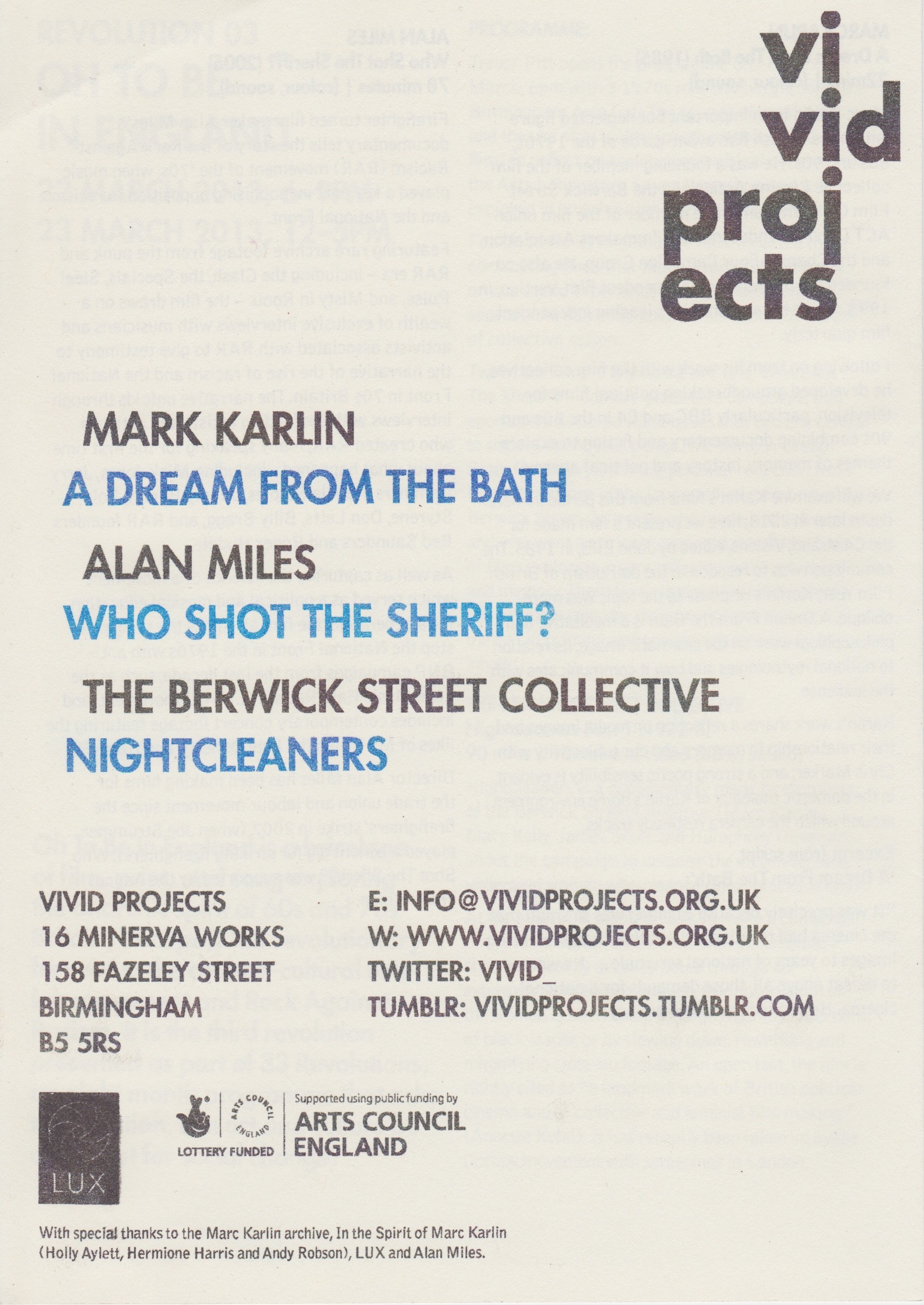
Following on from Vivid Project’s short introduction on Marc Karlin in March this year, three of Karlin’s films will be screened over a three days from tomorrow (13-15th June). Here is the flyer from the March event, promotional material for the June will be up soon.


A Time For Invention · A Symposium of Radical Filmmaking

Sheffield Hallam University Thursday, 13 June 2013 from 10:30 to 18:00 (BST) Sheffield, United Kingdom
“We want to make films that unnerve, that shake assumptions, that threaten, that do not soft-sell” Robert Kramer, ‘Newsreel’ Film Quarterly, Vol. 22, No. 2 (Winter, 1968-69), p.46, University of California Press
The late ’60s and ’70s saw the development of documentary film collectives in the UK that addressed the burning political issues of their day. They developed radical forms of independent film production and distribution prior to digital or the web and produced a large body of work, from short agitational cinetracts to sophisticated essayistic features.
The symposium seeks to re-ignite the work of this radical wave, to ask how they engaged with politics and film and how this might inform politically engaged filmmaking today. It will feature films, and filmmakers, from the ’70s generation alongside radicals of today.
Keynote Speaker: Federico Rossin (Critic and Curator)
Panelists include: Holly Aylett (Vertigo and ‘In the Spirit of Marc Karlin’ project) · Luke Fowler (Artist, Turner Prize Nominee 2012) · Lina Gopaul and David Lawson (Black Audio Film Collective/Smoking Dog Films) · Ann Gueddes (Founder of Cinema Action) · Dan Kidner (Writer and Curator, recently published ‘Working Together: Notes on British Film Collectives in the 1970s’) · Christine Molloy (Artist, Desperate Optimists) · David Panos (Artist, Jarman Award Winner 2011) · Steve Sprung (Cinema Action/Poster Film Collective/Lusia Films)
RELATED TICKETED SHEFFIELD DOC/FEST SCREENINGS:
Wednesday 12 June · 18:45 · Showroom 2
‘The Poor Stockinger, the Luddite Cropper and the Deluded Followers of Joanna Southcott‘ (2012) by Luke Fowler
Thursday 13 June · 20:45 · Sheffield Library Theatre
‘The Stuart Hall Project‘ (2012) by John Akomfrah
The symposium is supported by: Sheffield Hallam University, Sheffield Institute of Arts, Art and Design Research Centre, Sheffield Doc/Fest
Producers: Virginia Heath, Esther Johnson, Steve Sprung
Enquiries: k.a.christer@shu.ac.uk · +44 (0)114 225 6918
Links: https://twitter.com/time4invention ·http://www.shu.ac.uk/research/c3ri/events/a-time-for-invention
Maybe, she wrote to us… Nicaragua Part 1 – Voyages: The Posthumous Director’s Cut

Voyages (1985), the first part in Marc Karlin’s extraordinary Nicaraguan series, comprises of stills by the American photographer Susan Meiselas. Between 1978 and 1979, Meiselas captured the two revolutionary insurrections which brought the FSLN to power in Nicaragua, overthrowing the fifty year dictatorship of the Somoza family. The film is in the form of a letter, written by Meiselas to Karlin. Through her own words, the film interrogates the responsibility of the war photographer, the line between observer and participant, and the political significance of the photographic image.
The film is composed of five tracking shots, each approximately ten minutes in length. Shot in a studio by Karlin’s cinematographer, Jonathan Bloom, the camera glides slowly over Meiselas’ blown up stills, shifting focus between images in the background and foreground, allowing the editing to be achieved in camera. The mediative camera movement accompanying Meiselas’ words, creates a distance for the audience, reflecting the photographer’s own separation from the events she witnessed. The studio space was a form Karlin used repeatedly, layering his films with structured, contemplative intervals in between segments of exterior, vérité investigation. Inside the ‘dark chamber’ objects, figures and monitors bearing images are caught in a single shot, gradually revealed by the meandering camera movement. The studio acts as a immersive space of thought and pre-empts the installations and large scale multi-screen projections within the gallery space today.
A new cut of Voyages is now being shown at Iniva in a film programme curated by The Otolith Collective. When broadcast by Channel 4 in October 1985, the film drew criticism due to the fact that Meiselas’ words were narrated by a British actress, whose RP delivery lends the film an unwanted class distinction. A letter from the archive explains Karlin’s decision. Originally, Karlin wanted to narrate the film. This was strongly objected to by Alan Fountain, the commissioning editor of Channel 4’s The Eleventh Hour, on the grounds of feminist politics – it was a women’s experience therefore a woman should read it. Karlin disagreed, feeling that after the popular revolution, men and women should be able to work together, and not be seen as appropriating a women’s experience. Already having reservations about the possibility of sustaining a British audience’s attention at 10pm with 45 minutes of stills, Karlin’s own doubt unfortunately kicked in – would his voice bore the audience?
Karlin went back to the drawing board and produced three choices, 1. to get Meiselas to read the letter out herself. 2. To get an American to play Meiselas. 3. To get an English woman to read the letter. Karlin adamantly stated the original intention of the film was that the letter would be read out by the receiver, rather than the writer. If he used Meiselas’ voice, it would be the sender’s voice addressing the images rendering the film one-dimensional. If he used an American voice, the same objections regarding the sender/receiver objections would come into play. So, Karlin opted for a female, English voice; albeit one that connoted privilege, running contrary to progressive politics at the time and the new found pluralism of Channel 4.
Recently in the archive, a recorded voiceover by Marc Karlin was discovered on a umatic, and after a discussion between Susan Meiselas and Hermione Harris, Karlin’s partner, it was decided Karlin’s voice would narrate the film. Voyages is being screened at Iniva until the 18 May.
Year of the Beaver – A Film about the Modern “Civilised” State.
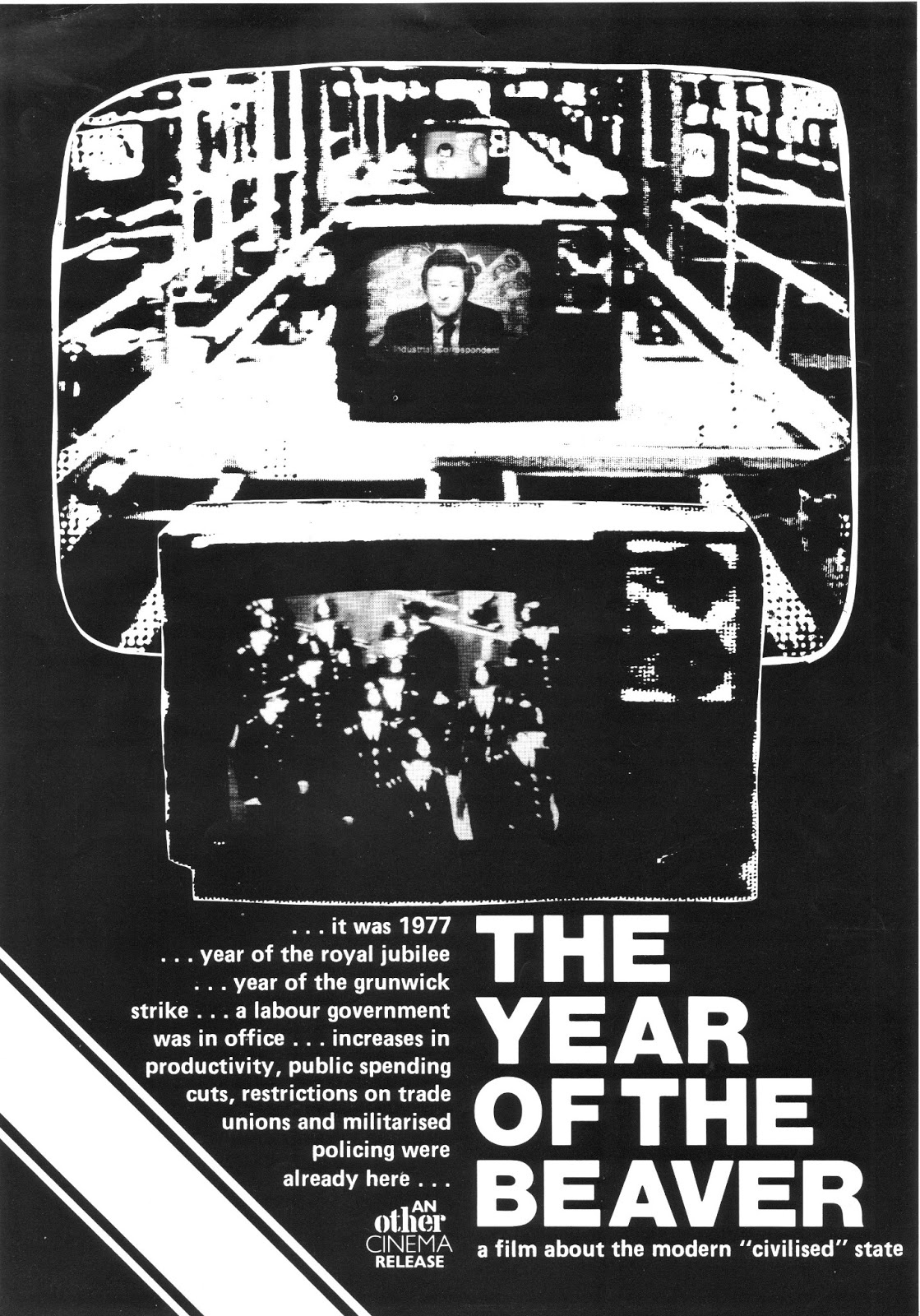

The Year of the Beaver (1985), directed by Steve Sprung, Dave Fox and Sylvia Stevens, recently screened by Radical Islington earlier this month, focuses on the industrial dispute at the Grunwicks photographic processing plant in Willesden, London in the summer of 1977. The workforce, predominately consisting of British Asian women, most of whom had only recently arrived in the UK, decided to go on strike over the issue of trade union recognition. The strike lasted for two years.
Jack Jones, the General Secretary of the Transport and General Workers Union (TGWU) under the Callaghan government, had tagged 1977 the ‘Year of the Beaver’ in an endeavour to encourage productivity and revitalise confidence in union-management relations. Contrary to this optimism, weaving workers interviews with news footage, the film reveals issues of race and gender discrimination in the workplace, media misrepresentation and dubious trade union conduct, all intensified on the picket line by an excessive police presence. Fundamentally, Year of the Beaver reveals the epoch transition from the post-war consensus in Britain, underpinned by the Keynesian economic model, to the neo-liberalist attitudes and policies adopted by the Thatcher government. The film depicts the inauguration of the post-Fordist paradigm – the casualised, flexible, temporary, outsourced working life to which we have now grown accustomed.
Steve Sprung, the film’s co-director and editor, was a member of Cinema Action, a leading independent film group, which became one of Channel 4’s first ‘independent sector’ workshops, a founder member of Faction Films and member of the Poster-Film Collective. In addition, Steve was a key collaborator with Marc Karlin and Lusia Films. Here is an excert from a wonderful article written by Steve for Vertigo magazine recalling his collaboration with Marc Karlin.
It was this Thatcher period which formed the context for my work with and for Marc. My background had been in a more agitational cinema, but I had been struggling for years, labouring away in the basement under Lusia Films, with a film about a failed strike under the previous Labour government, and its role in laying the ground for the Thatcherism that was to come. How to talk about events which had been mischaracterised both by the dominant media industry and by the working classes’ own trade union and political organisations? How to reveal this massive content, tell this necessary story, and find an adequate form in which to do it? This film, The Year of the Beaver, finally emerged in the early eighties. It manages to create multiple layers of meaning, drawing connections between the myriad things it had been necessary to take on board. When he saw it, Marc hugged me. This, I felt, was our first real meeting.
Steve Sprung would act as cameraman, editor and narrator on five films directed by Marc Karlin, including Between Times (1993), an essay on the future of the left and the search for viable alternatives, and The Serpent (1997), an indictment of the left’s demonising of Rupert Murdoch. Here are the first thirty minutes of The Year of the Beaver (1985).
The Year of the Beaver
UK 1985 Dir. Dave Fox/Steve Sprung/Sylvia Stevens. 77 min 16mm/b&w/2772 feet
Script SPRUNG, Steve
Script STEVENS, Sylvia
Script FOX, David
Director of Photography SCHESARI, Nancy
Director of Photography SPRUNG, Steve
Photography SPRUNG, Steve
Production crew SCHESARI, Nancy
Editor SPRUNG, Steve
Editor STEVENS, Sylvia
Editor FOX, David
Editorial consultant RONAY, Esther
Title Design GREEN, David
Sound Editor MacGILLIVRAY, Carol
Narrator LAMONT, Anne
Narrator SPRUNG, Steve
Company Information
Other Cinema Ltd – Foreign Theatrical Distributor
Poster-Film Collective – Production Company
Faction Films – Production CompanyGLC Productions, Inc. – Producer Credit
I Am Writing To You From A Distant Country… Marc and Marker (The Monk/L’maître).
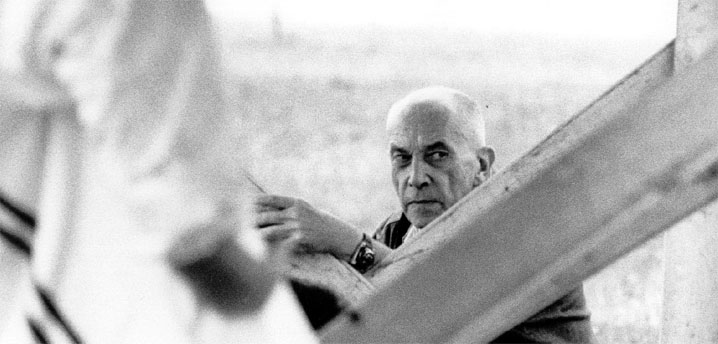
Just before Marc Karlin’s death, film-maker Isaac Julien remarked, ‘The reason why his (Karlin’s) work is still screened, is because he is seen as like the Chris Marker or Jean Luc Godard of the British independent scene. He was more or less the only person representing that sort of voice, that sort of perspective’.
Indeed Marker’s reflection on images, the media and their relationship with memory and with human subjectivity are themes shared by Karlin. And in terms of form, both film-makers are key to deploy alternating commentaries on history and society, with private musings and recollections. It is a voice that constantly shifts in linguistic registers, adopting poetic and prosaic tones in order to shake an amnesia strikened history.


Marc called Marker ‘The Monk’, on account of his reclusive nature and mythical standing with his contemporaries. Up until his death last month, Marker rarely granted interviews, opting to leave calling cards such as pictures of cats or owls. It is clear that Marker was a key influence on Marc, but what has been forgotten is Marc Karlin and Chris Marker were actually long-standing-collaborators. He met Marker during May ’68 while Marker was working on Cine-Tracts (1968) with Jean-Luc Godard. Marker had just formed his film group SLON and had since released Far from Vietnam (1967),a collective cinematic protest with offerings from Jean-Luc Godard, Alain Resnais and Agnes Varda, inspired by the film-making practices of the Soviet film-maker, Alexander Medvedkin.
Born in 1900, Medvedkin was little known outside of his homeland unlike his contemporaries, Sergei Eisentstein and Dziga Vertov. Marker was drawn to Medvedkin after viewing his film Happiness (1934) in 1961, a satirical fantasy that promoted the benefits of collectivisation. The American writer Jay Leyda, who wrote Kino: A History Of The Russian And Soviet Film, introduced Marker to Medvedkin at the Leizig Film Festival in November 1967. This meeting resulted in Marker’s next film, Le Train en marche (1971) an attempt to explain the myth of Medvedkin’s kino-poezd/cine train, the impact it had on cinema and the practices it could inspire in democratic film-making.
Medvedkin saw his kino-poezd (294 days on the rails, 24,565m of film projected, 1000km covered) as a means of revolutionising the consciousness of the Soviet Union’s rural dwellers. Marker hoped his recent unearthing would incite similar political film-making. In London, Karlin and other kindred spirits joined Cinema Action.” There was a relationship to the Russians. Vertoz, the man and the movie camera, Medvedkin, and his agitprop Russian train; the idea of celebrating life and revolution on film, and communicating that. Medvedkin had done that by train. SLON and Cinema Action both did it by car. Getting a projector, putting films in the boot, and off you went and showed films – which we did”.
Marc recalls being asked to shoot the English version of Marker’s The Train Rolls On in the mid-1970s. “If Chris asked you to do something you did it: There was no question”. Marker instructed Marc to film at Peugeot car factory, where Marker wanted to make a film on car workers. He couldn’t go in person as he was known to the officials as an agitator. Working under the pretense he was making a film for the Common Market, Peugeot responsed by putting Marc and his crew in a luxury hotel in Paris.
Choosing not to approach filming the monotonous labour of the workers in a Godardian way, Marc found inspiration in how the workers for a few seconds would cease work,
“all they did was boom, boom, boom. Then I noticed that the workers on the assembly line would come up like fish for air. They would not touch, and they would open their mouths. The Peugeot people were so canny, because they would put together a Moroccan, Portuguese, French and an Italian, so no one could actually speak to each other because on one knew each other’s lanuguage. That was why an excessive amount of touching was going on. I said to the cameraman, ‘Look, that’s how we film. We don’t film the work, because we can show that in twenty or thirty seconds. But we can film these people gasping for air. Or touching, whatever’. That is what we filmed. And then the audience had to imagine. What does it take for somebody to come up for air like that? Or touch? Those are the questions; when you talk about images of labour, how do you film labour?”


In the mid 1970s, Marker contacted left-wing filmmakers and groups to send him their offcuts. As Marker was ‘le maitre’, Marc agreed. Here Marc describes Marker’s studio upon a visit, “Chris had a garage, a huge studio with drainpipes all across it. It was vast, and he put these little rolls of films all along the drainpipes, and then divided it onto countries, so you had Columbia, Peru, Cuba, Africa and so on. I entered this garage to find all these films from all these countries: the whole world was there. Right at the end there was Chris Marker on a platform with his editing table, and he looked like God. You had to walk past these films to reach him and sit down”.
The film became Le fond de l’air est rouge (1977). It focused on the doomed optimism of left-wing activism from the second half of the 20th century. The ‘red in the air’ implying the socialist project only existed in the air, communicated only by a dream language. Again, Marc did the English version, A Grin without a Cat (1988) for Channel 4. Running shorter than Marker’s film and adding a new voice cast including Jim Broadbent and Cyril Cusack.

A Grin Without A Cat Channel 4 Contract. © The Marc Karlin Archive
Around this time, Marc, in need of political inspiration, wanted to make a film about Chris Marker that would use Marker’s images, entitled, I Am Writing To You From A Distant Country… In keeping with Marker’s style, it begins with a letter followed by a montage of stills and sequences from Letters From Siberia (1957), Le joli mai (1963), La jetée (1962) and Le fond de l’air est rouge (1977) . From the treatment, we see the intention – to locate a time-travelling Marker. Marc asks, who is this letter writer and traveller? How do we recognise him?.. What does he declare at customs? There are no photographs of him, no evidence other than his letters. He is a Martian, an astronaut, an 18th century time-traveller, a descendant of Vikings, a Marxist, a subversive, an old man of letters… There are traces but no apparition, we have the grin but no cat. But we know where he lives: in a house in Neuilly, painted outside with owls whose eyes glint in the dark…
Here is a rather faded, time travelling letter from Marc to the Monk, informing him of the project. It comes at a time where Marc is creatively and politically jaded – in ‘Thatcher’s trough’.
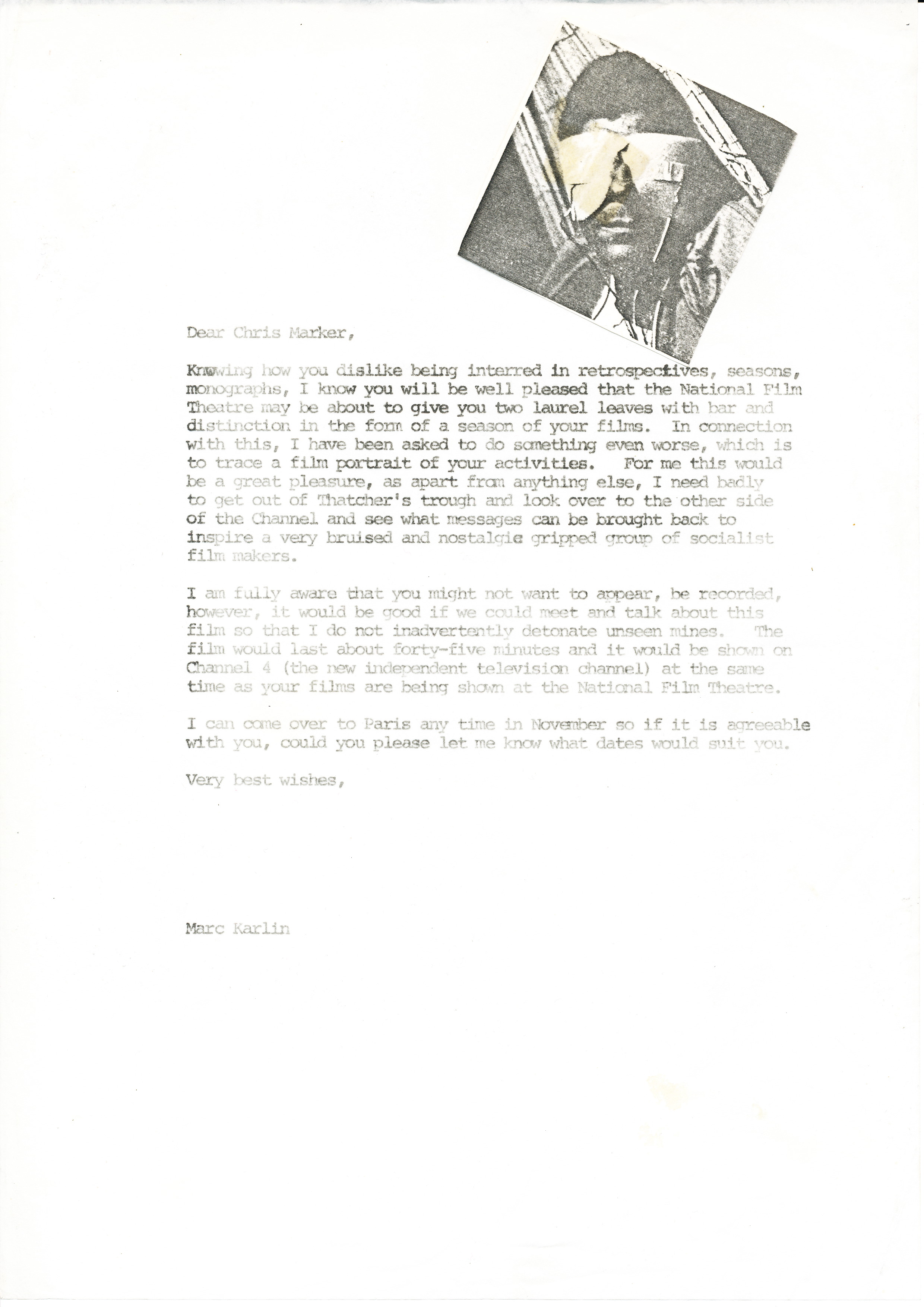
Letter to Chris Marker. © The Marc Karlin Archive
The film never materialised, undoubtedly sucked into a black hole. Undettered, Marc ploughed into his next project, Between Times (1993). Possessing dialectic discsussive voice-overs, Between Times is a clear nod to Marker. The film’s main focus is on the Thurcroft miners failed attempt to buy their colliery from British Coal and the search for fresh alternatives after the devisive general election defeat for the left in 1992. This new perspective draws optimism from the educational ethos at Northern College, a residential college dedicated to the education and training of men and women who are without formal qualifications. The film observes a key moment in the shifting attitudes and aspirations among the working class in Britain at the time and recalls a May ’68 slogan,
le pain pour tous mais aussi / bread for all but
La paix/peace
le rire/laughter
le théâtre/theatre
la vie/life
The slogan is actually taken from a strike in March 1967 at the Rhodiaceta textile factory in Bresancon, France. The workers were not merely demanding higher wages but challenging the core oppression within capitalist society; wages yes, but what about education and cultural life? Chris Marker entered the strike on March 8 1967, resulting in the documentary À bientôt, j’espère (1967) (see below, sorry no Eng Subs) filmed by Marker between March 1967 and January 1968 with the Communist filmmaker Mario Marret and the SLON team.
As Trevor Stark points out in his excellent essay, “Cinema in the Hands of the people”; Chris Marker, the Medvedkin Group, and the Potential of Militant film, the film À bientôt, j’espère emphasises the liberating experience of laying claim to sectors of life inaccessible to the worker: to creativity, to culture, to communication. Forty-two minutes into the documentary we see Pol Cébé, a factory worker from the working class district of Palente-les-Orchamps who had established a cultural programme for the local community and had regenerated the factory’s library with classic Marxist and Communist texts, in close-up state,
For us culture is a struggle, a claim. Just as with the right to have bread and lodgings, we claim the right to culture – it’s the same fight for culture as for union or in the political field.
À bientôt, j’espère is left purposley open-ended with little resolution, marked tellingly by Pol Cébé reciting the documentary’s title À bientôt, j’espère – ‘Hope To See You Soon’. The strike at Rhodiaceta achieved nothing but the broadening of class concsiousness that consequently lit the test paper for the events in Paris the following May. These concerns are resuscitated in Between Times. The miners are halted in their plan to buy their colliery and are pointed to the development of technology for optimism. Sadly, Marc Karlin observes the irony that before, a dream language could still be spoken, now the dreams are possible we no longer know how to speak it. Like À bientôt, j’espère, Between Times ends without a dialectical antithesis, leaving all but tension.
So he decided to keep his voices, make them argue, merge, split again. Be on high and on the ground. Anything to keep that sleepy logic at bay. But then there were those who were doing this all along…
These words are spoken over a slow tracking shot of a wildlife garden revealing in the foreground, a golden egg – Marker’s owl.
Sources
Looking at Class. Film, Television and the Working Class in Britain, S, Rowbotham & H, Beynon, (Rivers Oram Press:2001)
The Personal Camera: Subjective Cinema and the Essay Film, L, Rascaroli, (Columbia University Press:2009)
Chris Marker: Memories of the Future, C, Lupton, (Reaktion Books:2004)
Kino: A History of the Russian and Soviet Film, J, Leyda (Princeton University Press:1983)
“Cinema in the Hands of the people”; Chris Marker, the Medvedkin Group, and the Potential of Militant film, T, Stark, (mitpressjournals:2012)
 marckarlin